


Dr. Sony Sherpa (MBBS)
In addition to her clinical experience, Dr. Sherpa is a published medical researcher and holistic health advocate. Her dual expertise in emergency care and alternative therapies brings a unique lens to medically reviewed content—ensuring it is both accurate and accessible.
If you are looking at IVF prices in the United States or Canada and wondering how you will ever afford treatment, you are not alone. Many couples and single parents in your position start to look at Mexico when the numbers at home simply do not add up. You might be imagining yourself boarding a plane or crossing the border, scheduling clinic visits and post-clinic activities, and hoping this trip is the one that finally brings you a baby.
The cost difference is hard to ignore. A single IVF cycle that can cost $15,000 to $25,000 in the United States, or around $14,000 in Canada, often starts at $3,000 to $4,000 USD in Mexico before medication. Stimulation medications that run $3,000 to $6,000 USD at home usually cost $1,500 to $3,500 USD there. That gap is the main reason why more and more people go to Mexico for fertility medical tourism every year.
At the same time, expert groups remind you that price is only one side of the story. Professional guidelines from organizations, such as the American Society for Reproductive Medicine (ASRM) and the European Society of Human Reproduction and Embryology (ESHRE) emphasize lab quality, physician training, ethical donor screening, and honest counseling about age and risk. Your goal is to capture the financial advantages of Mexico while staying aligned with those standards.
IVF in Mexico typically costs $4,000 to $6,500 USD for a basic cycle with your own eggs, plus $1,500 to $3,500 for medication. Donor egg IVF ranges from about $6,500 to $9,000 before medication, compared with $25,000 or more in the United States. With careful clinic selection, you can often match North American success rates, reduce your total bill by 50 to 70 percent, and complete most monitoring near home while traveling to Mexico for key steps like egg retrieval and embryo transfer.
Next step: Use this guide to compare costs, protocols, and clinic standards, then shortlist two or three Mexican clinics and their programs that meet your medical and financial needs.
What the Latest Research Shows
Large registry studies and randomized trials over the last decade have reshaped how IVF is delivered worldwide. Success rates for frozen embryo transfers are now comparable to or exceed those of fresh transfers for many patients; furthermore, donor egg cycles frequently achieve or exceed a 50% live birth rate per transfer. Similarly, well-screened gestational carriers consistently show pregnancy outcomes equal to or better than other IVF pregnancies. These clinical trends remain consistent regardless of where you receive treatment, including Mexico.
All research citations in this article use peer-reviewed sources. You can open any PubMed or guideline link in the reference list to explore the original data and recommendations.
In This Guide
Own eggs: $4,000–$6,500 USD
Donor eggs: $6,500–$9,000 USD
Mexico: $1,500–$3,500 USD
US/Canada: $3,000–$6,000 USD
Stay for retrieval: 8–12 days
FET trip: often a few days
Why People Choose IVF in Mexico
When you compare your local quotes with Mexican programs, the savings can feel almost unbelievable. Many patients move from feeling stuck and priced out to feeling that treatment is finally within reach. At the same time, you probably carry a healthy dose of skepticism. You want to know whether lower prices reflect shortcuts in care or simply differences in health systems.
In established clinics, the price gap mostly comes from structural factors. Clinics in Mexico work with lower commercial rent, salaries, insurance premiums, and malpractice costs than clinics in the United States and Canada. They do not carry the same layers of billing and administrative overhead, yet they can still pay for modern incubators, cleanroom-quality air systems, and full-time embryology teams.
This means that when you see a standard Mexican IVF price of $4,000 to $6,500 USD, you are not automatically looking at a lower medical standard. In fact, many programs follow ASRM and ESHRE guidance for lab operation, use the same injectable medications, and rely on very similar protocols. The differences show up more in the billing office than in the procedure room.
Latest Research Insights
56% vs 40% – Frozen Transfer Advantage: In a review of more than 260,000 first IVF cycles, live birth from the first transfer reached about 56 percent with frozen transfers that used PGT-A, around 48 percent with frozen transfers without PGT-A, and 40 percent with fresh transfers. Over a full year, both frozen strategies reached about a 74 percent live birth rate, while fresh transfers reached about 60 percent. This supports the growing trend toward freeze then transfer protocols.
3 in 4 Succeed – PGT-A vs. No Testing: A randomized trial in younger, good-prognosis patients found that roughly three out of four women had a baby within three single embryo transfers, whether or not they used PGT-A. When age or history clearly justifies it, using PGT-A makes the most sense, as it reduces miscarriages but does not increase the overall chance of live birth in this group.
57% vs 46% – Gestational Carrier Advantage: In more than 20,000 donor egg cycles in the United States, embryos transferred to gestational carriers led to live birth in about 57 percent of transfers, compared with about 46 percent when transferred to the intended mother. Babies carried by surrogates were also less likely to arrive early or at low birth weight, which is important if your own uterus or health adds risk.
These findings come from large peer-reviewed studies. The exact numbers for you will depend on your age, diagnosis, and the clinic you choose.
Real IVF Costs in Mexico vs. the USA and Canada
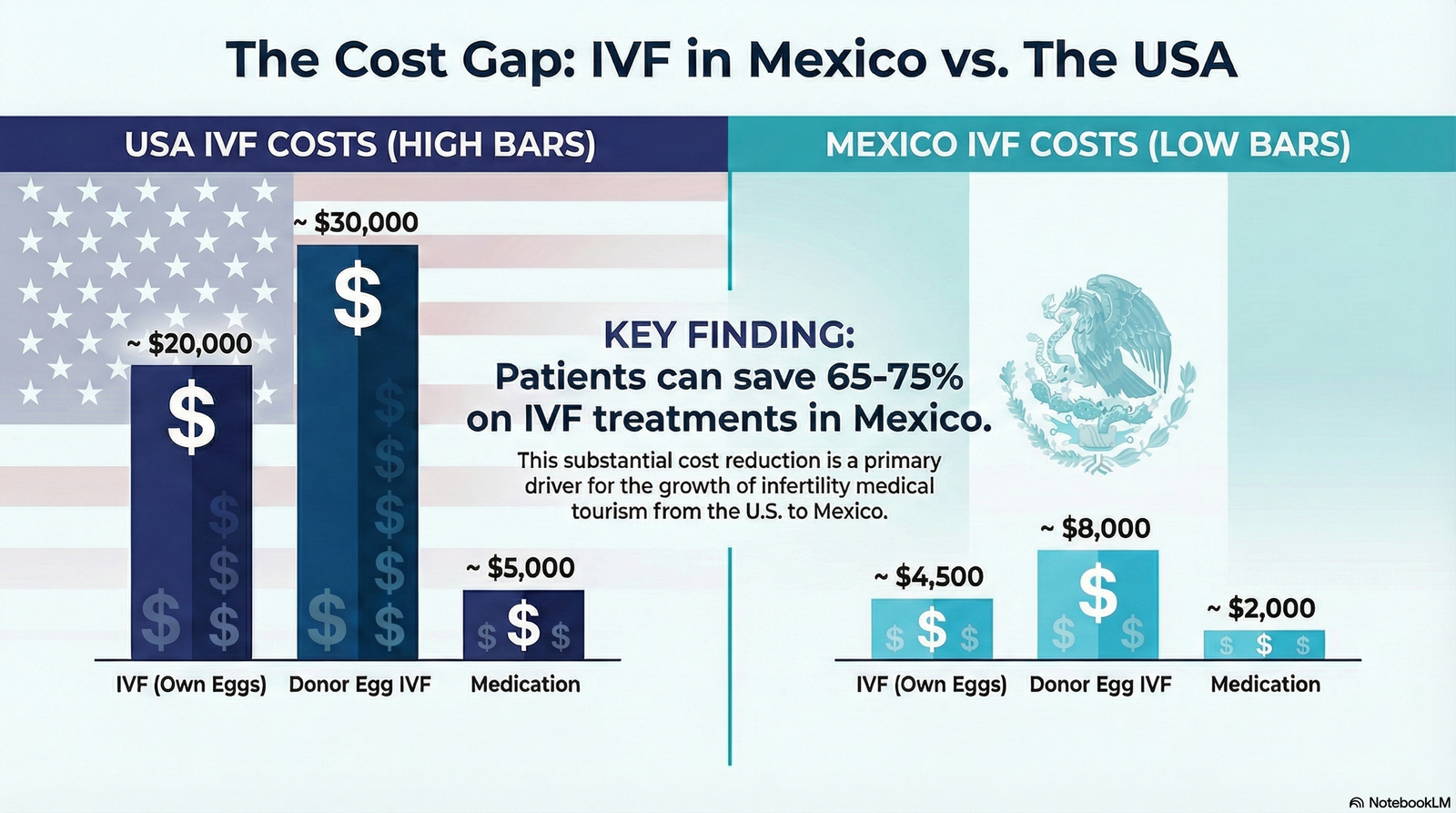
Once you understand that lower prices are mostly structural, you can look closely at what you actually pay for. The biggest levers are the base IVF fee, donor or add-on costs, and medication. Travel and lodging matter too, but they usually do not erase the savings.
Below is a realistic 2026 range across reputable Mexican clinics. These numbers outline IVF bundles only, excluding expenses associated with travel arrangements, such as flights and hotels. Therefore, to tailor your budget for both non-medical travel costs and clinical variables—such as stimulation medications, PGT-A testing, or embryo storage—you should always request an inclusive, itemized quote that accounts for all potential additional fees.
| Procedure | Mexico Cost (USD) | USA/Canada Cost (USD) |
|---|---|---|
| IVF with own eggs | $4,000–$6,500 | $15,000–$25,000 |
| Donor egg IVF | $6,500–$9,000 | $25,000–$35,000 |
| Egg freezing | $3,500–$6,500 | $15,000+ |
| Stimulation medication | $1,500–$3,500 | $3,000–$6,000 |
For a full cycle with your own eggs in Mexico, including medication and typical add-ons, you often end up in the $6,000 to $12,000 USD range. The same treatment in the United States easily reaches $30,000 to $40,000 USD once you add medication, freezing, storage, and genetic testing.
The key is not to chase the lowest possible number. If you see base cycle prices well under $3,000 USD, that often means that core elements such as ICSI, blastocyst culture, or freezing are missing from the package, or that the clinic is cutting costs on staff and lab equipment.
Treatment Options and Protocols in Mexico
Once you know the financial picture, your next decision is which treatment path fits your situation. Mexico offers the same core tools you see at strong clinics worldwide, but with different price tags and sometimes different legal options.
Standard IVF with Your Own Eggs
If your ovarian reserve and age are still favorable, you may start with standard IVF. A typical Mexican cycle includes monitoring, egg retrieval under sedation, ICSI fertilization, culture to blastocyst, a fresh or frozen transfer, and freezing of any remaining high-quality embryos.
Many programs now favor a freeze then transfer approach. As the research summary above showed, frozen cycles often produce better live birth rates across a full year of treatment than fresh transfers. For international patients, frozen cycles also make logistics easier because you can travel home between egg retrieval and embryo transfer.
IVF with Donor Eggs
Donor eggs become a strong choice when your own egg quality no longer supports good success rates. That is usually the case in your early to mid-forties, or sooner if you have very low AMH or prior failed cycles.
Mexican clinics maintain donor databases and screen donors based on age, health history, infectious disease testing, and increasingly genetic carrier screening. ASRM notes that donor egg IVF often produces more than a 50 percent live birth rate per transfer in well-run clinics. Many Mexican programs report per-transfer live birth in the 50 to 70 percent range for donor cycles.
IVF with Donor Sperm or Double Donation
Donor sperm is common for single mothers by choice, female couples, and severe male factor infertility. Double donation, where you use both donor egg and donor sperm, is an important path if both sides carry genetic risk or if both gamete sources have not worked despite several attempts.
Double donation costs more than a basic IVF cycle but still tracks far below double donation prices in the United States or Canada. You should always ask how many donor embryos you are likely to receive from a given package and how many transfers are included.
Data and Safety Interpretation
7 vs 4 in 100 – Blood Pressure After Frozen Transfer: Large registry data from Scandinavian countries show high blood pressure conditions in pregnancy in about 7 out of 100 IVF pregnancies after frozen embryo transfer, compared with about 4 out of 100 pregnancies conceived without IVF. Fresh transfers tracked much closer to natural conception for this risk. If you already have blood pressure or heart issues, this is one more reason to look closely at your protocol.
50%+ Per Transfer – Donor Egg Benchmark: ASRM guidance describes donor egg cycles with live birth rates generally above 50 percent per transfer in suitable recipients. When you read any clinic’s website, whether in Mexico or at home, you can use that benchmark to decide whether the claims are realistic for donor egg IVF.
Multi-Cycle Strategies – Up to 96% Cumulative Claim: Some Mexican programs offer packages that include two to four cycles at a fixed price, sometimes with a partial refund if no live birth occurs. When clinics quote cumulative success as high as 96 percent across all included attempts, they are describing the benefit of multiple tries, not a single super-powered cycle.
These interpretations help you read numbers with the right context, so that you can compare clinics and packages on fair terms.
PGT-A and Sex Selection
PGT-A is widely available in Mexico, both for medical reasons and for family balancing when local law allows. In addition to checking chromosome counts, some programs offer panels for specific hereditary diseases and even non-medical traits such as eye color.
Family balancing and non-medical trait selection raise ethical questions. ASRM and many ethicists have discussed these issues in depth. Your job is to decide where your own values sit and to work with a clinic that communicates clearly about what they will and will not do.
Risks, Safety, and Age Considerations
Every fertility treatment plan should include an honest talk about risk. This is true whether you stay in your home country or travel abroad. Mexico adds a second layer, because you also need to think about follow-up care once you return home.
On the medical side, IVF risks in Mexico are similar to those in other countries when you choose a reputable clinic. You face the standard possibilities of ovarian hyperstimulation, procedure complications, multiple pregnancy if more than one embryo is transferred, pregnancy-related high blood pressure, and gestational diabetes. These do not change simply because you board a plane.
Age adds a second layer of complexity. The ethics opinion of ASRM on advanced maternal and paternal age identifies three main categories of risks. There are genetic risks linked to older eggs and sperm, pregnancy risks linked to older bodies, and parenting risks if older parents face serious health problems or die while children are still young.
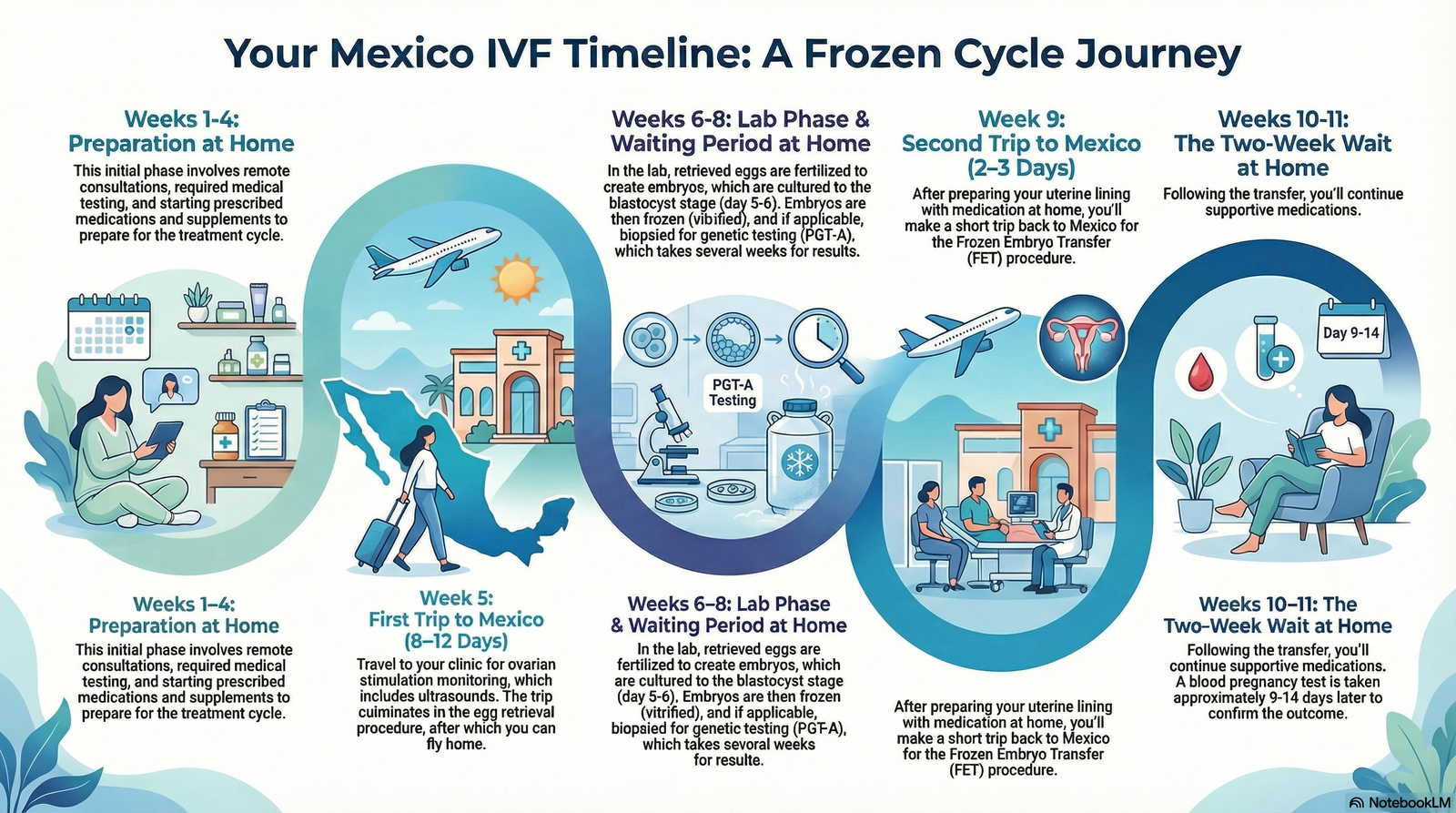
Typical frozen embryo transfer timeline in Mexico: from preparation to two-week wait at home.
Choosing a Mexican Fertility Clinic
Once you understand your options and risks, you reach the most concrete decision point. You need to choose where you will actually place your trust, money, and embryos. A strong clinic match can make your treatment feel organized and human. A poor match can leave you confused and under-informed.
OVU Expert Guidance
Three Non-Negotiables – Lab, Doctor, Transparency: First, insist on a lab that explains its equipment, quality controls, and embryologist experience. Second, make sure a reproductive specialist, not just a salesperson, reviews your AMH, age, and past cycles to design your protocol. Third, demand a clear, itemized quote that separates base fees, medication, storage, and genetic testing. If a clinic in Mexico can meet all three, you are much closer to safe, high-value care.
Decision Point – How to Narrow Your List: After you understand costs and medical options, it is natural to feel both hope and pressure. This is the moment to shortlist two or three clinics, schedule calls, and ask the same set of questions about lab standards, protocols, and support for international patients. Comparing their answers side by side will give you the clarity you need to move forward.
Clinic Snapshots
Ingenes: A large network in Mexico that focuses on multi-cycle IVF packages and money-back guarantees if no live birth occurs after completing a program. They report cumulative success claims as high as 96 percent across four attempts. Patients often mention very responsive WhatsApp support and a strong focus on refund structures.
Enlistalo Fertilidad: A coordination service that works within existing clinics in Mexico City, such as Inmater and Procrea. Medical oversight comes from a reproductive biologist and a gynecologist, and international patients receive detailed support on testing, travel dates, and medication schedules.
The Fertility Institutes (Guadalajara): A program with United States board-certified oversight that focuses on PGT-based gender selection, screening for hundreds of hereditary diseases, and, in some cases, eye color selection. Standard IVF prices run around $4,200 to $4,600 USD before medication.
LIV Fertility Center (Puerto Vallarta): Located in a resort destination, LIV offers IVF, egg donation, and MicroSort-based sex selection. They report donor egg live birth rates around two-thirds per transfer, and strong results for younger patients using their own eggs.
IMI Mexico and Beta Plus Fertility: IMI Mexico runs clinics in several cities, and Beta Plus Fertility in Cancun is a European run program that offers donor egg and gender selection services, with high reported pregnancy rates in some donor programs.
Want help comparing clinics and costs?
If researching all of this feels like a second full time job, you are not imagining it. Our advisors can collect itemized quotes from vetted Mexican clinics, explain what is included, and help you map a realistic treatment timeline at no cost to you.

Why trust this guide? The OVU commitment
You are probably juggling hope, timelines, and a lot of tabs open in your browser. And you deserve clear, current, human advice. At OVU, we review clinic protocols, compare real quotes, and talk to people who have done this - intended parents and gestational carriers - so we can give you practical steps, not just theory. If you want help comparing options without sales pressure, we will gather itemized quotes and success data that match your exact situation. You decide, we will bring the info to your table.
Frequently Asked Questions
What is a realistic minimum price for safe IVF in Mexico?
For a complete IVF cycle with your own eggs, plan on at least $3,400 to $4,500 USD before medication. Prices much lower than this core median often hide missing steps, such as anesthesia for egg retrieval, ICSI, blastocyst culture, or embryo vitrification, or reflect weaker lab standards. Your goal is not just to find the cheapest ad, but to find the best value for safe, comprehensive care.
What should a standard IVF package include?
A core IVF package should cover cycle planning, ultrasound monitoring and bloodwork during controlled ovarian stimulation phase, egg retrieval under anesthesia or sedation, ICSI, culture to blastocyst stage, at least one embryo transfer, and freezing of any extra good-quality embryos. If a quote does not clearly outline these steps, request a detailed cost breakdown for each service before committing to any bundle.
How long do I need to stay in Mexico for IVF?
Most patients stay from 8 to 12 days around the egg retrieval timeframe. Clinics that favor frozen transfers often let you return home afterwards and come back later for a shorter visit for embryo transfer. Border patients who use Tijuana sometimes cross back and forth several times during monitoring and procedures.
Is PGT-A worth it if I am under 38 years old?
If you are younger than 38 with several good-quality blastocysts, PGT-A likely lowers your miscarriage risk but does not raise your overall chance of having a baby compared with transferring untested embryos one at a time. If you are older, have a history of repeated miscarriages in the past, or carry specific genetic risks, PGT-A becomes more useful in your case. The right answer depends on your age, ovarian reserve, and medical history.
Is sex selection legal for family balancing in Mexico?
Yes, many Mexican programs offer sex selection through PGT-based testing, and some use sperm sorting methods as well. Laws differ by region, and ethical opinions vary, so you should talk through both the technical details and the ethical side before deciding.
How do I judge whether a Mexican clinic is safe?
Ask who runs the embryology lab, what equipment they use, how they monitor air quality, and how many cycles they handle per year. Ask the doctor to explain your protocol in plain language. Finally, ask for an itemized quote that lists every fee you might face. Clear answers on these points are a positive sign that the clinic takes both science and transparency seriously.
Reference List 8 sources
Journal Article (Research): Segal TR, Kim K, Mumford SL, Goldfarb JM, Weinerman RS. How much does the uterus matter? Perinatal outcomes are improved when donor oocyte embryos are transferred to gestational carriers compared to intended parent recipients. Fertility and Sterility. 2018;110(5):888–895. PMID: 30316434. Available from: https://pubmed.ncbi.nlm.nih.gov/30316434/
Journal Article (Systematic Review & Meta-Analysis): Masjedi AD, Mandelbaum RS, Erickson KV, et al. Obstetric characteristics and outcomes of gestational carrier pregnancies: a systematic review and meta-analysis. JAMA Network Open. 2024;7(9):e2422634. PMID: 39042408. Available from: https://pubmed.ncbi.nlm.nih.gov/39042408/
Journal Article (Research): Petersen SH, Åsvold BO, Lawlor DA, et al. Risk of hypertensive disorders in pregnancy after fresh and frozen embryo transfer and natural conception: a population-based cohort study with within-sibship analysis. Hypertension. 2022;80(2):e6–e15. PMID: 36154568. Available from: https://pubmed.ncbi.nlm.nih.gov/36154568/
Journal Article (Comparative Study): Wang SF, Seifer DB. Comparative age-stratified analysis of live-birth outcomes in frozen embryo transfer with preimplantation genetic testing for aneuploidy, frozen embryo transfer without testing, and fresh transfer in initial autologous cycles. Obstetrics & Gynecology. 2025;145(4):675–686. PMID: 40839881. Available from: https://pubmed.ncbi.nlm.nih.gov/40839881/
Journal Article (Randomized Controlled Trial): Yan J, Qin Y, Zhao H, et al. Live birth with or without preimplantation genetic testing for aneuploidy. New England Journal of Medicine. 2021;385(23):2047–2058. PMID: 34818479. Available from: https://pubmed.ncbi.nlm.nih.gov/34818479/
Journal Article (Research): Guo L, Li X, Guo A, et al. Comparative study on pregnancy complications: PGT-A vs IVF-ET with gender-specific outcomes. Frontiers in Endocrinology. 2024;15:1453083. Available from: https://www.frontiersin.org/articles/10.3389/fendo.2024.1453083/full
Committee Opinion (Guidance): Practice Committee of the American Society for Reproductive Medicine. Gamete and embryo donation guidance. Fertility and Sterility. 2024;122(4):799–813. Available from: https://www.asrm.org/practice-guidance/practice-committee-documents/guidance-regarding-gamete-and-embryo-donation/
Ethics Committee Opinion: Ethics Committee of the American Society for Reproductive Medicine. Assisted reproduction with advancing paternal and maternal age: an Ethics Committee opinion. Fertility and Sterility. 2025;123(6):999–1005. Available from: https://www.asrm.org/practice-guidance/ethics-opinions/assisted-reproduction-with-advancing-paternal-and-maternal-age-an-ethics-committee-opinion-2025/
Final Thoughts
Choosing IVF in Mexico is not just a financial decision. It is a choice of who to ally with, how far to go, and what risk-support balance suits you. The lower prices can open doors that felt permanently closed, but you still deserve careful, evidence-based care and honest communication.
If you take the time to check lab quality, doctor oversight, and transparency on costs, you can use Mexico’s structural advantages without trading away safety. You are not asking for miracles. You are asking for a fair chance at a child, at a price that does not destroy your future. With the right clinic partner, that is a very reasonable ask.
Ready to explore your cross-border IVF options?
You do not have to compare every clinic and quote alone. Talk to an OVU advisor to review your medical profile, narrow down Mexican clinics that match your needs, and build a realistic plan that respects both your timeline and your budget.
Related articles

How to Choose Fertility Clinics Abroad: Complete Vetting Guide 2026
Fertility Tourism & Global Care Your guide to fertility treatment abroad Last Updated: 31 December 2025 Medically Reviewed 14 min read Evidence-based If you are staring at Spain’s IVF prices and wondering if the flight is worth it, or checking Mexico and trying to decide if “affordable” also means “safe”, you are not alone in being forced to explore the alternative destinations offering less expensive options. Infertility now affects 1 in 6 people worldwide, and that pressure has pushed more people to look outside their home country for treatment. By 2024, over 60% of fertility patients said they were considering
21 min read
IVF in Ukraine 2026: Costs, Clinics, Success Rates & Surrogacy Options
IVF Abroad & Surrogacy Your guide to IVF in Ukraine, donor eggs, and surrogacy options Last Updated: 24 December 2025 Medically Reviewed 18 min read Evidence-based If you are looking at IVF or surrogacy in Ukraine, you are probably already tired, worried about money, and wondering how much longer you can keep going. It is a significant step to leave your home country for treatment, and it helps to see clearly what you are getting into before booking a single flight. The good news is that Ukraine has been a major destination for donor-egg IVF and gestational surrogacy, with some
14 min read
IVF in Greece 2026: Costs, Legal Framework & Top Fertility Clinics
IVF & Fertility Destinations Your guide to IVF in Greece as you compare international fertility options for 2026. Last Updated: 19 December 2025 Medically Reviewed 18 min read Evidence-based If you are comparing clinics across countries and wondering whether IVF in Greece is a realistic way to grow your family, you are not on your own. Many people look at prices in the United States, the United Kingdom, or Canada and then start searching for safer, more affordable options abroad, allowing them to complete a cross-border treatment cycle without hassle and bustle, without compromising the quality, and without exceeding their
17 min read