


Dr. Sony Sherpa (MBBS)
In addition to her clinical experience, Dr. Sherpa is a published medical researcher and holistic health advocate. Her dual expertise in emergency care and alternative therapies brings a unique lens to medically reviewed content—ensuring it is both accurate and accessible.
If you are looking at IVF or surrogacy in Ukraine, you are probably already tired, worried about money, and wondering how much longer you can keep going. It is a significant step to leave your home country for treatment, and it helps to see clearly what you are getting into before booking a single flight.
The good news is that Ukraine has been a major destination for donor-egg IVF and gestational surrogacy, with some programs reporting live-birth rates close to 90% when you combine donor eggs and a well-screened surrogate. At the same time, standard IVF with your own eggs follows the same age curves you see everywhere else, with rates dropping sharply after 40.
Professional groups, such as the American Society for Reproductive Medicine (ASRM) and the European Society of Human Reproduction and Embryology (ESHRE), have established clear guidelines on selecting surrogates, determining the number of embryos to transfer, and ensuring the safety of ovarian stimulation. This article uses those frameworks so you can look at Ukrainian clinics with a clinical, not just an emotional eye.
Ukraine offers relatively high success rates and lower prices than many Western countries for IVF, egg donation, and surrogacy. Donor-egg surrogacy programs can reach around 90% live-birth rates in some clinics, while standard IVF with your own eggs follows age-based success patterns. Your safest plan is to work with a clinic that screens surrogates to ASRM-style standards, uses modern GnRH antagonist protocols, and favors single-embryo transfer.
Next step: Shortlist 2–3 Ukrainian clinics and ask them specific questions about surrogate screening, twin rates, success rates within a single IVF cycle or frozen embryo transfer bundle (depending on the type of embryo you will transfer), and whether they routinely use single-embryo transfer with donor eggs.
What the Latest Research Shows
Large registry and meta-analysis studies now follow tens of thousands of gestational carrier and IVF pregnancies. These data show that, when clinics choose healthy, experienced surrogates, outcomes are similar to or better than other IVF pregnancies, while live-birth rates in donor-egg surrogacy can be very high.
Professional guidelines from ASRM and ESHRE now strongly support single-embryo transfer in good-prognosis IVF and recommend modern GnRH antagonist protocols to cut the risk of ovarian hyperstimulation syndrome without sacrificing success.
In This Guide
Donor-egg surrogacy cycles can reach about 90% live-birth rates in some Ukrainian programs.
Standard IVF cycles start around $1,000–4,000 USD, while guaranteed surrogacy can exceed 60,000 €.
Modern protocols use GnRH antagonists and single-embryo transfer to reduce OHSS and twin risks.
Why Ukraine for IVF and Surrogacy?
If you are comparing Ukraine with other fertility destinations, you are usually balancing three things: price, success, and legal clarity. Ukraine has historically combined comparatively lower costs with advanced lab work and a legal framework that supports gestational surrogacy and anonymous egg donation.
Many international patients travel for donor-egg IVF with or without surrogacy because they want strong success rates without paying US-level prices for guaranteed packages. Others come because they are not legally allowed to pursue surrogacy at home, or because waiting lists in their own health systems are simply too long.
Latest Research Insights
57% vs 46% – The Success Gap: When donor-egg embryos were transferred to gestational surrogates, about 57% of cycles led to a live birth, compared with 46% when the same type of embryos were transferred to the intended parents. Babies in surrogate pregnancies were also nearly half as likely to have low birth weight. For you, this means that using a well-screened surrogate can turn good embryos into higher live-birth chances and healthier birth weights. Source: Fertility and Sterility (PMID: 30316434).
17% Higher Live-Birth Chance – The Carrier Advantage: In a US registry of fresh IVF cycles using parents’ own eggs, cycles with a gestational surrogate had about a 17% higher chance of live birth than cycles where the intended parent carried the pregnancy. However, twins and preterm births were also more common when clinics transferred more than one embryo. This tells you that a gestational surrogate can boost your odds, especially if you also commit to single-embryo transfer to keep twin risks down. Source: Fertility and Sterility (PMID: 27087401).
2 in 100 vs 6 in 100 – The Safety Reality: A population study from Utah found that serious complications such as ICU admission, heavy bleeding, or emergency hysterectomy affected about 2 in 100 gestational surrogates, compared with about 6 in 100 other IVF pregnancies. Overall, surrogates had similar safety to carefully matched non-IVF pregnancies. This means that when you work with a properly screened carrier, the pregnancy is usually no more dangerous for her than a typical IVF pregnancy and can be safer than many high-risk IVF cases. Source: Journal of Assisted Reproduction and Genetics (PMID: 33145724).
28,300 Pregnancies – The Big-Picture Verdict: A 2024 review pooling over 28,000 surrogate pregnancies showed outcomes were similar or slightly better than other IVF pregnancies, but the risk of high blood pressure in pregnancy was higher than in natural conceptions. Severe complications and maternal deaths were very rare. For you, this means surrogate pregnancies behave much like other IVF pregnancies: generally safe, but still needing close monitoring for blood pressure and twins. Source: JAMA Network Open (PMID: 39042408).
These findings come from peer-reviewed research. Your own odds still depend on your age, egg and sperm quality, and the clinic and surrogate you choose.
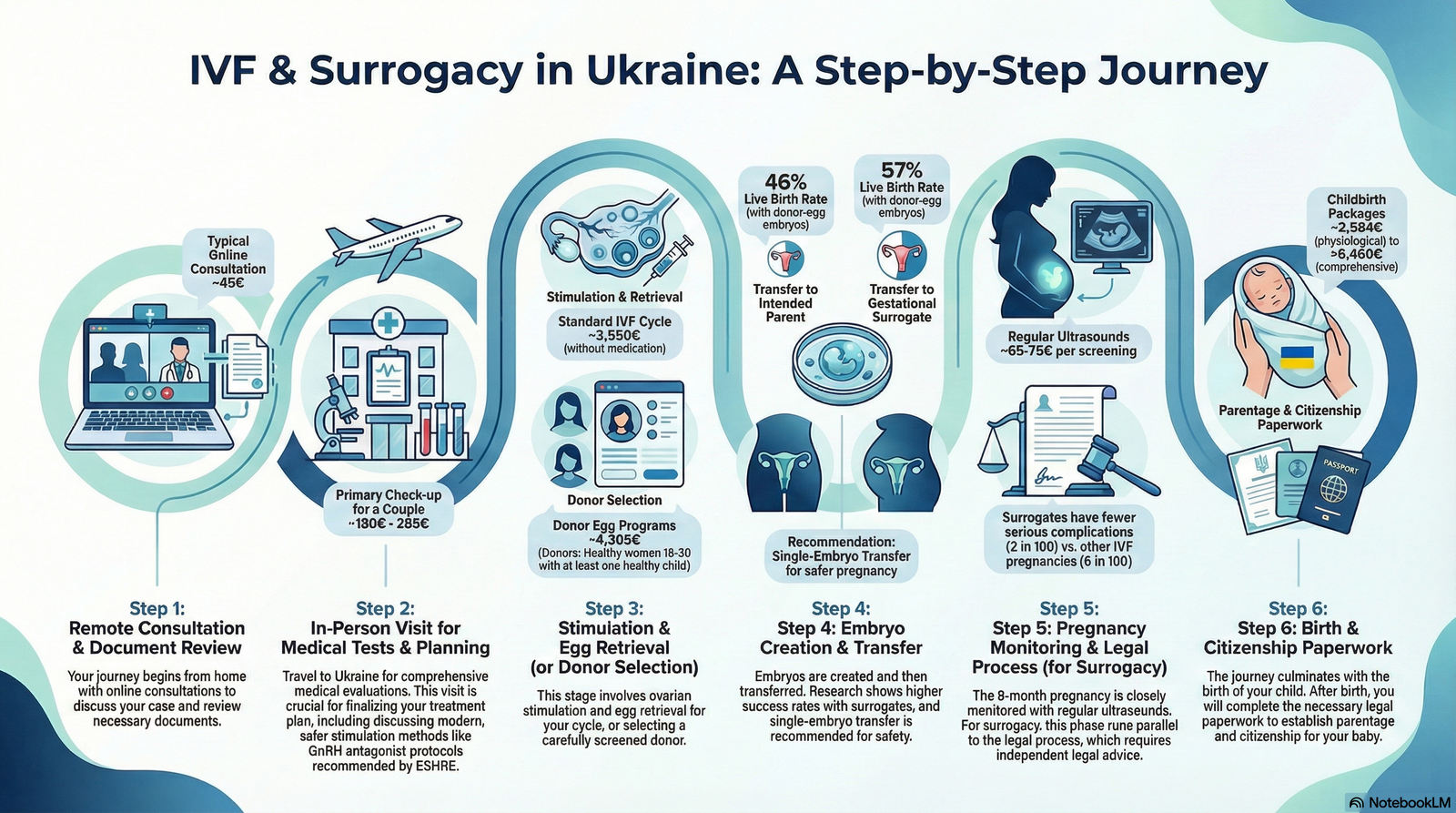
How IVF, egg donation, and surrogacy fit together in a typical Ukrainian treatment plan.
Real-World Success Rates
Success rates in Ukraine follow the same basic rules you see everywhere else: younger eggs perform better, donor eggs outperform older eggs, and surrogacy helps when the main problem is the uterus, not the embryo.
Here is a simplified view of what you can expect from different paths, based on clinic-reported numbers and international data:
| Program Type | Typical Live-Birth Rate | Key Drivers |
|---|---|---|
| Own-egg IVF under 35 | Around 30–40% per cycle | Age, embryo quality, single vs double embryo transfer. |
| Own-egg IVF 40+ | About 10–30% per cycle | Egg quality decline, number of embryos, clinic strategy. |
| Donor-egg IVF | Often 50–70% per transfer | Donor age, lab quality, screening of embryos. |
| Donor-egg surrogacy | Up to 90% in some clinics | Surrogate health, single-embryo transfer, clinic protocols. |
Costs and Program Types
When you budget for treatment in Ukraine, you need to think in layers: core IVF cycle, medications, genetic testing, donor fees, surrogate compensation, legal work, and travel. Different clinics bundle these pieces in different ways, so you want to compare like with like.
Here is a high-level look at common program types and headline prices:
| Clinic / Program | Approximate Cost | What It Includes |
|---|---|---|
| IVMED “Natural cycle” IVF | $987 USD (42,000 UAH) | Minimal stimulation, ICSI, very low risk of OHSS and multiples. |
| IVMED “Classic” IVF (own eggs) | $1175 USD (50,000 UAH) | ICSI on at least 4 eggs, blastocyst culture, and lab work. |
| ISIDA “Optimal” IVF | €2320 | Standard IVF cycle, medications, and some extra services. |
| ICSI IVF + ICSI “full cycle” | €3550 | Full IVF cycle with ICSI, medications, and some extra services. |
| Donor-egg IVF (6–18 eggs, IVMED) | $2467–4230 USD | Frozen donor eggs, fertilization, and guarantees on having specific number of good-quality embryos. |
| Guaranteed surrogacy (donor eggs, ICSI) | €63,800–78,450 | Unlimited attempts until live birth, donor eggs, NGS testing, and surrogate compensation. |
These prices do not include flights and most day-to-day living costs, unless you choose a program like those at Vittoria Vita that bundles apartments and transfers into the package price.
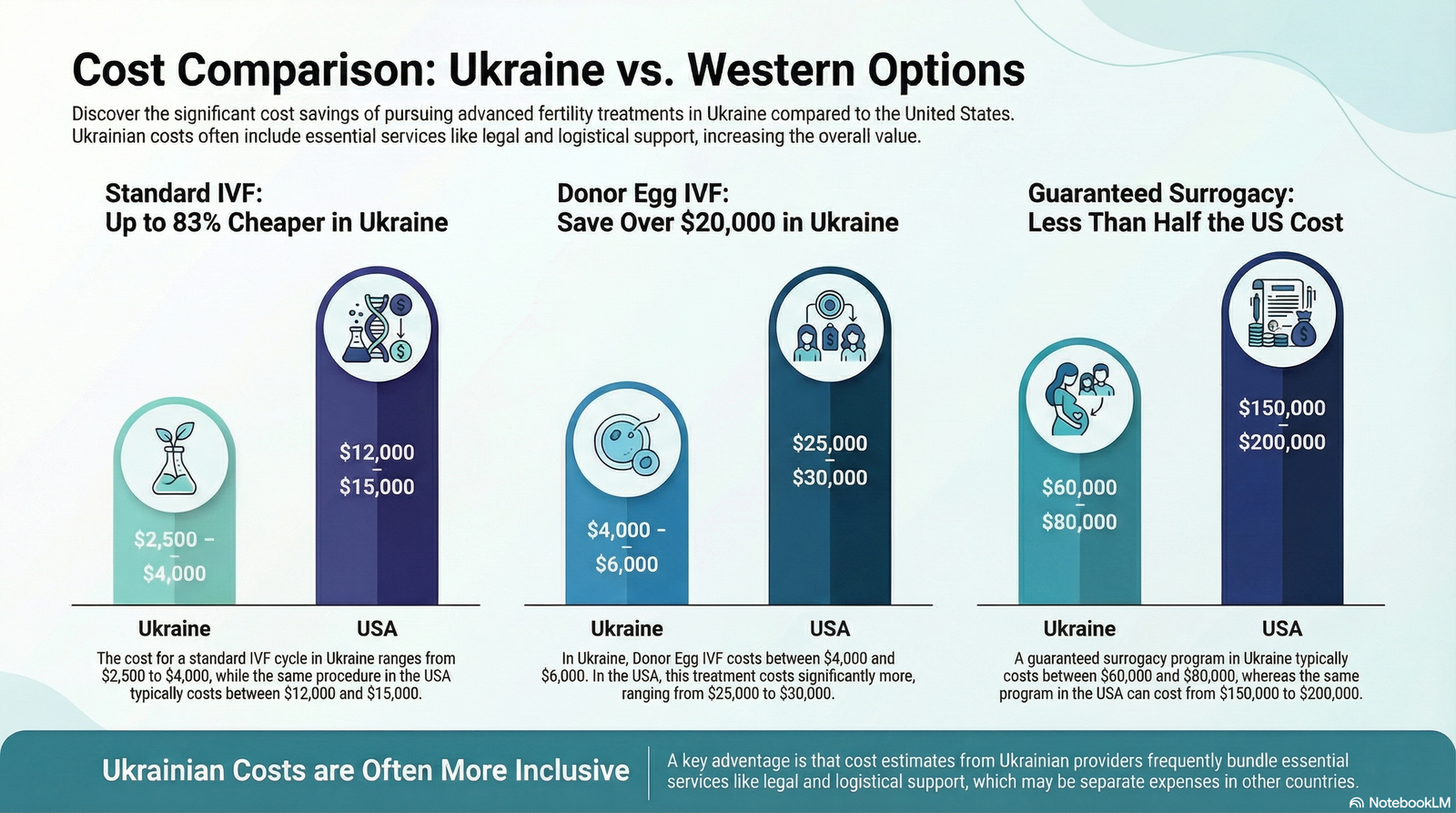
How Ukrainian IVF and surrogacy costs compare with typical Western European and US pricing.
How Treatment Typically Works
The exact sequence depends on your program, but most international patients follow a similar pattern. You usually start with a remote consultation and document review, then a short in-person visit for testing and planning, followed by stimulation and egg retrieval or donor-egg thawing, and finally embryo transfer to you or to a surrogate.
If you use a surrogate, you also have a parallel legal and psychological screening track. The agency or clinic screens carriers and donors, matches you, and prepares contracts so that parentage is clear under Ukrainian law. After birth, you will need paperwork for your own country’s citizenship and passport process, so it is wise to involve a lawyer early.
Safety, Screening, and Treatment Choices
4x Higher Risk – Why Screening Protects: In one US study, about 1 in 5 surrogates did not meet medical guidelines. When this happened, babies were nearly four times more likely to need special neonatal care, and caesarean and preterm birth rates were higher. For you, this shows why strict agency and clinic screening is not just red tape; it is a core safety measure for your surrogate and your baby. Source: Obstetrics & Gynecology (PMID: 32649497).
1 in 3 Twins – The Embryo Number Trade-Off: National US data found that when gestational surrogates received more than one embryo, around one in three births were twins or higher. These pregnancies had more preterm births and low-birth-weight babies, even though overall success was high. For you, this highlights a key decision: transferring a single strong embryo may slightly slow how fast you reach a live birth, but it sharply lowers the chance of NICU time and complications. Source: Fertility and Sterility (PMID: 27087401).
Single Embryo First – Official Guidance: The European Society of Human Reproduction and Embryology (ESHRE) now recommends single-embryo transfer for most good-prognosis IVF patients and warns that twins are the main avoidable risk of IVF. For your Ukraine plan, this means you can push for single-embryo transfer in most cycles, especially with donor eggs or a proven surrogate. Source: ESHRE embryo-transfer guideline (Hum Reprod 2024).
GnRH Antagonists First – Safer Stimulation: An ESHRE guideline reviewing IVF stimulation found that using GnRH antagonist protocols gives similar live-birth rates to older “long” agonist protocols, but with a lower risk of OHSS. The group issued a strong recommendation to prefer antagonist protocols for most patients. If you are comparing Ukrainian clinics, this is a practical question to ask: do they mainly use modern antagonist protocols and have a clear plan to prevent OHSS? Source: Human Reproduction Open (PMID: 32395637).
Safety, Risks, and Screening
Any fertility treatment carries risk, and any treatment cycle initiated abroad adds extra layers. You need to look at ovarian stimulation safety, multiple pregnancy risks, surrogate safety, and legal and emotional stress for you and the carrier.
On the medical side, ESHRE’s ovarian stimulation guideline recommends GnRH antagonist protocols for most patients because they cut the chance of moderate and severe OHSS without lowering live-birth rates. Many Ukrainian clinics already use these protocols and will also offer “freeze-all” strategies or mild stimulation if you are high risk.
On the pregnancy side, twin and higher-order pregnancies are the single biggest avoidable risk in IVF. Surrogates and intended parents both face higher rates of high blood pressure, preterm birth, and caesarean delivery when pregnant with twins. That is why serious programs now build single-embryo transfer into their default plans for donor-egg and surrogacy cases.
OVU Expert Guidance: Screen First, Then Compare Prices
When you explore different Ukrainian programs, it is tempting to start with price. A safer approach is to start with screening and protocols. Ask clinics to share their surrogate and donor criteria in writing, their twin and OHSS rates, and whether they routinely use single-embryo transfer. Once you know who is protecting you and your baby, you can compare costs inside that smaller, safer group.
Clinic and Program Options
You will see four names often when you research IVF and surrogacy in Ukraine: ICSI, ISIDA, IVMED, and Vittoria Vita. Each has its own focus.
ICSI Clinic
ICSI offers full-cycle IVF, donor-egg programs, and a wide variety of guaranteed and unlimited surrogacy packages. Some guaranteed plans with donor eggs and NGS testing sit in the €63,800–78,450 range and run until you have a live birth. You also see advanced male-factor treatments, including testicular sperm extraction for severe male infertility.
ISIDA Clinic
ISIDA runs “Optimal” IVF programs around €2320, full-cycle IVF around €4150, and several surrogacy pathways. One headline option is a guaranteed surrogacy program with donor eggs, starting at €26,178, which promises a result before birth under its contract terms. ISIDA also provides obstetric services, so some families stay with ISIDA from IVF and embryo transfer through delivery.
IVMED Clinic
IVMED leans into protocol safety and lab quality. The clinic emphasizes single-embryo transfer with an average of 1.2 embryos per transfer and stresses that it has not seen OHSS in its recent patient cohorts. For donor eggs, the medical team reports an 80% thaw survival rate (per oocyte cohort devitrification and fertilization). Additionally, the clinic offers hybrid programs enabling the use of the intended mother’s oocytes and donor’s oocytes within the same IVF cycle. The nuclear transfer program is reserved for specific poor-prognosis egg-quality cases.
Vittoria Vita
Vittoria Vita offers a treatment bundle with more of a “clinic plus concierge” model. IVF packages like “New Life” and “Chance” include PGD and gender selection, along with accommodation, transfers, translation, and a dedicated program coordinator. The “Result” program, priced around €13,000, is pitched as a pregnancy-guarantee package under defined conditions.
Want help comparing clinics and costs?
If this feels like a full-time job, our advisors can help you request clear, itemized quotes from verified Ukrainian and European clinics and map your treatment timeline with you. You can start here: compare IVF and surrogacy programs with an OVU advisor.

Why trust this guide? The OVU commitment
You are probably juggling hope, timelines, and a lot of tabs open in your browser. And you deserve clear, current, human advice. At OVU, we review clinic protocols, compare real quotes, and talk to people who have done this - intended parents and gestational carriers - so we can give you practical steps, not just theory. If you want help comparing options without sales pressure, we will gather itemized quotes and success data that match your exact situation. You decide, we will bring the info to your table.
Frequently Asked Questions
How safe is IVF in Ukraine compared with my home country?
The core medical risks of initiating IVF are similar everywhere. What matters more is which protocols your clinic uses and how they manage complications. In Ukraine, many clinics now use GnRH antagonist protocols and single-embryo transfer, which lowers the risk of OHSS and twins. When you ask for clinic statistics, focus on their OHSS rates, twin rates, and how often they end up in emergencies during stimulation or pregnancy.
Is surrogacy in Ukraine safe for the surrogate herself?
Large studies suggest that when surrogates are healthy, multiparous women who meet guideline criteria, severe complications remain uncommon and are often lower than in other IVF pregnancies. The biggest safety levers are strict medical screening, avoiding twin pregnancies, and having good obstetric backup. When you talk to agencies, ask exactly which criteria they use and how they handle high-risk findings.
How much should I budget if I want a guaranteed surrogacy program?
Most guaranteed surrogacy packages with donor eggs and genetic testing in Ukraine start well above €60,000 and can climb toward €80,000 once you add legal work and extras. You will also need to budget for flights, accommodation, if not included, and legal costs in your home country for citizenship and passports. The upside is that you cap the medical side of the risk, because the clinic carries the cost of extra cycles.
Can I choose my baby’s sex during IVF in Ukraine?
Some Ukrainian clinics offer sex selection as part of preimplantation genetic testing, while others restrict it to cases with a specific medical necessity. Before proceeding, ensure that sex selection aligns with the laws and ethical guidelines of your home country. If this is a priority for you, discuss it openly during your initial consultation and request a copy of the clinic’s written policy.
What if my ovarian reserve is very low?
If your ovarian reserve is low, clinics may suggest natural-cycle IVF, mild stimulation, or moving to donor eggs, depending on your age and goals. Natural-cycle IVF in Ukraine is relatively affordable and avoids heavy medication, but it usually gives only one egg per cycle. Donor eggs deliver much higher success rates and are the main path clinics recommend once your own eggs no longer produce good embryos.
Reference List 8 sources
Journal Article (Research): Segal TR, Kim K, Mumford SL, Goldfarb JM, Weinerman RS. How much does the uterus matter? Perinatal outcomes are improved when donor oocyte embryos are transferred to gestational carriers compared to intended parent recipients. Fertility and Sterility. 2018;110(5):888-895. PMID: 30316434. Available from: https://pubmed.ncbi.nlm.nih.gov/30316434/
Journal Article (Research): Perkins KM, Boulet SL, Jamieson DJ, Kissin DM; National Assisted Reproductive Technology Surveillance System (NASS) Group. Trends and outcomes of gestational surrogacy in the United States. Fertility and Sterility. 2016;106(2):435-442.e2. PMID: 27087401. Available from: https://pubmed.ncbi.nlm.nih.gov/27087401/
Journal Article (Research): Swanson K, Letourneau JM, Kuppermann M, Einerson BD. Obstetric morbidity in gestational carrier pregnancies: a population-based study. Journal of Assisted Reproduction and Genetics. 2021;38(1):177-183. PMID: 33145724. Available from: https://pubmed.ncbi.nlm.nih.gov/33145724/
Journal Article (Systematic Review & Meta-Analysis): Matsuzaki S, Masjedi AD, Matsuzaki S, Anderson ZS, Erickson KV, Mandelbaum RS, et al. Obstetric characteristics and outcomes of gestational carrier pregnancies: a systematic review and meta-analysis. JAMA Network Open. 2024;7(7):e2422634. PMID: 39042408. Available from: https://pubmed.ncbi.nlm.nih.gov/39042408/
Journal Article (Research): Swanson K, Letourneau JM, Kuppermann M, Einerson BD. Association of obstetric and neonatal outcomes with deviation from guidelines for gestational carriers. Obstetrics & Gynecology. 2020;136(2):387-393. PMID: 32649497. Available from: https://pubmed.ncbi.nlm.nih.gov/32649497/
Committee Opinion (Guidance): Practice Committee of the American Society for Reproductive Medicine; Practice Committee of the Society for Assisted Reproductive Technology. Recommendations for practices using gestational carriers: a committee opinion. Fertility and Sterility. 2022;118(1):65-74. PMID: 35725121. Available from: https://pubmed.ncbi.nlm.nih.gov/35725121/
Committee Guideline (Embryo Number): ESHRE Guideline Group on the Number of Embryos to Transfer. ESHRE guideline: number of embryos to transfer during IVF/ICSI. Human Reproduction. 2024;39(4):647-657. PMID: 38364208. Available from: https://pubmed.ncbi.nlm.nih.gov/38364208/
Committee Guideline (Stimulation Safety): ESHRE Guideline Group on Ovarian Stimulation; Bosch E, Broer S, Griesinger G, et al. ESHRE guideline: ovarian stimulation for IVF/ICSI. Human Reproduction Open. 2020;2020(2):hoaa009. PMID: 32395637. Available from: https://pubmed.ncbi.nlm.nih.gov/32395637/
Final Thoughts
Choosing IVF or surrogacy in Ukraine is a serious decision, and you deserve to feel informed rather than rushed. You have learned how success rates change when you prefer using donor eggs or a surrogate, what drives costs up and down, and which questions separate safer programs from those that look inexpensive on paper.
If you keep your focus on screening standards, twin and OHSS rates, and clear legal structures, you give yourself the best chance of coming home not only with a baby, but also with everyone involved as safe and supported as possible. Numbers matter, but so does how you feel about the team that will handle your embryos, your body (in case you undergo IVF treatment), and surrogacy, when another woman carries a pregnancy for you.
Need a second set of eyes on your short list?
You can share your top clinic choices with an OVU advisor and walk through their protocols, pricing, and success rates together. Sometimes a 30-minute structured conversation is enough to turn confusion into a clear next step.