


Dr. Sony Sherpa (MBBS)
In addition to her clinical experience, Dr. Sherpa is a published medical researcher and holistic health advocate. Her dual expertise in emergency care and alternative therapies brings a unique lens to medically reviewed content—ensuring it is both accurate and accessible.
If you are staring at Spain’s IVF prices and wondering if the flight is worth it, or checking Mexico and trying to decide if “affordable” also means “safe”, you are not alone in being forced to explore the alternative destinations offering less expensive options. Infertility now affects 1 in 6 people worldwide, and that pressure has pushed more people to look outside their home country for treatment. By 2024, over 60% of fertility patients said they were considering going overseas.
You might want to save 50% or more on treatment, access surrogacy that is illegal where you live, or avoid long waiting lists. The global market is ready to sell you all of that. While the global market is full of possibilities, it is essential to look beyond the perfect websites to find truly secure, premium-quality, ethical medical care. This guide walks you through how to vet clinics for 2026, what costs to expect, and what legal issues you need to understand before you bring your baby home.
We understand this process may feel heavy and personal. You are not just buying a bundle of services; you are entrusting the medical team with your health and the health of your future child. Clear data, honest questions, and a transparent structure for comparing options can help you move from feeling flooded with information to feeling ready to make a decision.
Choosing a clinic abroad means checking three main areas. First, your clinic’s lab must be accredited, with clear systems for storing and tracking oocytes, sperm, and embryos. Second, legal and ethical frameworks must protect you, your surrogate or donor, and your child. Third, success rates should be grounded in clinical reality, not marketing. While costs in Mexico, Colombia, Thailand, and India can be 50% to 70% lower than in the United States (even including travel), those savings are only realized if the clinic is transparent about safety and outcomes.
Next step: Create a shortlist of three clinics and ask each one the same set of questions to compare them side-by-side. Focus on lab accreditation, embryo storage, and single embryo transfer policies. Additionally, ask for success rates specifically for cases like yours, the core costs of your preferred bundle, and a full disclosure of any potential additional fees.
What the Latest Research Shows
Recent research on gestational carriers and IVF outcomes gives you a clearer picture of what to expect when you work with a well-run clinic abroad. Large studies now include hundreds of thousands of IVF cycles and tens of thousands of gestational carrier pregnancies, so you can compare real results instead of relying on isolated stories.
A major United States study of more than 1 million transfers found that using a gestational carrier has raised live birth rates from about 44% to about 54% per transfer. A 2024 meta-analysis that pooled 28,300 surrogate pregnancies reported that outcomes were similar or slightly better than in other IVF pregnancies, while serious complications for carriers remained rare. These findings support the idea that careful screening and modern laboratory protocols matter far more than the country in which you choose to seek care.
In This Guide
- The 2026 Global Fertility Landscape
- Destination Spotlight: Where to Go
- Cost Breakdown and Comparison
- The Ultimate Vetting Checklist
- Understanding Success Rates
- Legal Requirements and Shifting Laws
- Travel, Logistics, and Support
- Pros and Cons of Treatment Abroad
- Frequently Asked Questions
- Making Your Decision
1 in 6 people face infertility worldwide, and ART use has more than doubled in ten years.
You can often cut IVF costs by 40 to 60% by going to Mexico, Colombia, Thailand, or India.
Gestational carrier cycles reach about 54% live birth per transfer compared with around 44% without a carrier.
Quick Facts: The 2026 Global Fertility Landscape
If you are still undecided about whether to stay local or travel, these numbers can help frame your decision.
- Global demand: Use of assisted reproductive technology has more than doubled in the last ten years, and IVF accounts for almost all of these treatments.
- Where treatment happens: Roughly 35% of the global ART market is in North America, 25% in Latin America, and 20% in Europe.
- The main driver: Cost is the top reason people leave their home country, and many patients save at least half by going to lower-cost regions.
- Success benchmarks: Global live birth rates per IVF cycle sit around 30 to 35%. The wider use of embryo genetic testing and smarter embryo selection has helped keep rates in this range as more older patients seek treatment.
- Surrogacy growth: The commercial surrogacy market was valued at approximately $14 billion in 2022 and is projected to reach $129 billion by 2032.
- Who is traveling: Single mothers by choice and LGBTQ+ families are a fast-growing share of patients. In the United Kingdom, single women now account for about 10% of fertility treatments.
Key Research Insights You Can Use
54% vs. 44% – The surrogacy success differential: A U.S. study of over 1 million IVF transfers found that cycles using a gestational carrier achieved a live birth rate of approximately 54%, compared to 44% for transfers involving the intended mother. This benchmark helps you determine if a clinic’s projected success rates are grounded in clinical reality. Source: JAMA (PMID: 37851614).
73% vs 63% – Higher chance of post-transfer pregnancy: The same study reported that embryo transfers to gestational carriers led to a positive pregnancy test in 73% of cycles, versus about 63% for non-carrier cycles. These figures show that comprehensive gestational carrier screening and uterine preparation impact the post-transfer success of the procedure. Source: JAMA (PMID: 37851614).
28,300 pregnancies – Big picture verdict: A 2024 review pooling 28,300 surrogate pregnancies found that outcomes were similar or slightly better than other IVF pregnancies and that serious complications for carriers were rare. Source: JAMA Network Open (PMID: 39042408).
Destination Spotlight: Where Should You Go?
The ideal destination for your journey depends entirely on your specific clinical and legal needs. Whether you are seeking straightforward IVF, exploring surrogacy, requiring donor eggs, or wanting to adopt an embryo, the following sections compare how different global regions navigate these options, helping you match your priorities with the right location to initiate a round of IVF or blueprint the surrogacy arrangement.
Latin America, an Emerging Powerhouse
Mexico and Colombia now attract a large share of North American patients, roughly 20% of international fertility travelers.
Mexico, Mexico City, and Guadalajara: A standard IVF cycle, which costs around $20,000 in the United States, often runs between $5,000 and $7,000 in Mexico. Patients still have access to experienced specialists, and many clinics tailor the entire experience for international visitors, providing everything from airport pickups to translation services.
Colombia, Bogotá: Colombia is rapidly becoming a key surrogacy hub. While full surrogacy programs in the United States often cost more than $100,000, many programs in Colombia range from $50,000 to $80,000. Courts in Colombia permit compensated surrogacy, making it a viable alternative for Europeans originating from countries that prohibit or severely restrict the practice.
Europe, Gold Standard for Donor Eggs
Navigating surrogacy and fertility arrangements in European jurisdictions can be complex due to evolving legal nuances and diverse regulatory hurdles. However, while legal frameworks vary, several destinations stand out for their accessibility and high standards.
Spain: Spain is the primary European destination for fertility tourism and handles approximately 40% of all international patients in the region. You see short waiting times, anonymous egg donation, and clinics used to working with patients from the United Kingdom, France, Germany, and the Middle East. Many global patients choose Spain to undergo treatment during their annual vacation, allowing them to pair their medical journey with a relaxing stay along the coast or in a vibrant cultural hub.
Greece and the Czech Republic: If you want strong standards and prices lower than in Spain, these two countries often come up first. Laws are generally friendly to donor egg IVF and to international patients. Greece has allowed single women to access IVF for years, so if you are planning treatment on your own, it is a steady option.
Denmark and the Netherlands: Recognized as Europe’s inclusivity hubs, these countries are often called the inclusivity hubs in Europe. If you are LGBTQ+ or a single parent, you will see clearer laws, more open sperm banks, and staff who are used to working with diverse families.
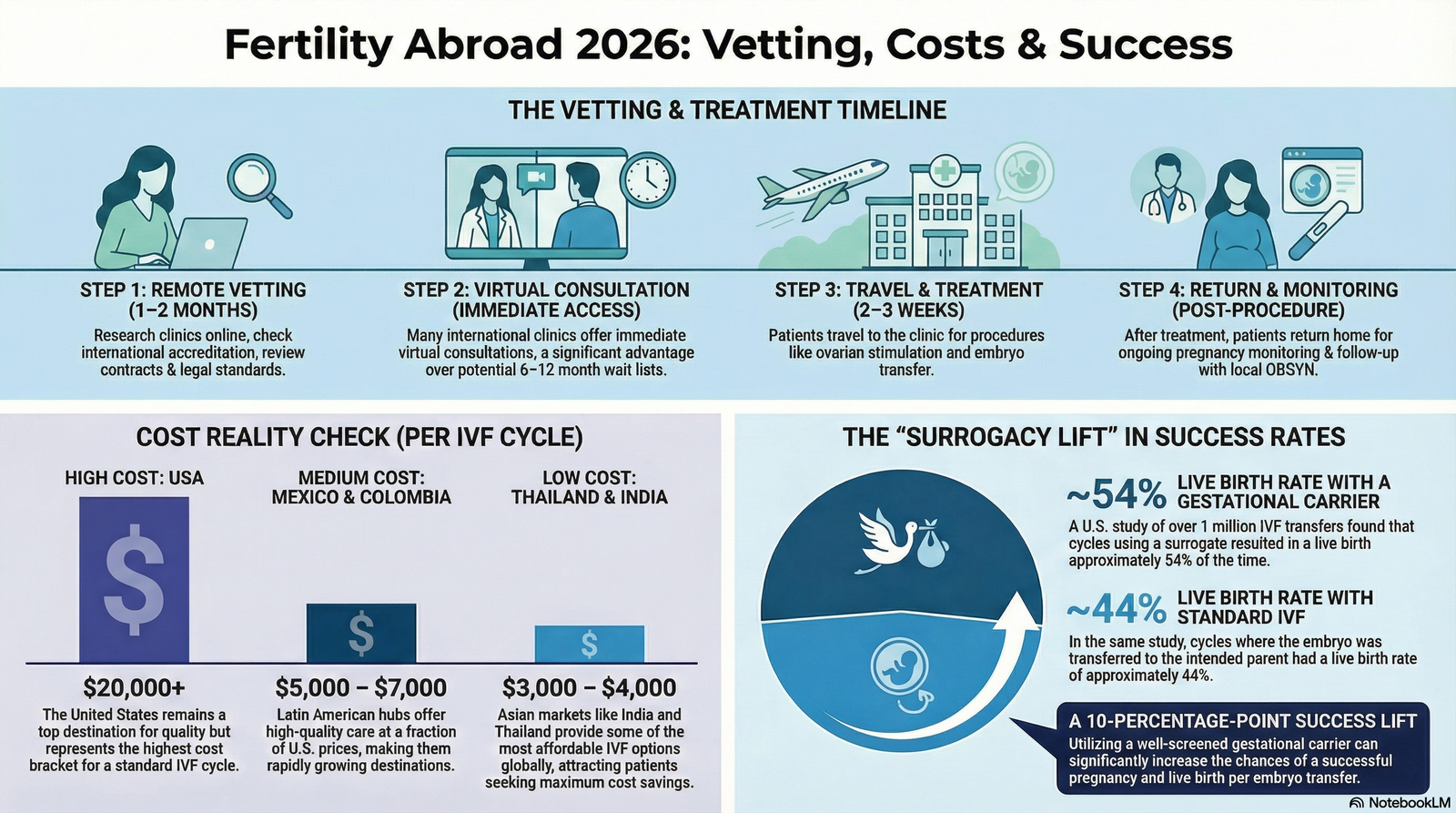
Fertility treatment abroad at a glance, vetting timeline, typical costs, and success rate comparison.
Ukraine, the Surrogacy Specialist
Before the war, Ukraine was one of the main global centers for relatively affordable surrogacy. The situation on the ground is still complicated, but the screening standards built there now shape how agencies think about quality worldwide.
High-end agencies, such as Delivering Dreams, report that they accept roughly 1 out of 20 women who apply to become surrogates. Clinics turn away the rest of the applicants because of medical issues, past pregnancy complications, more than five deliveries, multiple C-sections, or social risks. When you talk with any agency or clinic, at home or abroad, you want to know whether their screening looks anything like this or is just a quick form and a basic exam. Ultimately, a stringent vetting process is the primary safeguard for both the health of the child and the legal security of the intended parents.
Asia and the Middle East, High Tech and Low Cost
Thailand: Thailand is a popular destination for affordable, all-inclusive IVF bundles that utilize medical technology on par with Western standards. A typical IVF cycle costs around $4,000, compared with over $20,000 in the United States once medications and monitoring are included. For many patients from Australia, China, and the Middle East, the flight time and cost feel manageable compared with local prices.
India: India remains one of the least expensive IVF destinations in the world, with cycles often priced at $3,000 or less. However, surrogacy laws have tightened significantly. Today, commercial surrogacy is prohibited, and the practice is limited to altruistic arrangements for Indian citizens, so if you are from outside India, you can use IVF services but not commercial surrogacy programs.
United Arab Emirates (Dubai and Abu Dhabi): The UAE has invested heavily in private hospitals and fertility centers, positioning itself as a premier regional healthcare hub. Clinics often highlight their ability to respect specific religious guidelines, such as utilizing only the husband’s sperm and the wife’s eggs. For those living in the Gulf, this destination reduces travel time and eliminates language barriers while providing access to state-of-the-art laboratory facilities.
Cost Breakdown and Comparison for 2026
Lower advertised prices are only part of the financial picture. Beyond the clinic fees, you must account for medications, flights, lodging, time off work, and legal expenses. Even with these additions, many families still find that going abroad offers significant savings.
| Treatment Type | United States | Mexico / Colombia | Thailand / India |
|---|---|---|---|
| Standard IVF cycle | $20,000+ | $5,000 – $7,000 | $3,000 – $4,000 |
| Surrogacy program | $100,000+ | $50,000 – $80,000 | N/A (restricted) |
| Egg freezing | High | Moderate | Low |
In 2022, approximately 98,289 babies were born through assisted reproductive technology (ART) in the United States, accounting for about 2.5% of all births. Because most insurance plans still do not cover IVF, even middle-income families are increasingly looking towards these lower-cost options abroad.
The Ultimate Vetting Checklist: How to Spot a Bad Clinic
Success in cross-border reproductive care depends heavily on your ability to distinguish world-class medical centers from substandard agencies. In major hubs like Ukraine, for instance, you will find dozens of clinics specializing in surrogacy; however, their standards can range from clinical excellence to ethically questionable or unsafe practices. Because many international destinations lack the rigid oversight found in the U.S. or the UK, you must be your own advocate. Use the following checklist to evaluate any clinic or agency to ensure they prioritize transparency, surrogate welfare, and patient safety over profit.
1. Watch for Medical Red Flags
Ask direct questions about medical practices. You want simple, clear answers, not vague promises.
- Testing: What medical tests do you run on surrogates, donors, and intended parents? If the list is very short, the clinic is saving money somewhere, and that usually means a higher risk for you and the baby.
- On-site or outsourced: Does your clinic run its own lab or send embryos and samples elsewhere? A clinic that only rents an office and sends lab work out may have less control over quality.
- Tracking systems: How do you track eggs, sperm, and embryos during every step? Ask about barcodes, double checks, and electronic witnessing systems. You want more than “we are careful”.
- Outcomes: Do you track and share complication rates or health problems in babies? Clinics that never discuss outcomes beyond pregnancy test results are hiding part of the picture.
2. Check Legal and Ethical Transparency
A good clinic or agency works in the open. You should feel like a partner, not a product.
- Direct access to doctors: Can you speak with the treating physician or lead embryologist on a call or video before you commit money? If you only talk with coordinators or advisors, you are not seeing the full picture.
- Contact with surrogates: If you use surrogacy, can you speak directly with your carrier once everyone signs the contract? If the agency blocks contact or limits it heavily, ask why.
- Contract balance: Have a lawyer review the contract before signing it. Watch for sections that release the clinic from almost all responsibility or give you no clear rights if something goes wrong.
- Proof of biological links: Ask how the clinic proves that the child is genetically related to you or your donor. That should include clear lab protocols and documentation you can keep.
3. Look Closely at Lab Standards
When patients are asked what matters most, 91% now put accurate embryo transfer and safe storage policies ahead of cost or even headline success rates. Your questions should match that priority.
- Is your lab accredited by a recognized international body? Specifically, does it maintain certification from the College of American Pathologists (CAP), the European Society of Human Reproduction and Embryology (ESHRE), or ISO 15189 standards for quality management and clinical competence?
- What kind of incubators do you use, and how do you monitor embryo growth and conditions?
- How often do you recommend transferring only one embryo, and in what situations do you suggest transferring more than one?
Why Single Embryo Policies Matter
A Clear Risk Signal (800,000+ IVF Twin Cases): A 2024 review of more than 800,000 twin pregnancies after IVF confirmed that twins carry much higher risks of preterm birth and medical complications compared to singletons. You should prioritize clinics that advocate for single-embryo transfer (SET) whenever clinically appropriate, rather than those promising high success rates at any cost. Source: Human Reproduction Update (PMID: 38345641).
The Hidden Cost of High Success Claims (Multiple births): National data show that about 15% of births in gestational carrier cycles resulted in multiples when clinics transferred more than one embryo. High twin and triplet rates significantly increase the likelihood of Neonatal Intensive Care Unit (NICU) stays and long-term health issues. Source: JAMA and Fertility and Sterility (PMIDs: 37851614, 27087401).
Success Rates: Understanding the Surrogacy Lift
You will see many clinics advertise success rates in big print. You need to understand what those numbers mean and what they hide.
The Power of Using a Gestational Carrier
A large-scale U.S. study analyzing over one million embryo transfers revealed a significant performance gap between patient types. When clinics utilized a gestational carrier, live birth rates reached approximately 54%. In contrast, transfers to intended parents within the same dataset resulted in a live birth rate of roughly 44%. Clinical pregnancy rates followed a similar pattern, standing at 73% for gestational carriers compared to 63% for non-surrogacy cycles.
These numbers give you a realistic target when you evaluate clinics abroad. If a clinic shows carrier success rates in the 50 to 60% range per transfer, and they are not boosting these numbers with lots of multiple embryo transfers, that is in line with strong practice. If you see promised success rates of 80 or 90% per transfer, that is a sign of aggressive marketing, unusual patient selection, or risky embryo transfer strategies.
Surrogacy is now a normal part of fertility care worldwide. Based on recent reviews, gestational carrier cycles account for about 2.5% of all IVF cycles and nearly 4% of assisted reproductive technology pregnancies. If a clinic treats surrogacy as unproven or rare, that is a concern.
The Risk of Boosting Success with Multiples
Some clinics, particularly in lower-cost destinations, may inflate their success statistics by transferring two or three embryos simultaneously. While this strategy increases the likelihood of at least one embryo implanting, it significantly raises the risk of multiple gestations (such as twins or triplets) along with the serious medical complications associated with high-risk pregnancies.
- Large studies of twin pregnancies after IVF show much higher rates of preterm birth and low birth weight compared with singletons.
- In one national dataset, about 15% of births in surrogacy cycles were twins or more when multiple embryos were transferred, compared with about 13% in cycles without carriers.
Professional societies such as the American Society for Reproductive Medicine now recommend a single embryo transfer strategy in many cases, especially when you use high-quality embryos and preimplantation genetic testing in a pre-transfer embryonic cohort. When comparing clinics, always ask for their specific SET rate and their incidence of multiple births. High-quality clinics should have these metrics readily available and be willing to share them transparently, without hidden caveats or attempts to obscure the risks of multiple gestations.
Legal Requirements and Shifting Laws
Fertility law is changing quickly. A destination that looks perfect today might limit treatment options in a year or two, so you need a current snapshot when you plan.
- France: In 2021, France opened IVF to single women and lesbian couples. That change led to about 15,100 new requests in the first year, around seven times the demand from heterosexual couples in that program. Many people still go abroad from France for egg donation and surrogacy, but more options now exist at home.
- Israel: In 2022, Israel removed its ban on surrogacy for same-sex couples and single men. This gave many intended parents a local path instead of traveling to North America or Eastern Europe.
- China: Surrogacy remains banned, and many forms of third-party reproduction face tight limits. Wealthier Chinese patients often travel to the United States, Thailand, or other countries to access surrogacy and donor eggs.
- United States: The legal picture varies by state, but many international patients still choose the United States for surrogacy because parentage orders and protections for same sex parents are clear in key states.
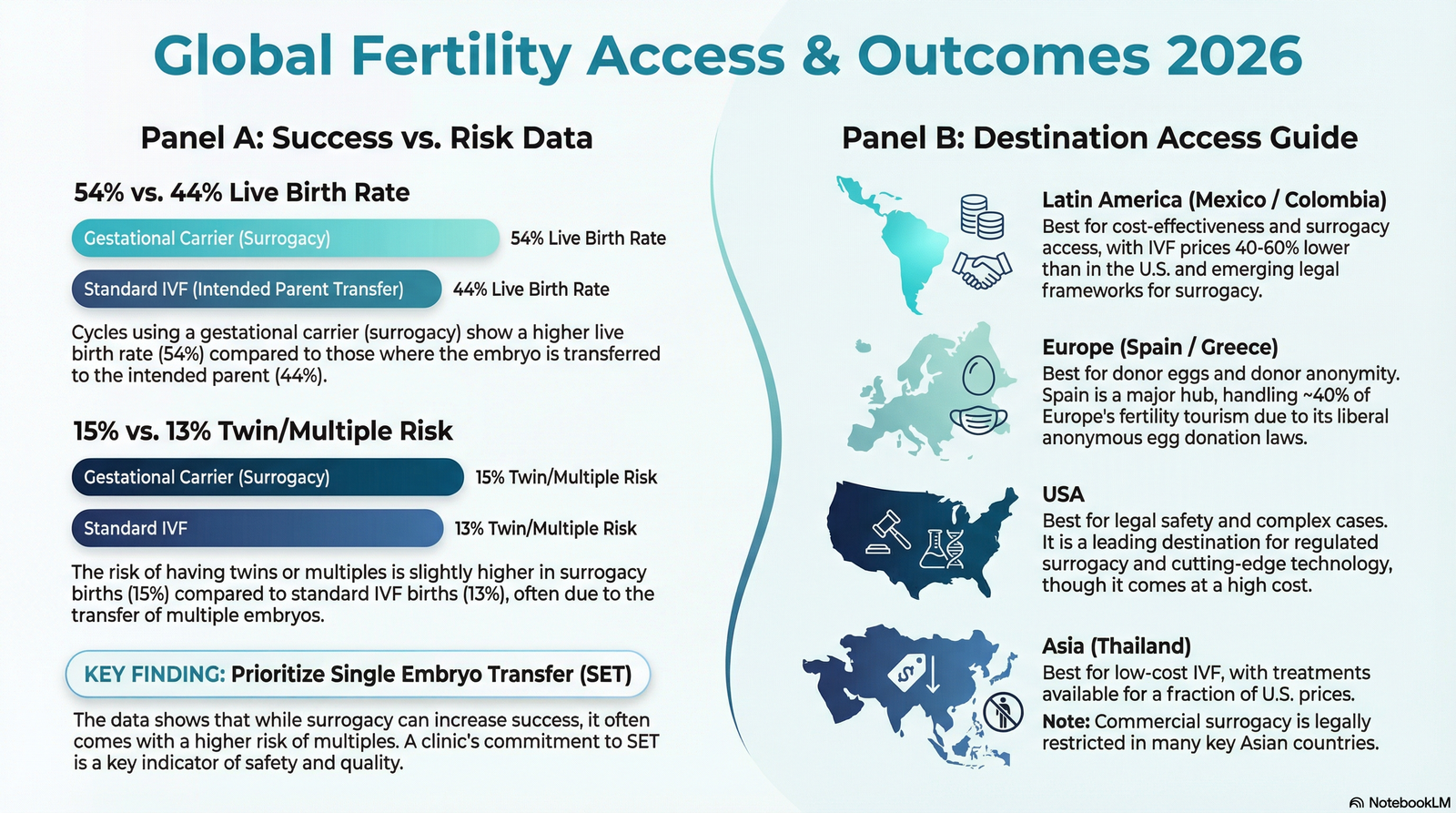
Key numbers for success rates, surrogacy use, and legal access when you look abroad for treatment.
Travel, Logistics, and Support
Going abroad for medical care involves more than just the treatment plan. The way a clinic handles logistics tells you a lot about its experience with international patients.
Wait times: If you live in a country with public healthcare, such as the United Kingdom or Canada, you may face a waiting list of a year or more for some fertility services. In Spain or many Eastern European clinics, you can often start within a single cycle. For someone in their late thirties or early forties, shaving six to twelve months off the wait is often worth more than saving a few thousand dollars.
Clinic support: Many international clinics now offer IVF vacation or fertility travel packages. These include airport transfers, hotel partnerships, translators, and help with paperwork. You should still compare prices, but a clinic that knows how to manage travel details usually communicates better and responds faster to questions.
Communication style: Pay attention to how a clinic responds to your first email or messaging app contact. Clear, prompt, and specific answers are a good sign. If replies are slow, vague, or copy-pasted, that pattern often continues once you start treatment.
Pros and Cons of Fertility Treatment Abroad
Potential Advantages
- Large cost savings: You often save between 40% to 60% on IVF or surrogacy compared with countries like the United States, Canada, or the United Kingdom.
- Access to restricted options: You can sometimes use treatments abroad that are limited or banned at home, such as certain forms of surrogacy, sex selection, or donor anonymity.
- High quality in some hubs: Many clinics in Spain, Mexico, Colombia, Thailand, and other locations now match or come close to outcomes in top United States centers.
- Shorter timelines: You often avoid long waiting lists and start when you feel ready, not when a system has room for you.
Possible Drawbacks
- Travel strain: Long flights, jet lag, and being away from your usual support network add stress on top of an already emotional time.
- Legal risk: Weak regulation in some countries can leave gaps in contracts or parentage documents. Sorting that out later can be expensive and frightening.
- Language barriers: Misunderstandings in medical conversations can affect your safety. You should prioritize clinics with clear English support or translation in your language.
- Follow-up care: After you return home, your local doctors might not know the protocols your overseas clinic used. You may need to explain more or bring detailed records to every appointment.
Want help comparing clinics and costs?
If this feels like a full time job, and it often does, our advisors can collect clear, itemized quotes from verified clinics and map your treatment timeline at no cost to you.

Why trust this guide? The OVU commitment
You are probably juggling hope, timelines, and a lot of tabs open in your browser. And you deserve clear, current, human advice. At OVU, we review clinic protocols, compare real quotes, and talk to people who have done this - intended parents and gestational carriers - so we can give you practical steps, not just theory. If you want help comparing options without sales pressure, we will gather itemized quotes and success data that match your exact situation. You decide, we will bring the info to your table.
Frequently Asked Questions
How can I verify if a clinic’s success rates are accurate?
Request age-specific data and, where possible, results categorized by treatment type (e.g., donor egg vs. autologous, fresh transfer vs. frozen, fresh donor eggs vs. vitrified, hybrid cycle involving own oocytes and donor eggs, transfer of embryo after preimplantation genetic testing vs. non-tested embryo, success per single transfer vs. cumulative success (over multiple attempts), one transfer attempt vs. multiple, specific stimulation protocols (Single Stim vs. Double Stim IVF), etc.). Reliable clinics typically provide data that match national registries or are verified by external audits. Be skeptical of broad, round numbers, such as a “flat” 80% success rate, that lack context regarding patient age, the number of embryos transferred, or the specific definition of “success” being used (e.g., clinical pregnancy vs. live birth).
Can I do surrogacy abroad if I am single or LGBTQ+?
Yes, in the right location. Colombia, Mexico, Canada, and several United States states have clear paths for single parents and LGBTQ+ families. Some popular destinations only allow surrogacy for heterosexual married couples, so you need to match your family structure with the legal rules of the country and region.
What is the most important question to ask an embryologist?
Ask how they protect your embryos. That includes storage systems, backup power, alarm systems, and procedures that prevent mix-ups. You can start with a simple line such as “If I left my embryos with you for five years, what protects them?” and listen to the level of detail in the answer.
Is egg freezing abroad worth it?
For many, the answer is yes. As the demand for oocyte vitrification has grown, locations such as Mexico, Spain, and Greece have become top destinations. If you are in your early to mid-thirties, freezing eggs in locations like Mexico, Spain, or Greece can cost thousands less than in the United States or the United Kingdom while using similar technology. Though selecting a high-quality lab remains essential, opting for an international clinic allows you to preserve your future fertility at a much more accessible price point.
What happens if my IVF cycle fails while I am abroad?
You should ask this question before you start IVF. A responsible clinic explains what support they offer after a failed cycle, including follow-up consultations, a clear plan for the next steps, and how they share all your records. If the clinic sounds eager to move you into another cycle without any review, that is a warning sign.
Do I need a lawyer for treatment abroad?
If you are using surrogacy or donors or planning to move your child across borders, you should work with a lawyer. Try to find someone who understands family and fertility law in both your home country and the destination. It is far easier to set things up correctly from the start than to fix problems later.
How do clinics screen egg donors and surrogates?
Strong programs use full medical histories, including family history of each donor, in-person infertility workup, genetic testing, mental health assessments, and social background checks. For surrogates, most guidelines recommend at least one previous uncomplicated birth and no serious chronic conditions. If a clinic cannot explain its screening steps in detail or seems annoyed by your questions, look elsewhere.
Reference List 9 sources
Journal Article (Research): Shandley LM, DeSantis CE, Lee JC, Kawwass JF, Hipp HS. Trends and outcomes of assisted reproductive technology cycles using a gestational carrier between 2014 and 2020. JAMA. 2023;330(17):1691–1694. PMID: 37851614. Available from: https://pubmed.ncbi.nlm.nih.gov/37851614/
Journal Article (Systematic Review & Meta-Analysis): Matsuzaki S, Masjedi A, Mandelbaum RS, et al. Obstetric characteristics and outcomes of gestational carrier pregnancies: a systematic review and meta-analysis. JAMA Network Open. 2024;7(7):e2422634. PMID: 39042408. Available from: https://pubmed.ncbi.nlm.nih.gov/39042408/
Journal Article (Research): Perkins KM, Boulet SL, Jamieson DJ, Kissin DM; National Assisted Reproductive Technology Surveillance System Group. Trends and outcomes of gestational surrogacy in the United States. Fertility and Sterility. 2016;106(2):435–442.e2. PMID: 27087401. Available from: https://pubmed.ncbi.nlm.nih.gov/27087401/
Journal Article (Systematic Review): Söderström-Anttila V, Wennerholm UB, Loft A, et al. Surrogacy: outcomes for surrogate mothers, children and the resulting families, a systematic review. Human Reproduction Update. 2016;22(2):260–276. PMID: 26454266. Available from: https://pubmed.ncbi.nlm.nih.gov/26454266/
Journal Article (Systematic Review & Meta-Analysis): Marleen S, Kodithuwakku W, Nandasena R, et al. Maternal and perinatal outcomes in twin pregnancies following assisted reproduction: a systematic review and meta-analysis involving 802,462 pregnancies. Human Reproduction Update. 2024;30(3):309–322. PMID: 38345641. Available from: https://pubmed.ncbi.nlm.nih.gov/38345641/
Committee Opinion (Guidance): Practice Committee of the American Society for Reproductive Medicine; Practice Committee of the Society for Assisted Reproductive Technology. Recommendations for practices using gestational carriers: a committee opinion. Fertility and Sterility. 2022;118(1):65–74. PMID: 35725121. Available from: https://pubmed.ncbi.nlm.nih.gov/35725121/
Ethics Committee Opinion: Ethics Committee of the American Society for Reproductive Medicine. Consideration of the gestational carrier: an Ethics Committee opinion. Fertility and Sterility. 2023;119(6):974–982. PMID: 36863967. Available from: https://pubmed.ncbi.nlm.nih.gov/36863967/
Ethics Committee Opinion: American Society for Reproductive Medicine Ethics Committee. Cross-border reproductive care: an Ethics Committee opinion. Fertility and Sterility. 2022;118(6):1090–1100. Available from: https://www.asrm.org/practice-guidance/ethics-opinions/cross-border-reproductive-care-an-ethics-committee-opinion-2022/
Committee Opinion (Guidance): Society for Maternal-Fetal Medicine. SMFM Consult Series Number 60: Management of pregnancies resulting from in vitro fertilization. American Journal of Obstetrics and Gynecology. 2022;226(3):B2–B12. PMID: 34736912. Available from: https://pubmed.ncbi.nlm.nih.gov/34736912/
Making Your Decision
Choosing a clinic abroad is a big step. You are trusting people in another country, often in another language and legal system, with your money, your health, and your future family. It is normal to feel anxious, hopeful, and unsure, sometimes all in the same day.
You do not have to rush this choice. Use the numbers in this guide to compare costs and success rates, and use the vetting questions to test each clinic or agency. Look for teams that answer clearly, share real data, and respect your need to understand every step. When you find people who treat you like a partner, not a sales lead, that is a strong sign you are in the right place.
Your baby may be born in a country you visit only for treatment, but your goal is to bring everyone home safely with clean paperwork, clear memories, and confidence that you chose well. With solid questions, honest answers, and a little patience with yourself, you give yourself that chance.
Ready to build your clinic shortlist?
If you want a clearer view of your real options, talk with an OVU advisor about vetted clinics, real costs, and success rates so you can move from scrolling to choosing.