

Dr. Sony Sherpa (MBBS)
In addition to her clinical experience, Dr. Sherpa is a published medical researcher and holistic health advocate. Her dual expertise in emergency care and alternative therapies brings a unique lens to medically reviewed content—ensuring it is both accurate and accessible.
The road to fatherhood often feels steep when you hear the word “infertility”. It is frustrating, lonely, and sometimes scary. At the same time, modern fertility medicine now gives many men a real chance to have a biological child, even when the semen analysis shows no sperm at all.
Non-obstructive azoospermia (NOA) means there is no sperm in the ejaculate because the testicles are not making enough mature sperm. This affects about 1% of men in the general population and around 10% to 15% of men who seek fertility care. For a long time, donor sperm or adoption were the only realistic options. Today, advanced microsurgery combined with intracytoplasmic sperm injection (ICSI) means many men with NOA can still use their own sperm.
If you are trying to decide which surgical option gives you the best chance, this guide walks you through the main choices. You will see how TESE, micro-TESE, and aspiration techniques differ and how each one fits into your path to becoming a parent.
If you have non-obstructive azoospermia, micro-TESE gives you the highest chance of finding usable sperm while preserving as much testicular tissue and hormone function as possible. For obstructive causes, less invasive options like PESA, MESA, or vasectomy reversal often work very well. Your best choice depends on why there is no sperm in your semen, your hormone levels, your partner’s fertility, and how many children you hope to have.
Next step: Ask your reproductive urologist which category you fall into (obstructive or non-obstructive) and how that shapes your surgical plan.
What recent research shows
Modern data paints a much more hopeful picture for men with severe male factor infertility. Micro-TESE retrieves sperm in roughly 43% to 63% of non-obstructive azoospermia cases, and testicular cancer patients can still bank sperm in about 7 out of 10 cases using onco-microTESE. For men with hormone-related azoospermia, combining long-term hormone therapy with micro-TESE leads to biological fatherhood for about half of men in some series.
These numbers do not guarantee your outcome, but they show that a “zero sperm” report on your first semen test does not have to be the end of the story.
In This Guide
Sperm retrieval in about 43% to 63% of NOA cases.
This method removes far less testicular tissue than older TESE techniques.
Patency rates up to 89.4% for vasovasostomy.
Often cheaper over time than IVF with retrieval.
About 71% of azoospermic testicular cancer patients bank sperm.
This is usually done within a week of diagnosis.
Understanding azoospermia and your options
Before you pick a surgery, you need to know why there is no sperm in your sample. That single detail changes almost everything about your next steps.
Obstructive azoospermia (OA) means your body produces sperm, but a blockage prevents sperm from leaving. This condition can follow a vasectomy, infection, prior surgery, or a missing vas deferens from birth.
Non-obstructive azoospermia (NOA) is different. The issue sits inside the testicles and affects sperm production itself. Even in NOA, sperm production is often patchy, not completely absent. Sperm may exist in small, isolated spots that a skilled surgeon can reach with micro-TESE.
About 10% of men who first receive an NOA diagnosis later show sperm in a repeat, carefully processed semen sample. A second analysis on the day of surgery, with extra time for the lab to search, sometimes finds enough sperm for ICSI and lets you skip an operation. Ask your team whether they plan to recheck a fresh sample on the day of your procedure. That simple step can save you discomfort, time, and cost.
Latest Research Insights
42% to 63% vs. 17% to 45% – The Micro-TESE Advantage: Across several studies, micro-TESE found sperm in about half of men with non-obstructive azoospermia, compared with roughly one in three using older TESE methods. Micro-TESE also removed far less testicular tissue, which helps protect long-term hormone health. Source: Translational Andrology and Urology (PMID: 28904907).
57% Retrieval Rate – After Undescended Testis Surgery: In 935 men who had surgery for undescended testicles, micro-TESE still found usable sperm in 57% of cases. Men who had earlier testis surgery and waited longer before micro-TESE did best, which can guide timing discussions with your surgeon. Source: PLOS One (PMID: 39546484).
56.6% Success – When Hormones Are Optimized: In 616 hypogonadal men with non-obstructive azoospermia, micro-TESE retrieved sperm in about 57 out of 100 procedures. Men who first had hormone treatment and reached healthier testosterone levels were more likely to have sperm found, so careful pre-surgery preparation can improve your odds. Source: Fertility and Sterility (PMID: 38909671).
74% Fatherhood Chance – When Micro-TESE Feeds ICSI: In 128 men with non-obstructive azoospermia, sperm retrieval ranged from about 34% to 74% depending on the underlying cause. When sperm were then used for ICSI, clinical pregnancy rates reached 40% to 68%, especially in men whose infertility followed illness or injury. This shows that surgery plus ICSI can work even in complex cases. Source: Zygote (PMID: 36268556).
These findings come from peer-reviewed research. Your results depend on your personal situation. Talk with your fertility specialist about what these numbers mean for you.
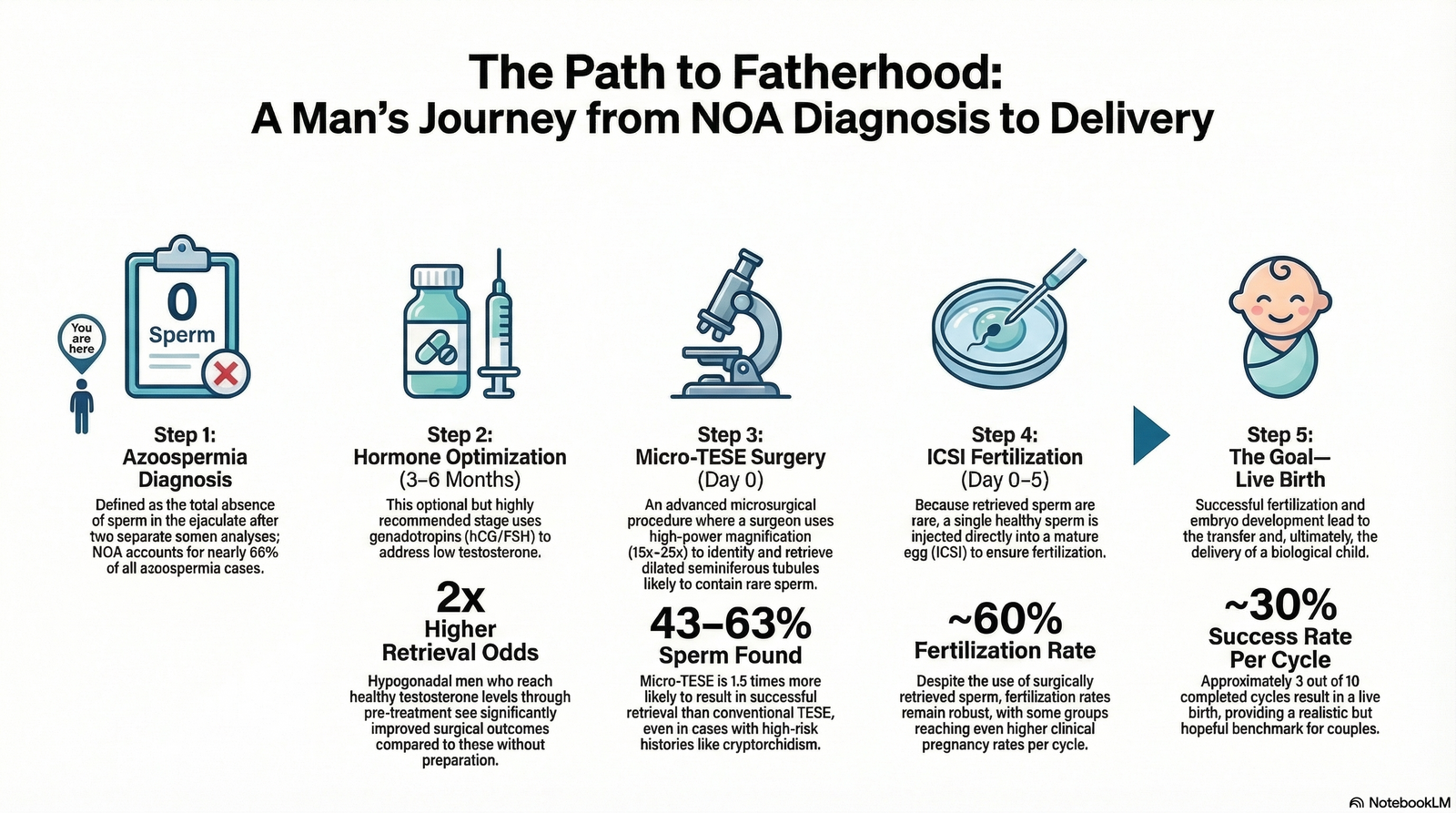
From diagnosis to micro-TESE and ICSI: a typical path from “no sperm” report to pregnancy.
Varicocelectomy: when vein surgery helps
A varicocele is a group of enlarged veins around the testicle. It appears in about 15% of all men and up to 40% of infertile men. It is the most common correctable cause of male infertility.
How varicocelectomy works
During the varicocelectomy, your surgeon ties off the dilated veins so blood flows through healthier pathways. This lowers heat and pressure on the testicle and helps protect sperm production.
The microsurgical subinguinal approach is the preferred technique. Your surgeon works through a small incision near the groin while using an operating microscope. This helps them see and protect the testicular artery and lymphatic vessels, and lowers the risk of hydrocele, recurrence, and damage.
Why you might consider repair
If you are staring at IVF costs, you may wonder whether varicocelectomy is worth adding to your plan. After repair, most men show higher sperm counts, better motility, and healthier sperm shape. DNA fragmentation and oxidative stress in semen occur in the majority of men. After surgery, a clear decrease in DNA fragmentation is seen in around 90% of men.
The real value often lies in the “upgrade”. In one study, 58.8% of men who originally needed IVF moved up to IUI or natural conception after varicocele repair. Even men who remain azoospermic can conceive after TESE or micro-TESE. When doctors repair the varicocele first, the odds of finding sperm in a later retrieval can more than double.
Cost and treatment comparison
Costs vary widely by country and clinic, but some patterns hold across systems. Thinking about money early helps you avoid painful surprises later.
| Treatment Option | What It Includes | Typical Cost Range (USD) |
|---|---|---|
| Vasectomy reversal | Microsurgical reconnection of vas deferens (VV or VE) | $20,000 to $30,000 (around $25,321 reported in some analyses) |
| IVF + sperm retrieval | Micro-TESE or TESE plus IVF and ICSI cycle | $58,000 to $62,000 or more for treatment and medications |
| Varicocelectomy | Microsurgical repair of varicocele, improves semen quality | Clinic dependent, often far less than a full IVF cycle |
For couples with a healthy female partner and a prior vasectomy, reversal usually costs less over time than repeated IVF cycles with surgical sperm retrieval. For NOA or complex causes, IVF with micro-TESE often becomes the main realistic path to a biological child.
How each sperm retrieval technique works
You will hear a lot of acronyms in the clinic. Knowing what they mean and how they differ helps you ask better questions.
TESE: testicular sperm extraction
TESE is an open operation in which your surgeon makes a small incision in the testicle and removes tissue for the lab to examine. In a conventional TESE, they sample several areas of the testicle through one or more openings.
TESE is often the starting point for men with NOA when a surgical microscope is not available. In obstructive azoospermia, TESE is highly effective, and sperm retrieval approaches 100%.
Micro-TESE: microsurgical testicular sperm extraction
Microsurgical TESE (micro-TESE) changed the outlook for men with severe male factor infertility. It is built on the idea of intratesticular heterogeneity. In simple terms, not every part of the testicle behaves the same. Even in areas that seem mostly shut down, tiny pockets of active sperm production can still exist.
During micro-TESE, you receive general anesthesia or an advanced local technique. The surgeon opens the testicle and uses an operating microscope with 15x to 25x magnification. Under that view, some tubules look wider, more opaque, and whiter. These are more likely to contain sperm. The surgeon then removes only these promising tubules and sends them to the embryology lab.
Across studies, micro-TESE retrieves sperm in about 43% to 63% of NOA cases and is about 1.5 times more likely to succeed than conventional TESE in this group. It also removes much less tissue, which helps protect hormone production.
How to think about your personal chances
It is normal to ask, “What are my odds?” A few clinical markers help frame that discussion:
- Testosterone levels: In hypogonadal men, reaching a pre-surgery testosterone level close to 418.5 ng/dL or a “delta T” rise of about 258 ng/dL with hormone therapy is linked to higher retrieval rates.
- FSH levels: High FSH often signals damage, but it does not rule you out. Micro-TESE still retrieves sperm at similar or better rates in many men with high FSH.
- Histology: Sperm retrieval rates are highest with hypospermatogenesis, followed by maturation arrest, and then Sertoli cell-only patterns.
- Ultrasound: At some centers, a testicular ultrasound that shows tubule diameters of 250 micrometers or more predicts better chances of retrieval.
What second opinions and special cases show
71% Preservation Rate – Even With Testicular Cancer: In men with testicular cancer and no sperm in the ejaculate, onco-microTESE preserved sperm for future treatment in 22 of 31 men. Surgery was completed within about a week of diagnosis, so you can protect your fertility without delaying cancer care. Source: BJU International (PMID: 39548846).
10% to 42% Success – The Redo Micro-TESE Second Chance: A review of redo micro-TESE after an earlier failed attempt found new sperm in roughly 1 to 4 men out of 10. Success was higher in men with Klinefelter syndrome and in those with some residual sperm production, so a second surgery can still be worth considering if your first procedure found nothing. Source: Asian Journal of Andrology (PMID: 39028625).
39% vs. 30% Live Birth – Fresh or Frozen Works: In men with Klinefelter syndrome, ICSI using fresh testicular sperm led to a 39% live birth rate, while frozen sperm led to about 30%. These numbers were not meaningfully different, so you and your partner can choose freezing or same-day use based on logistics rather than fear of lower success. Source: Frontiers in Endocrinology (PMID: 40661737).
51% Become Fathers – When Hormones and Surgery Work Together: In 35 men whose low brain hormones caused non-obstructive azoospermia, hormone injections alone led to sperm in the semen for 77% of men. In 7 out of 8 men who still needed micro-TESE, sperm were found, and about half of all men became fathers. Source: Journal of Clinical Medicine (PMID: 41682884).
These findings come from peer-reviewed research. Your situation is unique, so use these numbers as a starting point for a detailed discussion with your team.
PESA: percutaneous epididymal sperm aspiration
PESA is a needle-based procedure for men with obstructive azoospermia. It targets the epididymis, the coiled tube where sperm mature and wait for ejaculation.
Under local anesthesia, your doctor inserts a fine needle through the scrotal skin into the head of the epididymis. They apply gentle suction and collect fluid that the embryologist checks on the spot for moving sperm.
PESA is quick, avoids an incision, and costs less than more complex procedures. In men with congenital absence of the vas deferens, success rates approach 96.8%. Because the doctor cannot see the tubules directly, they may need to switch to a more invasive technique if early passes do not yield sperm.
MESA: microsurgical epididymal sperm aspiration
MESA is the microsurgical version of PESA and is often used in obstructive cases when the goal is to bank a large number of sperm for future cycles.
Your surgeon makes a small incision, exposes the epididymis, and uses the microscope to open a single tubule under direct vision. They then aspirate epididymal fluid rich in sperm.
In one session, MESA can collect large numbers of sperm, often in the range of hundreds of millions. The lab can freeze these in many vials for later IVF or ICSI cycles. In obstructive azoospermia, pregnancy and live birth rates with MESA sperm often reach about 47% and 39% per cycle, which is higher than TESE in similar cases.
TESA: testicular sperm aspiration
TESA (also called TeFNA) uses a needle to aspirate testicular tissue directly. It is usually done under local anesthesia in a clinic setting.
Because the doctor cannot see the tissue during the aspiration, TESA is less accurate for men with NOA. Overall sperm retrieval rates in this group sit around 23.6%. In well-selected men with average testis volume above 7.75 mL and FSH under 8.5 IU/L, retrieval rates rise to about 43%. In that setting, TESA can be a reasonable alternative to open TESE. Outside these conditions, your doctor is more likely to recommend micro-TESE.
Risks, recovery, and hormone health
Every surgery brings some risk. Understanding these risks ahead of time can make you feel more prepared and less blindsided.
With conventional TESE, surgeons remove more tissue, and the risks of scarring, hematoma, and reduced blood flow are higher. Micro-TESE focuses on limited, targeted removal of tubules and uses high magnification, so complication rates are lower.
Most men go home the same day after micro-TESE or within one to two days, depending on the hospital. You can expect swelling, bruising, and soreness for several days. A scrotal support, rest, and ice packs usually keep this manageable. Your team will tell you when it is safe to return to work, sex, and exercise.
Testosterone levels often dip after testicular surgery, especially in men with NOA and very small testes. In long-term follow-up, many men see testosterone rise back near baseline within 12 to 18 months. A small group, roughly 5% to 10% in some series, develops low testosterone that requires ongoing replacement therapy. The risk is higher with multiple surgeries.
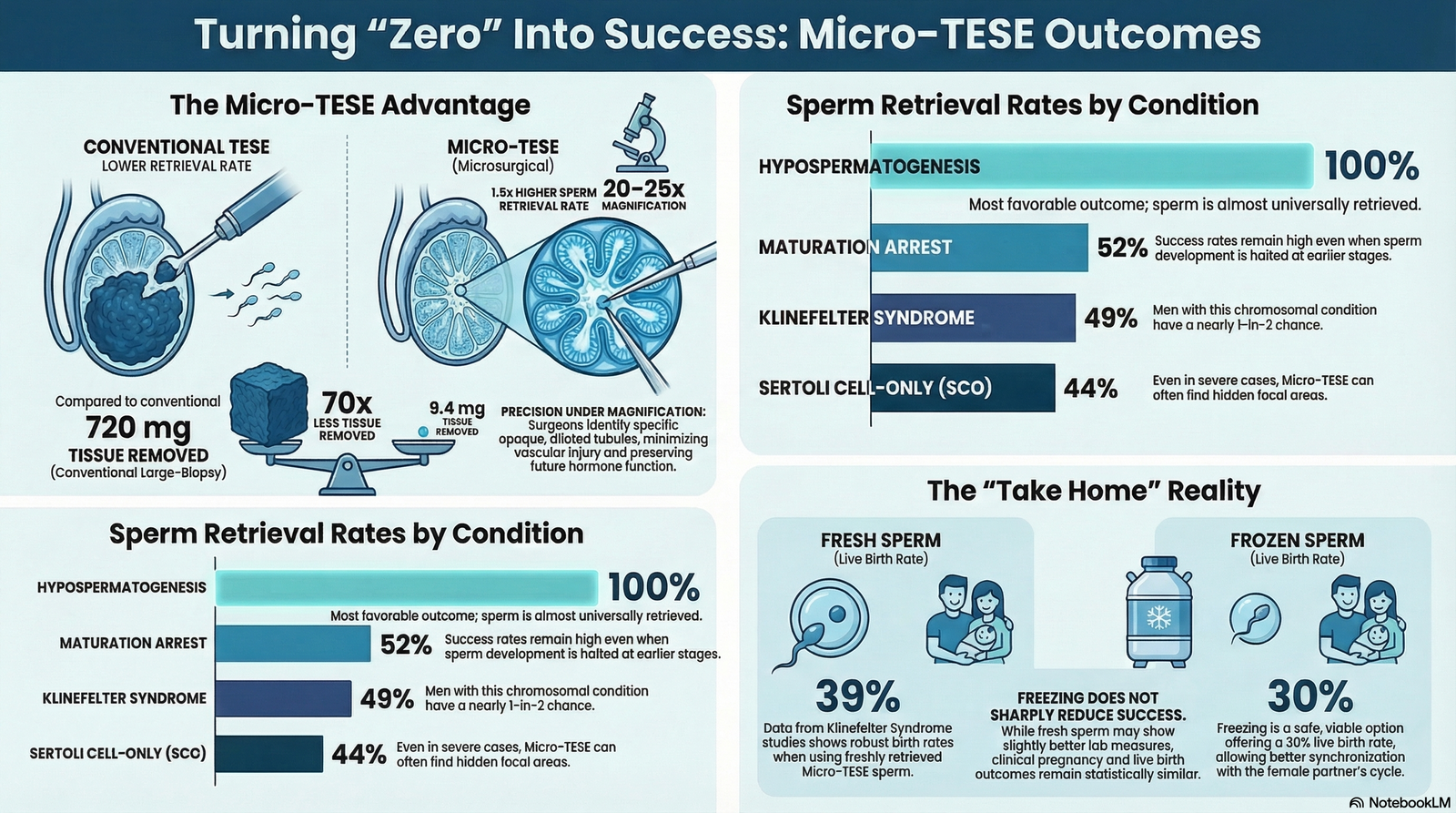
Micro-TESE and related procedures can turn a “no sperm” report into a realistic chance of pregnancy.
When to choose each option and how to talk to your doctor
There is no single “best” surgery for every man. You and your partner will choose based on diagnosis, age, budget, and how important a genetic link is to you.
OVU expert guidance: how to think about your next step
Obstructive azoospermia: If your body makes sperm but a blockage stops them from getting out, epididymal approaches (PESA or MESA) or vasectomy reversal usually make sense. Reversal is often the first choice if your partner has good fertility and you hope for more than one child.
Non-obstructive azoospermia: If your testicles struggle to make sperm, micro-TESE offers the best chance to find rare pockets of production. Hormone optimization and varicocele repair can improve the odds for some men and are worth asking about before surgery.
Complex or high-risk cases: If you have Klinefelter syndrome, prior chemotherapy, or testicular cancer, ask for a reproductive urologist who does these surgeries often. Onco-microTESE and redo micro-TESE are specialized procedures, and the surgeon’s experience matters.
When you meet your doctor, consider bringing a written list of questions. You might ask:
- Based on my tests, do you think my azoospermia is obstructive or non-obstructive?
- How many micro-TESE or TESE procedures do you perform each year?
- Do you recommend hormone therapy or varicocele repair before surgery in my case?
- What sperm retrieval rate do you see in men similar to me?
- Who will be in the embryology lab on the day of my surgery, and how experienced are they?
From retrieval to baby at home: what outcomes look like
Your real goal is a baby at home. Sperm retrieval is just one step in that process.
- Fertilization: In NOA cases, once sperm are retrieved with micro-TESE, ICSI fertilization rates often sit around 57% to 64%.
- Pregnancy: Clinical pregnancy rates in one series reached 68% in “secondary” NOA and about 31% to 40% in other NOA groups.
- Live birth: A large UK dataset showed live birth rates per cycle of about 28.7% for testicular sperm and 30.6% for epididymal sperm, similar to the 28.5% rate for ejaculated sperm.
- Embryo numbers: Cycles using testicular sperm sometimes yield fewer blastocysts, for example, 2 compared with 4 when using ejaculated sperm, but once you reach embryo transfer, your chance of a healthy baby remains strong.
Want help comparing clinics and costs?
If this already feels like a full-time job, you are not imagining it. Our advisors can collect clear, itemized quotes from verified clinics, explain which procedures fit your diagnosis, and help you map out a realistic timeline at no cost to you.

Why trust this guide? The OVU commitment
You are probably juggling hope, timelines, and a lot of tabs open in your browser. And you deserve clear, current, human advice. At OVU, we review clinic protocols, compare real quotes, and talk to people who have done this - intended parents and gestational carriers - so we can give you practical steps, not just theory. If you want help comparing options without sales pressure, we will gather itemized quotes and success data that match your exact situation. You decide, we will bring the info to your table.
Frequently Asked Questions
How long is the recovery from micro-TESE?
Most men go home the same day or within one to two days. Expect soreness, swelling, and bruising for about a week. You will likely wear a scrotal support and avoid heavy lifting and sex for at least one to two weeks. Serious complications, such as large hematomas, are uncommon when an experienced surgeon and team perform the procedure.
Does hormone therapy before surgery really help?
Yes, in many men with low testosterone. Treatment with medicines such as hCG and FSH over several months can raise testosterone and sometimes improve sperm production. In one large study, men who reached healthier testosterone levels before micro-TESE had higher sperm retrieval rates than men who went straight to surgery. Your doctor will help you weigh the extra time and cost against the potential benefit.
Is fresh sperm better than frozen sperm?
In most studies, fresh and frozen testicular sperm lead to similar pregnancy and live birth rates. In Klinefelter syndrome, live birth rates were about 39% with fresh micro-TESE sperm and 30% with frozen sperm. That difference was not large enough to prove a clear advantage. Freezing gives you flexibility, which can lower stress by separating the surgery date from your partner’s IVF cycle.
Can my age prevent a successful sperm retrieval?
There is no strict male age cutoff beyond which sperm cannot be retrieved. In some series, men over 50 had sperm retrieval rates around 73%, which is similar to, or even higher than those of younger men. Your overall health and your partner’s age have a much stronger effect on pregnancy and live birth rates than your age alone.
How much does vasectomy reversal cost compared with IVF?
One economic analysis estimated vasectomy reversal at around $25,321, while sperm retrieval plus IVF and ICSI can range between $58,000 and $62,000 or more. If your partner has good fertility and you hope for more than one child, reversal usually costs less over time because you do not pay for multiple IVF cycles.
Will repeat surgeries damage my testosterone levels?
Every testicular surgery can lower testosterone, at least for a while. Repeating micro-TESE further raises that risk. Most men recover close to baseline over 12 to 18 months, but a small group develops lasting low testosterone and may need hormone replacement. Your surgeon should review this risk with you before you commit to a second or third surgery.
Can any medication help the lab find usable sperm?
Yes. Embryology labs often use a medicine called pentoxifylline to help sluggish or nearly immotile sperm twitch just enough to spot them under the microscope. This technique has led to pregnancies, including twin births, in very challenging cases. It does not fix sperm production but gives the lab one more tool to make use of every viable sperm they see.
Reference List 39 sources
Journal Article (Review): Flannigan R, et al. Microdissection testicular sperm extraction. Transl Androl Urol. 2017;6(4):745-752. PMID: 28904907. Available from: https://pubmed.ncbi.nlm.nih.gov/28904907/
Journal Article (Systematic Review & Meta-Analysis): He Y, et al. Sperm retrieval rates and influencing factors after microdissection testicular sperm extraction in patients with cryptorchidism: A systematic review and meta-analysis. PLOS One. 2024;19(1):e0313866. PMID: 39546484. Available from: https://pubmed.ncbi.nlm.nih.gov/39546484/
Journal Article (Research): Achermann APP, Esteves SC. Factors influencing microdissection testicular sperm extraction success in hypogonadal men with nonobstructive azoospermia. Fertil Steril. 2024;122(1):153-162. PMID: 38909671. Available from: https://pubmed.ncbi.nlm.nih.gov/38909671/
Journal Article (Comparative Study): Wang K, et al. Micro-TESE surgery combined with ICSI regimen in the treatment of non-obstructive azoospermia patients and its effect analysis. Zygote. 2023;31(1):55-61. PMID: 36268556. Available from: https://pubmed.ncbi.nlm.nih.gov/36268556/
Journal Article (Research): Fanshawe JB, et al. Oncological microdissection testicular sperm extraction (Onco-microTESE) outcomes for fertility preservation of patients with testicular cancer with azoospermia or severe oligoasthenoteratozoospermia. BJU Int. 2024;[Epub ahead of print]. PMID: 39548846. Available from: https://pubmed.ncbi.nlm.nih.gov/39548846/
Journal Article (Review): Elbardisi HT, et al. Second chance in fertility: a comprehensive narrative review of redo micro-TESE outcomes after initial failure. Asian J Androl. 2025;27(3):[pages pending]. PMID: 39028625. Available from: https://pubmed.ncbi.nlm.nih.gov/39028625/
Journal Article (Comparative Study): Feng Y, et al. The impact of fresh versus cryopreserved testicular sperm on pregnancy outcomes in Klinefelter syndrome patients undergoing intracytoplasmic sperm injection. Front Endocrinol (Lausanne). 2025;16:1585818. PMID: 40661737. Available from: https://pubmed.ncbi.nlm.nih.gov/40661737/
Journal Article (Research): Zachariou A, et al. Fertility outcomes in men with nonobstructive azoospermia due to hypogonadotropic hypogonadism after gonadotropin therapy. J Clin Med. 2026;15(3):1204. PMID: 41682884. Available from: https://pubmed.ncbi.nlm.nih.gov/41682884/
Journal Article (Research): Pagani RL, et al. Fertil Steril. 2019.
Journal Article (Research): Ramasamy R, et al. Fertil Steril. 2014.
Journal Article (Research): Bernie AM, et al. Fertil Steril. 2015.
Journal Article (Research): Esteves SC, et al. Fertil Steril. 2015.
Journal Article (Research): Majzoub A, et al. Fertil Steril. 2021.
Journal Article (Research): Araki Y, et al. Fertil Steril. 2015.
Journal Article (Research): Wood S, et al. Fertil Steril. 2002.
Journal Article (Research): Stahl PJ, et al. Fertil Steril. 2011.
Journal Article (Research): Janzen N, et al. Fertil Steril. 2000.
Journal Article (Research): Schill T, et al. Fertil Steril. 2003.
Journal Article (Research): Nicopoullos JDM, et al. Fertil Steril. 2004.
Journal Article (Research): Pasqualotto FF, et al. Fertil Steril. 2005.
Journal Article (Research): Boyle KE, et al. Fertil Steril. 2006.
Journal Article (Research): Amer M, et al. Fertil Steril. 2008.
Journal Article (Research): Marmar JL, et al. Fertil Steril. 2007.
Journal Article (Research): Cocuzza M, et al. Fertil Steril. 2009.
Journal Article (Research): Kanto S, et al. Fertil Steril. 2008.
Journal Article (Research): Lee R, et al. Fertil Steril. 2009.
Journal Article (Research): Ishikawa T, et al. Fertil Steril. 2010.
Journal Article (Research): Turunc T, et al. Fertil Steril. 2010.
Journal Article (Research): Kamal A, et al. Fertil Steril. 2010.
Journal Article (Research): Abdel-Maguid A, et al. Fertil Steril. 2010.
Journal Article (Research): Hussein A, et al. Fertil Steril. 2013.
Journal Article (Research): Samplaski MK, et al. Fertil Steril. 2017.
Journal Article (Research): Kapadia AA, et al. Fertil Steril. 2018.
Journal Article (Research): Nariyoshi S, et al. Fertil Steril. 2020.
Journal Article (Research): Ozman O, et al. Fertil Steril. 2021.
Journal Article (Research): Zhang Q, et al. Fertil Steril. 2022.
Journal Article (Research): Lewin J, et al. Fertil Steril. 2023.
Journal Article (Research): Kendall Rauchfuss LM, et al. Fertil Steril. 2021.
Journal Article (Research): Lee S, et al. F&S Reports. 2025.
Final thoughts
Male fertility care looks very different today than it did a generation ago. You now have several concrete options, even if your first semen analysis showed no sperm.
If you have a varicocele, repair can lift your numbers and sometimes move you to simpler treatments. If you had a vasectomy, a carefully done reversal can put natural conception back on the table. If you face NOA, micro-TESE, combined with a strong ICSI lab, gives you a real chance of using your own sperm.
You do not have to make these choices alone. The best results come when you, your partner, a reproductive urologist, and a fertility specialist build the plan together. Bring your questions, including your fears. Use the numbers in this guide as talking points. With the right team, you can choose the approach that fits your diagnosis, your budget, and your hopes for your family.
Related articles

Fertility Surgery for Women: Techniques to Improve IVF Success
IVF & Fertility Surgery Your guide to fertility surgery and IVF success Last Updated: 01 July 2026 Medically Reviewed 17 min read Evidence-based For many women, the path to motherhood through in vitro fertilization (IVF) is full of hope and pressure at the same time. You invest money, time, and energy, and you still wonder if your body is truly ready to support an embryo. Think of your uterus as a first home for your baby. Before moving in, you would check the structure and clear out anything that might cause harm. Fertility surgery works in a similar way; it
16 min read
What is Time-Lapse Imaging? Watching Embryo Development 24/7
IVF & Fertility Treatments Your guide to time-lapse embryo imaging in IVF Last Updated: 30 June 2026 Medically Reviewed 14 min read Evidence-based Wondering if watching your embryos grow around the clock is worth the extra money? You are not the only one asking that. For years, your clinic could only check embryo growth a few times a day, like peeking at single snapshots in a photo album. Time-lapse imaging (TLI) changes that. Instead of a few snapshots, your embryos get their own continuous movie. A small camera inside the incubator records images every few minutes while your embryos stay
17 min read
Fresh vs. Frozen Embryo Transfer: Which Has Higher Success?
IVF & Fertility Treatments Your guide to fresh vs. frozen embryo transfer , part of our Complete IVF Guide Last Updated: 27 June 2026 Medically Reviewed 17 min read Evidence-based If you are choosing between a fresh or frozen embryo transfer, you are not simply deciding between two buttons on a screen. You are choosing the environment where your body and your future baby first meet. This can feel like a heavy burden to carry when you are already overwhelmed by the weight of appointments, lab bills, and hormone shots. The central question in this choice is whether to transfer
20 min read