

Dr. Sony Sherpa (MBBS)
In addition to her clinical experience, Dr. Sherpa is a published medical researcher and holistic health advocate. Her dual expertise in emergency care and alternative therapies brings a unique lens to medically reviewed content—ensuring it is both accurate and accessible.
For many women, the path to motherhood through in vitro fertilization (IVF) is full of hope and pressure at the same time. You invest money, time, and energy, and you still wonder if your body is truly ready to support an embryo.
Think of your uterus as a first home for your baby. Before moving in, you would check the structure and clear out anything that might cause harm. Fertility surgery works in a similar way; it helps your doctor clear physical barriers so an embryo has the best chance to implant and grow.
You might have heard about hysteroscopy, laparoscopy, ovarian drilling, or septum surgery and felt unsure which, if any, you really need. We understand the process can feel overwhelming, especially when every month matters and every decision has a cost. Research provides clear numbers on where surgery can improve your odds and where it adds more burden than benefit.
Fertility surgery does not replace IVF, but it can remove key barriers that lower your chances. Treating a damaged, fluid-filled tube, cavity-distorting fibroids, a uterine septum, or dense scar tissue can move pregnancy and live birth rates from very low ranges into more hopeful numbers. Not every woman needs surgery before IVF, and the best plan matches the procedure to a clear problem that affects your uterus, tubes, or ovulation.
Next step: Ask your fertility specialist which specific findings on your scans or tests could be improved with surgery, and how much that is likely to change your personal success rates.
If tracking natural cycles before discussing fertility surgery, you can use our free ovulation calculator, which estimates your fertile window from your last period and cycle length.
What the latest research shows
Studies in Human Reproduction, Fertility and Sterility, and other peer-reviewed journals show that treating certain structural problems can sharply change IVF outcomes. Removing or blocking a hydrosalpinx can more than double delivery rates. Correcting a uterine septum or dense adhesions can turn repeated miscarriage into a fair chance of live birth. In contrast, some popular add-ons, such as endometrial scratching, do not show a clear benefit.
These numbers help you decide where surgery truly supports your IVF plan and where it may only add cost and recovery time.
In This Guide
A specific type of blockage called hydrosalpinx occurs when a fallopian tube fills with fluid. This fluid can leak back into the uterus, creating an environment that is unwelcoming to an embryo and potentially cutting IVF success rates by half (50%). Surgical options, such as removing or sealing the affected tube, can stop this leakage and restore your success rates to near-normal levels.
Irregularities like a uterine septum (a wall of tissue dividing the uterus) or adhesions (scar tissue) can make it difficult for an embryo to implant or grow properly. Because these areas often have poor blood flow, they can keep live birth rates below 20%. Resolving these issues through a minor, minimally invasive procedure can often restore the uterine environment, potentially moving success rates into the 30% to 60% range.
Ovarian drilling restores ovulation in about 80% of women who do not respond to pills.
Quick Facts
- Hydrosalpinx impact: A damaged, fluid-filled tube can cut IVF success rates in half.
- Myomectomy success: Removing fibroids that distort the cavity leads to pregnancy rates around 49% to 57%.
- Tubal reversal vs IVF: For women under 37, tubal reversal can reach about 72% cumulative live birth, compared with about 52% from a single IVF cycle.
- Hysteroscopy accuracy: Office hysteroscopy finds issues inside the uterus that ultrasound misses in up to one-third of women.
- Ovarian drilling: In women with PCOS who do not respond to pills, drilling restores ovulation in about 80% of cases.
- Recovery times: Most minimally invasive surgeries let you return to normal activities within 1 to 2 weeks.
- Uterine septum: In some series, correcting a septum dropped miscarriage rates from about 88% to about 6%.
How fertility surgery can change your odds
If you are wondering whether surgery is worth the time, it helps to look at the size of the change rather than just the procedure itself. Removing a visible hydrosalpinx can raise delivery rates from about 18% to 40%, while treating severe scar tissue can shift the chance of a live birth from under 20% to over 60%. These are the kinds of significant changes that justify the cost and recovery. In contrast, some optional add-ons only nudge success rates within a much narrower range.
When you talk with your doctor, ask for these before-and-after numbers so you can see whether a suggested operation offers a minor improvement or a significant increase in your chances.
How Fertility Surgery Fits Into Your IVF Plan
Fertility surgery and IVF are partners, not competitors. IVF helps eggs and sperm meet. Surgery helps remove physical roadblocks that stop embryos from reaching or staying in the uterus.
You and your doctor usually start with a clear map. Imaging and basic tests show whether your main barrier lies in your tubes, your uterine cavity, your ovaries, or the pelvic space around them. Surgery then targets that exact spot, instead of trying to fix everything at once.
We understand it is particularly challenging to hear that you may need an operation on top of IVF. What often helps is seeing surgery as a way to protect the money, time, and emotion you are about to pour into each embryo transfer. If a clear problem is present, fixing it first can turn repeated failure into a fair shot at success.
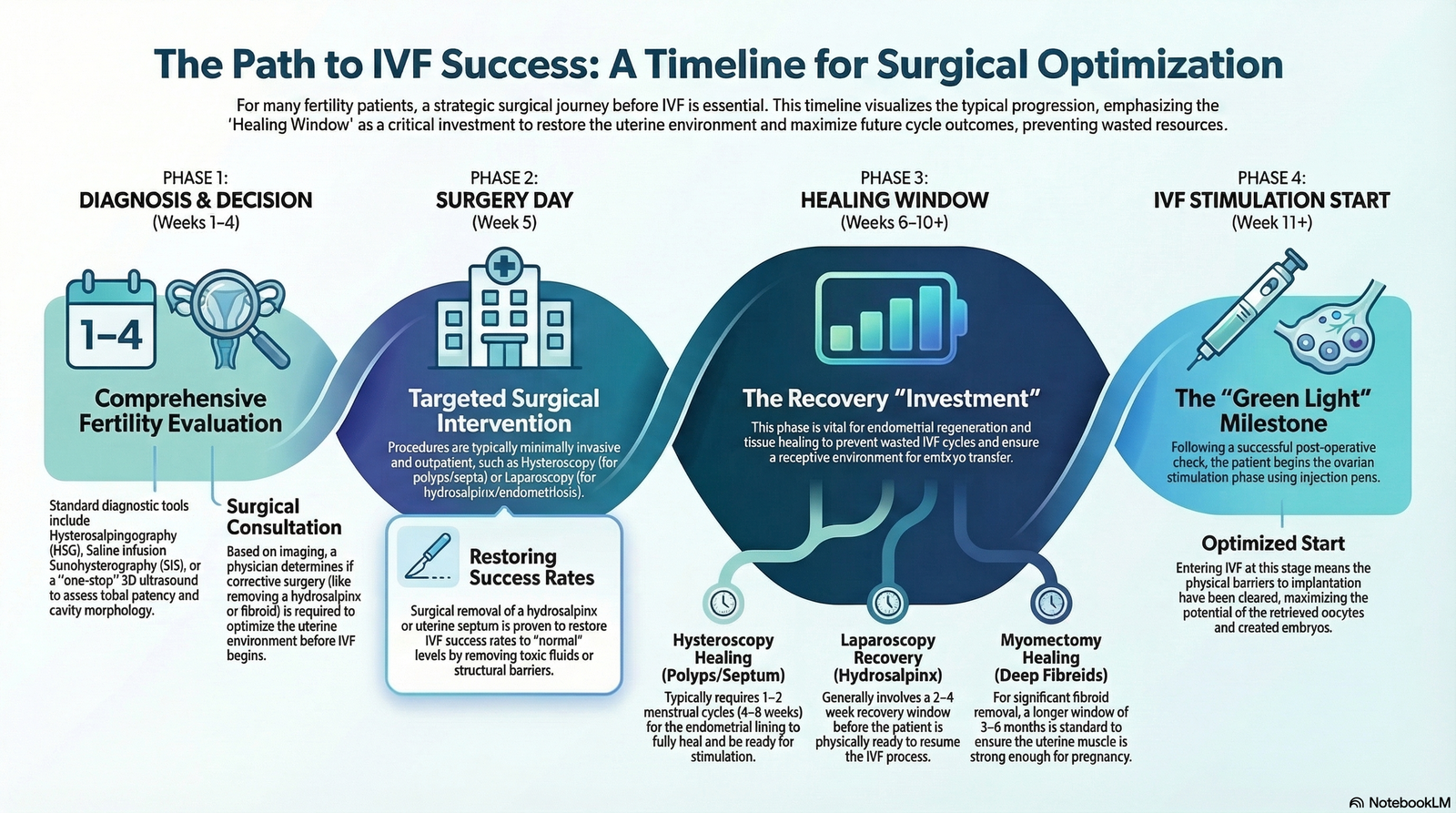
Typical timeline from diagnosis to surgery, healing, and IVF treatment start.
The “Toxic” Tube: Hydrosalpinx and Tubal Surgery
If you have been told you have a hydrosalpinx, you might think it does not matter because IVF bypasses the tubes. In reality, that damaged tube often leaks fluid back into your uterus. That fluid can wash an embryo out, change the lining, and act like a toxin.
Studies show that untreated hydrosalpinx lowers IVF pregnancy, implantation, and delivery rates by about 50%. When your doctor sees a clear hydrosalpinx on ultrasound, removing the tube before IVF can raise delivery rates from about 18% without surgery to about 40% with surgery.
If you are not comfortable with tube removal, your doctor can block the tube where it meets the uterus. Both methods bring IVF results closer to women without tubal disease. Some clinics try to drain the tube with a needle during egg retrieval, but the fluid often comes back quickly.
If your scan shows hydrosalpinx, it is worth having a focused talk with your specialist before you use valuable embryos for transfer.
Key decision point: fix tubes first, or go straight to IVF
If your tubes are healthy but blocked near the uterus, IVF alone can work well. If your tubes are swollen with fluid, leaving them in place can cut IVF success in half. This is one of the clearest situations where surgery changes numbers in a big way. When you look at costs and time, repairing or removing a toxic tube before IVF often saves you repeated failed cycles later.
Hysteroscopy, Myomectomy, Septum Surgery, and Adhesions
Hysteroscopy: a direct look inside the uterus
If you are wondering whether anything is hiding inside your uterus that could block an embryo, hysteroscopy gives you and your doctor a clear answer. During hysteroscopy, your doctor places a thin camera through the cervix and looks directly inside the cavity, with no cuts on the abdomen.
Standard transvaginal ultrasound picks up many cavity problems, but it still misses some. Hysteroscopy reaches very high accuracy for polyps, fibroids that poke into the cavity, and scar tissue. Your doctor can often do this procedure in the office with a small scope. Many women describe it as similar to a Pap smear or speculum exam.
Operative hysteroscopy lets your doctor treat what they find in the same session. This can include removing polyps, trimming small fibroids, removing misplaced sutures or devices, and spotting features that point to chronic inflammation of the lining.
Myomectomy: removing fibroids that block implantation
Fibroids are extremely common. Many never affect fertility. Others sit in exactly the wrong place and make implantation more difficult.
Submucosal fibroids that grow into the cavity have the biggest impact. They can cut IVF pregnancy rates by up to 70%. Removing them with hysteroscopic myomectomy often doubles pregnancy rates.
Intramural fibroids in the muscle wall cause more debate. Many doctors suggest removing fibroids over 3 to 4 cm that press on the cavity or distort its shape. Subserosal fibroids on the outside of the uterus rarely affect IVF, so doctors do not usually remove them just for fertility reasons.
Septum resection: opening a divided cavity
A uterine septum is a wall that divides the cavity partly or fully. It is common among women with infertility or repeated loss. The septum often has a poor blood supply, which makes implantation and growth harder.
Hysteroscopic metroplasty uses a small camera and scissors or an electrical loop to cut the septum under direct vision. In one trial of women with unexplained infertility, treating the septum improved pregnancy rates from about 20% to almost 39%, and live birth rates from about 19% to 34%.
Adhesiolysis: freeing scar tissue inside the uterus
Intrauterine adhesions, also called Asherman syndrome, are bands of scar tissue that stick the walls of the uterus together. They often follow curettage, infection, or a complicated delivery. If you have very light periods or no periods after a procedure, adhesions may be the reason.
Hysteroscopic adhesiolysis carefully cuts and removes these bands. Reported pregnancy rates after surgery range from about 32% to 81%. In women with recurrent pregnancy loss, live birth rates rose from about 18% to about 64% after treatment.
| Treatment technique | Main goal | Key outcome comparison |
|---|---|---|
| Salpingectomy for hydrosalpinx | Remove toxic tubal fluid | Delivery rate about 40% with surgery vs about 18% without |
| Myomectomy for cavity fibroids | Restore smooth uterine cavity | Pregnancy rate around 49% to 57% after surgery |
| Septum resection | Open divided uterine cavity | Live birth about 34% after surgery vs about 19% before |
| Adhesiolysis in Asherman syndrome | Free scar tissue inside the uterus | Live birth about 64% after surgery vs about 18% before |
| Ovarian drilling for PCOS | Restart regular ovulation | Ovulation restored in about 80% of resistant cases |
Seeing these numbers side by side helps you decide where surgery offers a clear return on the time, risk, and cost you take on before IVF.
PCOS, Ovarian Drilling and Other Laparoscopic Procedures
Laparoscopy: looking around the pelvis
While hysteroscopy looks inside the uterus, laparoscopy lets your doctor look around the uterus, ovaries, and pelvis. If you are dealing with pain, suspected endometriosis, or unexplained infertility, this procedure is often the best way to see what is really happening.
Your surgeon makes a few small cuts, places a camera through the belly button, and fills the abdomen with gas to create space. Thin instruments go in through the other small cuts. In one group of women being worked up for IUI, laparoscopy changed the planned treatment in about a quarter of cases.
Some centers also use single-site surgery through the belly button. The results may appear better from the outside. Some women do feel more shoulder tip pain afterwards, so it is worth asking about comfort as well as cosmetic results.
Ovarian drilling as a second-line option
If you have PCOS and you are not ovulating on pills like letrozole or clomiphene, your doctor may offer strong injectable hormones, surgery, or both. Laparoscopic ovarian drilling gives you a lower drug option.
During drilling, the surgeon uses a needle or laser to make several tiny punctures in each ovary. This lowers high androgen levels and helps your brain and ovaries restart a more normal cycle. About 80% of women restart regular periods and ovulation after drilling. In one long-term series, about three-quarters of women still ovulated 20 years later.
Compared with strong injections, drilling lowers the risk of twins, triplets, and ovarian hyperstimulation. If you want to avoid daily shots and frequent blood tests, you can ask whether drilling is a good fit for your age, weight, and egg reserve.
How laparoscopic surgery supports IVF rather than replaces it
It can feel as if surgery delays IVF, but for many women, it actually protects each future cycle. When laparoscopy removes deep endometriosis or frees ovaries from dense adhesions, your doctor often retrieves more eggs, your pain improves, and your quality of life rises. When you see surgery framed as a way to make every later retrieval and transfer count more, the timing makes more emotional sense.
Is Fertility Surgery Right for You?
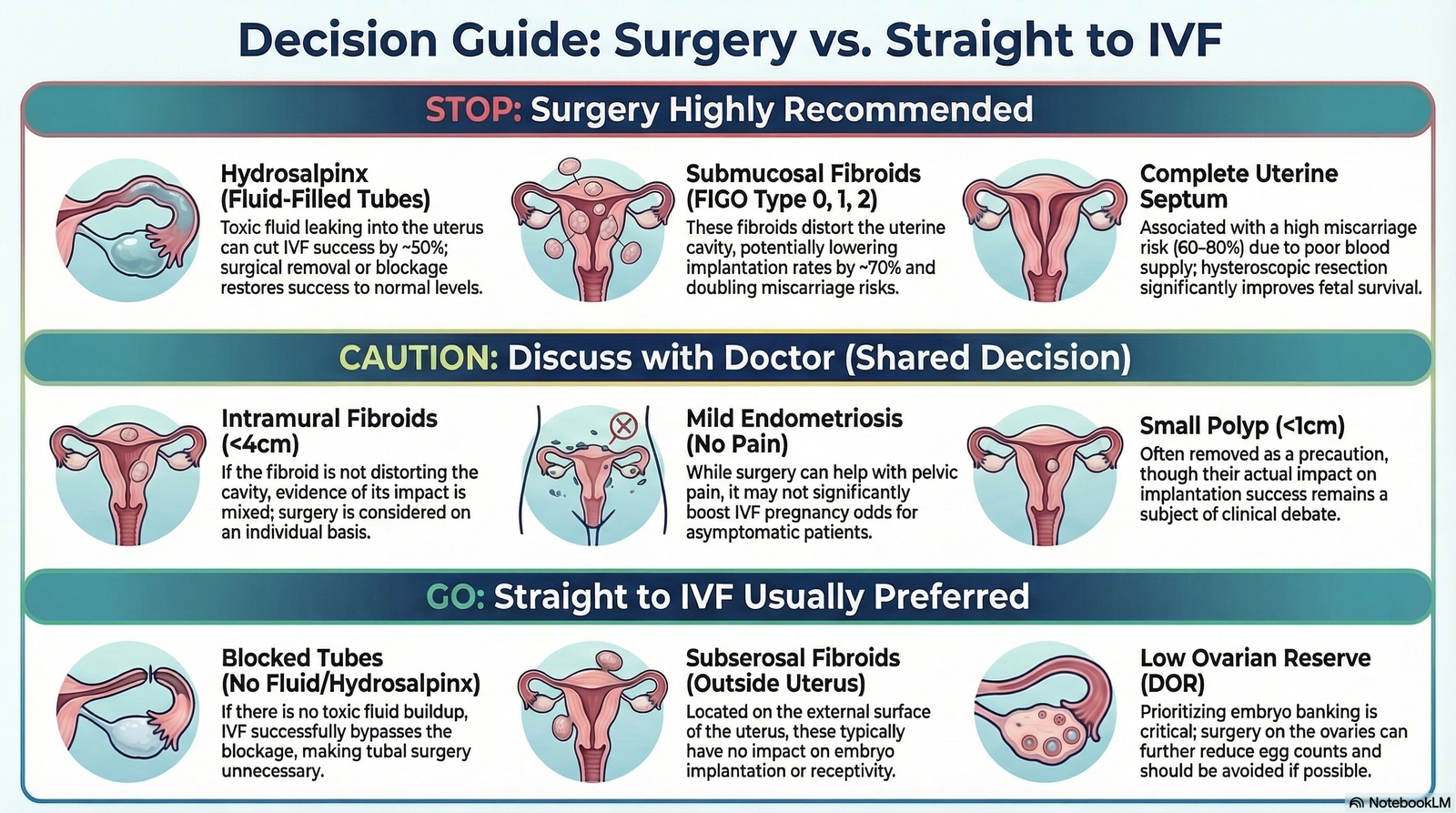
When surgery can move the needle on your IVF success, and when you may go straight to treatment.
When surgery is clearly helpful
Surgery is most clearly helpful when testing shows a direct, physical barrier between your embryo and a healthy pregnancy. Examples include a hydrosalpinx, fibroids that distort the uterine cavity, a strong uterine septum, or dense adhesions inside the uterus.
In these situations, the change in outcome is large enough to make the extra step worthwhile. You move from very low or unstable chances into a far more hopeful range. Treating these issues often turns repeated failed cycles into a realistic chance of success.
When surgery is more of a grey zone
Some decisions are less clear. Intramural fibroids that do not quite reach the cavity, mild endometriosis without pain, or a small septum in a woman who has never tried to conceive fall into this group.
In these cases, evidence is mixed. Your doctor should walk you through the possible upside, the risks of adhesion or loss of ovarian tissue, and the cost. Together, you can decide whether surgery or moving ahead to IVF first fits your values and time frame better.
OVU expert guidance on making your decision
If you feel stuck between doing more tests and getting on with IVF, focus on three questions. First, does this surgery resolve a problem that clearly lowers my odds? Second, how much does it change my numbers in real terms, not just in theory? Third, what do I gain or risk in money, time, and recovery? When your specialist can answer these questions transparently, you are ready to choose with confidence instead of fear.
Want help comparing clinics and costs?
If this feels like a full-time job, and honestly it can, our advisors can collect clear, itemized quotes from verified clinics and map your timeline at no cost to you.

Why trust this guide? The OVU commitment
You are probably juggling hope, timelines, and a lot of tabs open in your browser. And you deserve clear, current, human advice. At OVU, we review clinic protocols, compare real quotes, and talk to people who have done this - intended parents and gestational carriers - so we can give you practical steps, not just theory. If you want help comparing options without sales pressure, we will gather itemized quotes and success data that match your exact situation. You decide, we will bring the info to your table.
Frequently Asked Questions
Is fertility surgery painful?
Most diagnostic procedures, such as office hysteroscopy, cause mild to moderate discomfort, similar to a Pap smear. Larger procedures take place under anesthesia, so you do not feel pain during the operation. You can expect some cramping and tiredness afterward. Many women go back to work and daily tasks within 1 to 2 weeks, depending on the procedure and their job.
How long should I wait after surgery before starting IVF?
The wait depends on the type of surgery. After a simple hysteroscopic septum resection, many women can start IVF within about 9 weeks. After a myomectomy that cuts deep into the muscle, doctors often suggest waiting 3 to 6 months so the uterus can heal. Your surgeon will give you a timeline based on how much they had to remove and how they closed the uterus.
Does removing a tube or stripping a cyst lower my egg count?
Removing a tube for hydrosalpinx usually does not change how your ovaries respond during IVF. Surgery on an ovarian cyst is different. Stripping an endometrioma can remove some healthy ovarian tissue along with the cyst wall. To reduce this risk, many surgeons now use partial stripping with gentle energy sources to spare more follicles. If you already have a low egg reserve, make sure you discuss the procedure carefully before any ovarian surgery.
Can I deliver vaginally after a myomectomy?
Many women have vaginal births after myomectomy. The main concern is uterine rupture during labor. The overall risk is low, usually under 1%, but it depends on how deep and extensive your prior surgery was. Your obstetrician may recommend a planned C-section if you have had many fibroids removed, deep cuts into the wall, or an entry into the cavity.
Why do fibroids or adhesions sometimes come back after surgery?
Fibroids grow from hormone-sensitive muscle cells. Even after a clean myomectomy, new fibroids can appear over time. Recurrence rates reach about 51% to 62% at 5 years in some series. Adhesions can also return, especially after severe Asherman syndrome. To lower this risk, surgeons may use anti-adhesion gels, balloons, or an IUD after surgery and schedule a second-look hysteroscopy.
Is robotic surgery worth the extra cost for fertility problems?
Robotic tools help most in very complex cases, such as deep endometriosis or difficult myomectomies, where fine suturing or deep pelvic work matters. In these settings, the higher upfront cost can still lead to a similar or lower cost per baby because of strong success rates and fewer complications. For simpler procedures, standard laparoscopy usually works just as well at a lower price.
Should I have a laparoscopy even if my tests look normal?
There is no single right answer here. Some doctors point out that in women with unexplained infertility and normal imaging, laparoscopy still finds endometriosis or adhesions in up to 30% of cases and can treat them on the spot. Others prefer to move straight to IVF to save time. Your age, symptoms, budget, and tolerance for surgery all play into this choice. A detailed talk with your specialist can help you decide.
Reference List 7 sources
Journal Article (Research): Strandell A, Lindhard A, Waldenström U, Thorburn J, Janson PO, Hamberger L, et al. Hydrosalpinx and IVF outcome: a prospective, randomized multicentre trial in Scandinavia on salpingectomy prior to IVF. Human Reproduction. 1999;14(11):2762–2769. PMID: 10548619. Available from: https://pubmed.ncbi.nlm.nih.gov/10548619/
Journal Article (Systematic Review & Meta-Analysis): Johnson N, van Voorst S, Sowter MC, Strandell A, Mol BW. Surgical treatment for tubal disease in women due to undergo in vitro fertilisation. Cochrane Database of Systematic Reviews. 2020;10:CD002125. PMID: 33091963. Available from: https://pubmed.ncbi.nlm.nih.gov/33091963/
Committee Opinion (Guidance): Practice Committee of the American Society for Reproductive Medicine. Role of tubal surgery in the era of assisted reproductive technology: a committee opinion. Fertility and Sterility. 2021;115(5):1143–1150. PMID: 33642065. Available from: https://pubmed.ncbi.nlm.nih.gov/33642065/
Journal Article (Systematic Review & Meta-Analysis): Lensen S, Armstrong S, Gibreel A, Nastri CO, Raine-Fenning N, Martins WP. Endometrial injury in women undergoing in vitro fertilisation. Cochrane Database of Systematic Reviews. 2021;6:CD009517. PMID: 34110001. Available from: https://pubmed.ncbi.nlm.nih.gov/34110001/
Guideline (Patient Information): European Society of Human Reproduction and Embryology. Information for women with endometriosis. ESHRE Guideline Document. 2022. Available from: https://www.eshre.eu/-/media/sitecore-files/Guidelines/Endometriosis/ESHRE-ENDOMETRIOSIS-patient-Guideline_21032022.pdf
Committee Opinion (Guidance): Practice Committee of the American Society for Reproductive Medicine. Evidence-based diagnosis and treatment for uterine septum: a guideline. Fertility and Sterility. 2024; Published as ASRM Practice Guideline. Available from: https://www.asrm.org/practice-guidance/practice-committee-documents/evidence-based-diagnosis-and-treatment-for-uterine-septum-a-guideline-2024/
Committee Opinion (Guidance): American College of Obstetricians and Gynecologists. Management of symptomatic uterine leiomyomas. Practice Bulletin No. 228. Obstetrics & Gynecology. 2021;137(6):e100–e115. Available from: https://www.acog.org/clinical/clinical-guidance/practice-bulletin/articles/2021/06/management-of-symptomatic-uterine-leiomyomas
Final Thoughts
If you are reading this, you probably feel the weight of every month that passes. It is normal to worry that you might miss a key step or choose the wrong path. We understand how much is at stake for you and your family.
Fertility surgery is not a sign that IVF has failed. It is one of the tools that helps your body and your embryos meet halfway. When you remove a toxic tube, open a scarred cavity, or trim down a septum, you are not just doing more. You are making sure that when your embryo arrives, it finds a uterus that can welcome and hold it.
You deserve clear explanations, real numbers, and a plan that fits your body and your life. When you meet with your doctor, try asking, “Which specific surgery, if any, would really change my chances, and by how much”? That kind of honest answer can give you the confidence you need to take your next step, even when the road feels long.
Related articles

Male Fertility Surgery: TESE, Micro-TESE, and Sperm Retrieval
Male Fertility & Andrology Your guide to male fertility surgery and sperm retrieval options Last Updated: 03 July 2026 Medically Reviewed 16 min read Evidence-based The road to fatherhood often feels steep when you hear the word “infertility”. It is frustrating, lonely, and sometimes scary. At the same time, modern fertility medicine now gives many men a real chance to have a biological child, even when the semen analysis shows no sperm at all. Non-obstructive azoospermia (NOA) means there is no sperm in the ejaculate because the testicles are not making enough mature sperm. This affects about 1% of men
19 min read
What is Time-Lapse Imaging? Watching Embryo Development 24/7
IVF & Fertility Treatments Your guide to time-lapse embryo imaging in IVF Last Updated: 30 June 2026 Medically Reviewed 14 min read Evidence-based Wondering if watching your embryos grow around the clock is worth the extra money? You are not the only one asking that. For years, your clinic could only check embryo growth a few times a day, like peeking at single snapshots in a photo album. Time-lapse imaging (TLI) changes that. Instead of a few snapshots, your embryos get their own continuous movie. A small camera inside the incubator records images every few minutes while your embryos stay
17 min read
Fresh vs. Frozen Embryo Transfer: Which Has Higher Success?
IVF & Fertility Treatments Your guide to fresh vs. frozen embryo transfer , part of our Complete IVF Guide Last Updated: 27 June 2026 Medically Reviewed 17 min read Evidence-based If you are choosing between a fresh or frozen embryo transfer, you are not simply deciding between two buttons on a screen. You are choosing the environment where your body and your future baby first meet. This can feel like a heavy burden to carry when you are already overwhelmed by the weight of appointments, lab bills, and hormone shots. The central question in this choice is whether to transfer
20 min read