


Dr. Sony Sherpa (MBBS)
In addition to her clinical experience, Dr. Sherpa is a published medical researcher and holistic health advocate. Her dual expertise in emergency care and alternative therapies brings a unique lens to medically reviewed content—ensuring it is both accurate and accessible.
Parenthood is not always a straightforward journey. For many, it involves detours, delays, and heartbreak long before the words ‘egg donor’ or ‘sperm donor’ are even mentioned. Whether you are coping with infertility, which affects about 15% of couples globally, or you are a solo parent or LGBTQ+ individual starting your family, the process is emotionally and physically demanding. It’s important to remember that you have powerful options, ranging from intrauterine insemination (IUI) to IVF with donor eggs or sperm.
In 2026, donor matching is more structured, transparent, and personal than ever before. Choosing a donor is a significant medical decision, but it’s also a deeply personal one. You are weighing a blend of physical traits (considering what your baby might look like), ethnicity, and cultural heritage. You’re also looking at genetic makeup, whether you want a donor with a similar profile to your own or simply one whose screening eliminates serious hereditary conditions and chronic health risks. Balancing all these factors can feel overwhelming, but you don’t have to navigate them alone.
If you are feeling overwhelmed or scared about making the wrong choice, you are not alone. Many people describe this stage as the moment when grief over genetics meets real hope for a baby. Our goal is to give you clear, patient-focused information, grounded in current data and major professional guidelines, so you can move forward feeling informed rather than pushed.
Donor conception in 2026 is safe, rigorously screened, and often offers higher success rates than using your own gametes, especially for those at more advanced reproductive ages. Current data shows fresh donor egg transfers lead to a live birth in about 53% to 55% of cases, while frozen donor egg cycles average around 47%. For those using both donor eggs and sperm (double donation), the cumulative success rate can reach up to 94% over three cycles.
The Success Rate Nuance: While these “per-transfer” numbers are encouraging, the real power of donor conception lies in the cumulative probability of achieving a viable pregnancy after the transfer. Because donors are typically in their peak reproductive years, one cycle often results in multiple high-quality embryos, allowing for several attempts or future siblings from a single match. Your best choice depends on your medical history, budget, and how much you prioritize matching physical traits and heritage.
Next step: identify your “must-haves” (e.g., ethnicity, genetic health, specific heritage, or budget), then schedule a consultation with a donor coordinator to explore which program aligns with those priorities.
What the Latest Research Shows
Large donor egg programs report live birth rates of about 50% per transfer and even higher cumulative rates over several cycles. National registry data from the United States show that frozen donor eggs now perform close to fresh in terms of healthy term births, while donor sperm studies find no overall increase in most pregnancy or newborn complications compared with partner sperm.
Professional guidelines from groups such as the American Society for Reproductive Medicine (ASRM) and the European Society of Human Reproduction and Embryology (ESHRE) set strict rules for screening donors for infections, genetic conditions, and mental health concerns. Expanded genetic carrier screening and preimplantation genetic testing help lower the risk of serious inherited disease in donor-conceived children.
This guide focuses on how you can use these facts in real decisions about donors, clinics, and budgets, rather than asking you to decode technical papers on your own.
In This Guide
- Quick Facts: Donor Conception at a Glance
- The Egg Donation Process Step-by-Step
- How Sperm Donor Programs Work
- Embryo Donation as a Lower-Cost Option
- Choosing by Ethnicity and Heritage
- Global Donor Pool and Diversity Gaps
- Anonymous vs. Identity-Release Donors in 2026
- Known vs. Nonidentified Donors
- Ethics, Limits, and Donor Responsibilities
- Safety, Screening, and Infections
- Genetic Compatibility Testing (GCT)
- Why Embryo Testing Matters
- Modern Matching Platforms and Premium Donors
- Fresh vs. Frozen Donor Eggs
- Bundles, Cryoshipping, and Traveling Donors
- Guarantees on Eggs and Embryos
- Real Donor Costs and How to Plan
- Law, Policy, and Who Can Access Treatment
- Your Timeline From Consultation to Pregnancy Test
- Frequently Asked Questions
- Final Thoughts and Next Steps
- Fresh donor eggs: about 53.5% to 55.3% live births per transfer.
- Frozen donor eggs: about 46.7% live births per transfer.
- Using a donor egg and donor sperm to create an embryo can reach about a 94% cumulative pregnancy rate over three cycles.
- Embryo donation live birth rate is around 41.8% per transfer.
- Fresh donor eggs in the United States: about $35,000 to $65,000 total. For frozen donor eggs in the United States, costs typically range from $13,000 to $21,000, which may include a guarantee of at least one viable blastocyst. Including shipping fees to a local clinic, the estimated starting cost for a frozen egg cycle is approximately $22,000.
- Fresh donor eggs in Europe: about €3,790 and can range up to €17,500 for multi-cycle programs with a live birth guarantee. Frozen donor eggs in Europe cost €3,500 for mini-bundles with a one-blastocyst guarantee and full cycles ranging from €4,750 to €7,900. Shipped cohorts of six unfertilized oocytes can range from €6,000 to €19,000, including agency and shipping fees.
- Sperm vials: about $500 to $2,000 each, frozen eggs from about $21,000.
Quick Facts: Donor Conception at a Glance
Before you dive into the details of contact forms and donor profiles, it helps to step back and look at the big picture. These are the core considerations most aspiring parents explore first when determining how donor conception aligns with their values, preferences, goals, and lifestyle.
- Egg donor age range: Most programs prioritize donors between 21 and 29, though the industry standard extends to 34. At this age, donors usually respond optimally to ovarian stimulation, producing high-quality oocytes with a much higher probability of developing into euploid (chromosomally normal) embryos.
- Sperm donor age range: Most banks accept donors from 18 to around 39 years old. Some keep donors a bit older, up to 45, if their sperm quality stays strong.
- Success rates: On average, fresh donor egg transfers result in a live birth rate of 53.5% to 55.3% per transfer. Frozen donor egg cycles follow closely with a live birth average of about 46.7%, offering a highly effective and more flexible alternative for many intended parents.
- Double donation: When you use both donor eggs and donor sperm, the cumulative pregnancy rate can reach approximately 94% over three cycles.
- The 3% Rule: Why Donor Acceptance Rates are So Low: The donor selection process is exceptionally strict to ensure the highest health and safety standards. Only about 9% of sperm donor applicants and 22% of egg donor applicants receive acceptance in many programs. At some high-end agencies, the acceptance rate often drops below 3% after accounting for comprehensive genetic carrier screening, psychological evaluations, and physical health assessments.
- In-house vs. egg banks: Clinics managing their own donor programs typically yield between 15 and 25 eggs per fresh cycle. In contrast, egg banks generally provide frozen eggs in cohorts of 6 to 8. Some banks now offer “mini-bundles” of 2 to 3 vitrified oocytes; these serve as a more sophisticated, targeted, or budget-friendly option, especially for those prioritizing a specific rare ethnicity or a premium donor profile.
Research Insights on Donor Eggs and Sperm
50% Live Birth Rate – Donor Egg Power: Large donor egg programs report live birth in about 4 to 5 out of every 10 transfers, even when many recipients are over 40. This means that if your own egg quality is low, transitioning to IVF with donor eggs can boost your chances of bringing home a baby. Source: JBRA Assisted Reproduction (PMID: 37014939).
75% Term-Healthy Births – Fresh vs Frozen Eggs: A national United States study of more than 135,000 donor egg transfers found that about 3 in 4 single babies were born at term and at a healthy weight in both fresh and frozen donor egg cycles. Live birth rates were a bit higher with fresh donor eggs, but baby health at birth was similar. This lets you focus more on clinic quality and timing than on stressing about fresh versus frozen. Source: Fertility and Sterility (PMID: 38986758).
1.3 Million IVF Cycles – Donor Sperm Safety: An analysis of more than 1.3 million IVF cycles found that pregnancies conceived with donor sperm had slightly lower chances of very early loss and ectopic pregnancy compared with partner sperm. This reinforces the notion that carefully screened donor sperm serves as a medically reassuring option, rather than a final resort. Source: Human Reproduction (PMID: 36961939).
Guidance Backed by Multiple Societies: ASRM, ESHRE, and other bodies all recommend structured screening for donors and, when possible, genetic carrier testing. Their guidance shapes the clinic policies you will encounter. Source: ASRM Practice Committee guidance on gamete and embryo donation (PMID: 33838871).
These findings give you a data-based foundation. The rest of the article helps you translate those numbers into practical decisions.
The Egg Donation Process Step-by-Step
If you are thinking about using donor eggs, it helps to know what actually happens behind the scenes. This can make the process feel less mysterious and easier to talk about with your partner or family.
In a fresh donor cycle, your uterus and the donor’s ovaries need to be on the same rough schedule. Your doctor prescribes hormones to build your uterine lining so it is ready when the embryos are created. At the same time, the donor takes hormone injections for about 8 to 12 days. These medications stimulate her ovaries to grow many follicles instead of just one.
When enough follicles reach about 18 to 20 millimeters, the donor gets a single “trigger shot” of hCG to mature the eggs. Around 34 to 36 hours later, she has an egg retrieval. This is a short, minimally invasive procedure performed under sedation. The doctor uses a thin ultrasound-guided needle to gently suction the follicles and collect the eggs. Most donors go home the same day and feel back to normal within a few days.
With frozen donor eggs, all of this has happened earlier. The eggs were collected and then frozen using vitrification, a “flash freezing” method that prevents ice crystals from forming inside the egg. More than 90% of vitrified donor eggs survive thawing in good labs. Frozen eggs are ready when you are, and you don’t have to be on the same schedule as the donor, but you usually get fewer eggs and embryos than in a fresh cycle.

Donor conception timeline, from matching and legal paperwork to egg retrieval, embryo creation, and embryo transfer.
| Option | Typical Eggs or Embryos | Live Birth Rate per Transfer | Key Advantages |
|---|---|---|---|
| Fresh donor eggs | 10 to 20 eggs, several good-quality embryos | About 53.5% to 55.3% | More embryos, better chance for having siblings |
| Frozen donor eggs | 6–8 eggs per cohort | About 46.7% | On-demand availability, simpler process and optimal timing |
| Embryo donation | 1 to 3 embryos per match | About 41.8% | Lower cost, no stimulation is required |
| Double donation | Varies, often several good-quality embryos are created within a single IVF cycle | Up to 94% cumulative success rate is achieved over 3 cycles | Best odds when both egg and sperm are affected |
If you feel stressed by the medical details, remember that your clinic coordinates these steps for you. Your main job is to understand the big trade-offs: fresh versus frozen eggs, your budget, and how many children you hope to have in the future.
How Sperm Donor Programs Work
If you are looking at sperm banks for the first time, the catalogue can feel like a blend of a deep-dive biography and a detailed lab report. Once you know what the categories mean, it becomes much easier to focus on what matters to you.
Like egg donors, sperm donors undergo a comprehensive vetting process that includes in-depth interviews, background checks, and psychological evaluations, alongside rigorous medical exams and genetic testing. Modern donor banks recruit healthy applicants from diverse professional backgrounds and communities. They analyze health history across multiple generations, evaluating lifestyle factors and personal values to ensure a holistic match for future parents.
When you browse the donor database, you will usually see three main vial types:
- ART or IVF vials: More than 1 million motile sperm. Used for IVF or ICSI, where the lab places sperm directly with or into the egg.
- Premium vials: More than 10 million motile sperm. Often used for IUI at a clinic.
- Platinum vials: More than 20 million motile sperm. High-concentration vials are often chosen for IUI or specific protocols.
To ensure the highest level of protection, banks typically “quarantine” donor vials for 180 days. After this period, the donor is retested for infectious diseases, including HIV and hepatitis, to account for any potential window periods. Vials are only released for use once both sets of tests are confirmed clear. This rigorous double-check serves as a primary layer of safety for you and your future family.
Embryo Donation as a Lower-Cost Option
Embryo donation gives you embryos from someone who has finished their own treatment and does not plan to use them. You still carry the pregnancy yourself, but you do not go through stimulation, egg retrieval, or fertilization.
In the United States, recent clinical data show that approximately 41.8% of embryo donation transfers resulted in a live birth. Clinics often suggest this option when both partners experience infertility issues, when treatment with your own eggs and sperm has failed several times, or when you want to avoid passing on known genetic conditions. Additionally, it is a highly effective and accessible option for solo parents and LGBTQ+ individuals seeking an alternative to traditional egg or sperm donation.
Most donated embryos are frozen at the blastocyst stage (day 5 or 6), which tends to give higher implantation chances than earlier-stage embryos. This option can feel emotionally complex because you are using embryos created by another family, but for many patients, it is the most realistic path to parenthood.
Choosing by Ethnicity and Heritage
For many people, it matters that their child can see something of their own background when they look in the mirror. You may want your child to share your skin tone, hair texture, facial features, or cultural roots. Modern donor databases let you search by ethnicity, country of origin, and sometimes even region.
- Asian heritage: Donors may be listed as Chinese, Japanese, Korean, Filipino, Indian, Pakistani, Nepali, and many others.
- Black and African heritage: You may see African American donors, Afro-Caribbean donors, or donors from specific African countries.
- Hispanic and Latina heritage: Donors may identify as Mexican, Cuban, Colombian, Brazilian, or from other Latin American backgrounds.
- European heritage: Profiles often list Irish, Italian, Greek, Scandinavian, or Eastern European roots.
When you choose a donor with a similar background, you protect not only physical resemblance but also family traditions and language that you may want to share with your child. There is no “right” choice here. Some families prefer a close match, and others focus almost entirely on health and personality.
Global Donor Pool and Diversity Gaps
The internet and cryoshipping make it possible to work with donors across borders, but supply is not equal. Some countries underrepresent certain ethnic groups. For example, Asian donors are a small share of the donor pool in the UK relative to the number of Asian patients.
Large international cryobanks and agencies try to fill these gaps by recruiting in multiple countries. You will also see more multiracial donors, which can be a good fit if you and your partner have different backgrounds and want donor genetics that reflect both sides of the family.
Anonymous vs. Identity-Release Donors in 2026
If you are worried about anonymity, you are not overthinking it. This is one of the most emotional parts of donor choice for many parents.
With the rise of DNA testing, donor-conceived individuals who wish to explore their genetic origins can often find that information later in life, regardless of the original agreement. As a result, industry language is evolving. You will now see terms like “nonidentified” or “non-ID release” instead of “anonymous.” Simultaneously, more countries and clinics are moving toward identity-release (Open ID) programs, which prioritize the child’s future right to access information about their donor.
In countries such as the UK, Sweden, Germany, and the Netherlands, donor-conceived adults can request identifying information about their donor at age 18. The goal is to support the long-term well-being of the child, including their need to understand where they come from. When you choose an open-ID donor, you are giving your future child the option to receive information or contact details later, while you still remain the legal parent.
Known vs. Nonidentified Donors
If you are deciding between a known donor and a donor from a bank or agency, it helps to think about boundaries and long-term relationships, not just the associated cost of the treatment bundle you select.
- Directed (known) donors: This might be a friend or relative. You may like the idea of a genetic link, for example, using your partner’s sibling as a sperm donor so the child still shares DNA with the non-bio parent. You might also lower some direct donor costs. At the same time, you need clear legal agreements and honest conversations. Without that, there is real potential for tension about parenting roles, holidays, and decision-making.
- Nonidentified donors from a bank or agency: These donors give you a wider pool to choose from and a more formal legal setup. You pay more in fees, but the boundaries are defined in advance, and there is well-established case law supporting your parental rights.
Ethics, Limits, and Donor Responsibilities
Most parents worry about how many children can be born from a single donor. This concern is valid and part of the reason professional groups set limits.
- United Kingdom: Limit of 10 families per donor.
- Spain: Limit of 6 live births per donor.
- United States: ASRM suggests a cap of 25 births per 800,000 population, but tracking is based on guidance rather than strict law.
Another ethical cornerstone is that donors are not parents. Contracts make clear that you, not the donor, have the legal and practical responsibilities. The donor does not have parental rights or duties toward your child. This clarity protects you, your child, and the donor from legal hurdles and confusion in the future.
How Guidelines Protect You and Your Child
Strict Screening Standards – Official Guidance: ASRM’s gamete and embryo donation guidance outlines detailed requirements for infection screening, genetic testing, psychological evaluation, and record-keeping. This serves as the regulatory blueprint for the clinic policies you encounter when selecting any donor service or egg/sperm bundle. Source: ASRM Gamete and Embryo Donation Guidance.
Monitoring Pregnancy Outcomes – Safety Lens: Large studies compare births from donor sperm and donor eggs with other IVF pregnancies. While some risks shift slightly, most outcomes are broadly similar, and serious complications remain uncommon. This ongoing research helps clinics adjust protocols rather than leaving you in the dark.
When you choose a regulated clinic or bank, you are stepping into a system built around these ethical and safety rules, not starting from scratch on your own.
Safety, Screening, and Infection Testing
Choosing a donor involves a deep level of trust, and it is natural to prioritize safety above all else, even when selecting a premium donor bundle. To address these vital concerns, reputable clinics and banks utilize transparent, pre-established vetting programs. These protocols minimize risks through multiple layers of clinical and psychological screening for every applicant wishing to donate their eggs or sperm.
Donors go through physical exams, mental health checks, and detailed family history reviews. They also complete a large panel of lab tests. Typical testing includes:
- Infectious diseases: HIV, hepatitis B and C, syphilis, HTLV I and II, chlamydia, and gonorrhea.
- Other STIs: Many panels also check for Mycoplasma, Trichomonas, and other infections linked to pregnancy or newborn complications.
- Exclusion factors: Current drug use, heavy smoking, alcohol addiction, and a strong family history of serious mental illness usually lead to rejection.
When you choose a reputable clinic or bank, you are entering a system designed to keep your risk low, even though no medical process can be risk-free.
Genetic Compatibility Testing (GCT)
Most healthy people carry at least one recessive genetic condition without knowing about it. The main risk for your baby appears when both you and the donor carry the same recessive condition.
Genetic compatibility testing compares your genes and the donor’s genes to see whether you both carry the same recessive condition. In 2026, many programs use expanded carrier screening based on next-generation DNA sequencing (NGS). These tests can identify from 600 to more than 3,000 of the most common recessive genetic disorders, such as cystic fibrosis and spinal muscular atrophy.
When clinics avoid high-risk pairings, the chance of having a child with one of these severe conditions drops to a very low level. This testing adds cost and time, but for many families, it brings peace of mind that is worth it.
Why Embryo Testing Matters
Beyond the initial genetic compatibility matching, clinics can perform Preimplantation Genetic Testing (PGT) directly on the embryos to optimize transfer success. This typically involves three main approaches.
Preimplantation genetic testing (PGT) usually comes in two main forms:
- PGT-A: Screens for the correct number of chromosomes to identify embryos with the highest potential for successful implantation and healthy development.
- PGT-M: Targets specific single-gene disorders if a known risk has been identified in either your genetic history or the donor’s.
- PGT-SR: Tests for chromosomal structural rearrangements (like translocations or inversions). This is particularly valuable if a parent or donor is a known carrier of a rearranged chromosome, which can otherwise lead to recurrent pregnancy loss.
By selecting embryos with these confirmed genetic profiles, clinics can reduce miscarriage risks and improve the probability of a live birth. Your clinical team will help you determine which tests add the most value to your journey, especially when using young donor eggs, where chromosomal health is already statistically high.
Modern Matching Platforms and Premium Donors
If you are just opening donor profiles, the volume of information can feel like too much. To make this easier, many clinics and agencies now use matching platforms that organize donors by medical details, appearance, education, and personal traits.
Profiles may include childhood and adult photos, short videos, audio clips, and written answers to personal questions. This helps you get a sense of how a donor carries herself or himself, not just a list of lab values. In some programs, donors also agree to the match before it moves forward, which many parents find reassuring.
When you see labels like “premium donor,” it usually means a tighter filter, not different basic safety rules. Premium donors often have:
- Previous donations that resulted in live births.
- Advanced education, sometimes from very selective universities.
- Specific talents or achievements that agencies expect many parents will value.
Because of the strict criteria, acceptance rates can fall below 3% at some agencies. Fees are higher for these donors, so it is worth asking yourself which traits actually matter to you and which are marketing extras.
Fresh vs. Frozen Donor Eggs
If you are debating fresh versus frozen eggs, the choice ultimately balances the logistical flexibility and cost-efficiency of a bank against the higher egg yields and slightly increased success rates of a fresh cycle.
- Fresh donor cycles: Often yield 10 to 20 mature eggs, which can create several embryos. This increases your chances of having siblings later. Live birth rates per transfer are around 53.5% to 55.3%. The primary trade-off is the scheduling synchronization stress of coordinating your medical timeline precisely with the donor’s.
- Frozen donor eggs: Ready when you are, with no need to synchronize cycles. A standard cohort (usually 6 to 8 mature eggs) often starts at about $21,000, excluding clinic-specific fees. With modern vitrification, survival rates after thawing are approximately 90%. While a frozen cohort may result in fewer embryos than a full fresh retrieval, especially if fertilization or development is not perfect, you have an opportunity to purchase one more mini-bundle of unfertilized oocytes and have one more cohort of embryos for transfer or for vitrification.
Your decision often comes down to your budget, timeline, and how you prioritize specific donor traits. Many intended parents seeking a specific ethnicity, rare physical features, or high-demand professional backgrounds choose to invest in fresh cycles or multiple frozen cohorts to secure their ideal match and ensure enough embryos for genetic siblings.
For complex cases, such as severe male factor infertility requiring surgical sperm retrieval, some choose a “hybrid” approach: they fertilize a cohort of donor and/or own eggs with the available sperm (even if only a limited sample is obtained via surgical retrieval), while vitrifying the remaining oocytes for a delayed ICSI cycle once additional sperm is successfully retrieved.
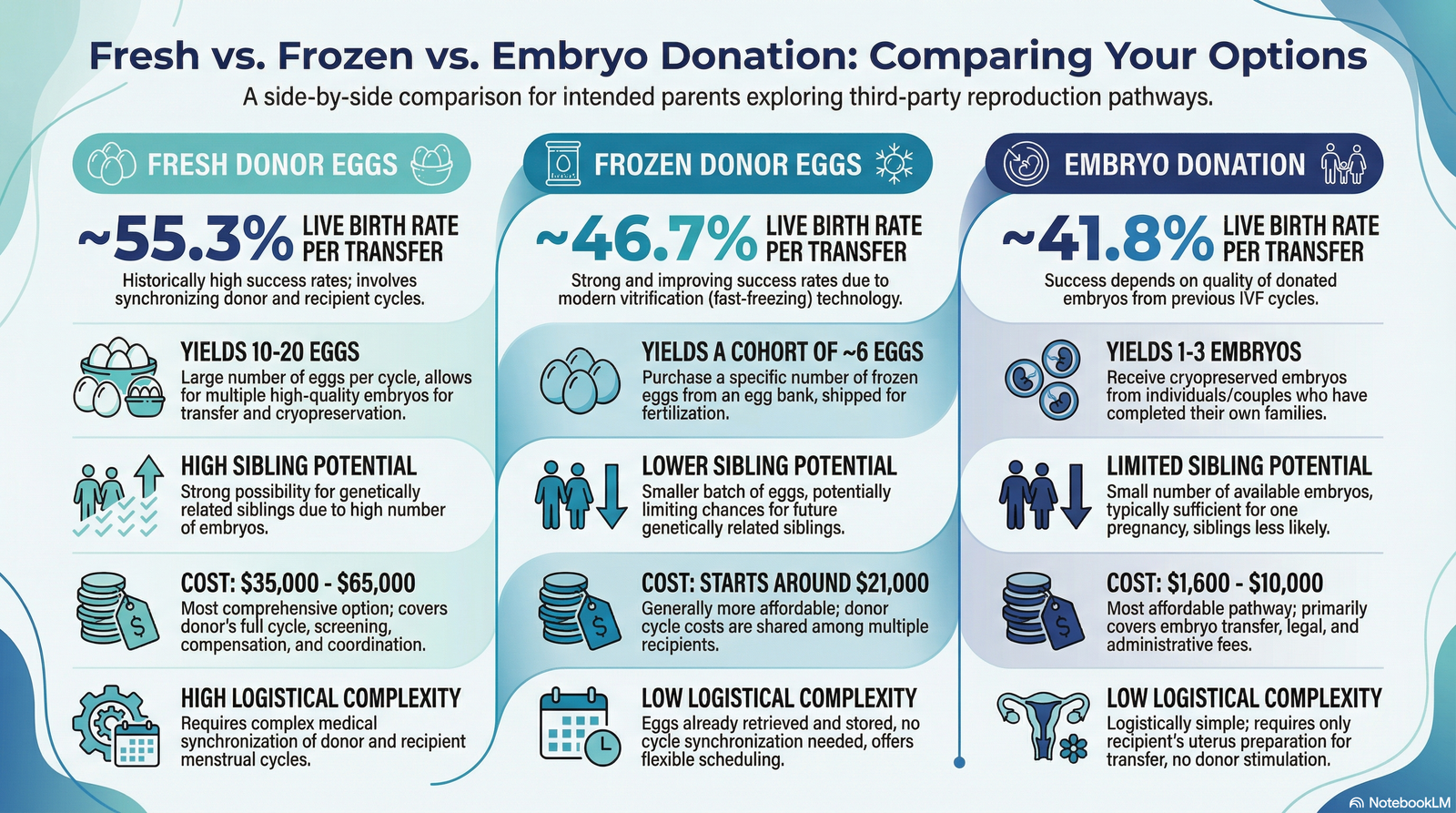
Fresh eggs, frozen eggs, and embryo donation each balance cost, timing, and success in different ways. Seeing them side by side can help you choose what fits you best.
Bundles, Cryoshipping, and Traveling Donors
Some agencies offer “packages” that wrap several services into one price. For example, if you choose an exclusive donor, you may buy all of that donor’s available eggs or sperm, so no other family uses them. This can be appealing if you want tight control over genetic siblings, but it is also expensive.
For international cases, eggs or embryos travel in cryoshipping tanks filled with liquid nitrogen vapor. These containers hold temperatures around minus 150 degrees Celsius and stay cold for several days in transit. Specialized couriers handle the paperwork and temperature tracking.
If you cannot travel to the donor’s clinic, the donor may travel to yours. Agencies organize medical monitoring close to the donor’s home and then arrange flights and housing so she can complete the retrieval at your clinic. From choosing the donor to your embryo transfer, this process usually takes about 2 to 4 months.
Guarantees on Eggs and Embryos
Some programs offer guarantees to reduce uncertainty for you. While these programs cannot eliminate medical risks, they provide a higher degree of predictability and a less stressful experience.
- With a standard cohort of 6 frozen eggs, many programs guarantee at least one good-quality blastocyst. If the embryos do not reach this stage of development, the reputable bank provides a supplemental cohort of oocytes at no additional cost.
- For fresh cycles, some clinics guarantee a minimum number of mature eggs, such as 4 to 10, or a specific outcome, such as two or more high-quality embryos.
These guarantees usually come with specific lab protocols (such as ICSI or IMSI) and may cost more up front. Many intended parents find the clarity worth it because it establishes a clear roadmap for what happens next if the first attempt does not go as planned or results in an unexpected outcome.
Real Donor Costs and How to Plan
It is natural to feel anxious about money at this point. Donor treatment is a major investment, and you deserve clear numbers to plan with.
- Fresh egg donation in the United States: Total costs often fall between $35,000 and $65,000. This initial fee usually includes agency fees (about $8,000 to $17,000), donor compensation (roughly $10,000 to $40,000), and legal fees (about $500 to $1,500), plus your clinic’s IVF costs.
- Frozen donor eggs in the United States: A cohort of 6 eggs usually starts around $21,000, not counting your clinic’s IVF fees.
- Sperm vials: Typically range from $500 to $2,000 per vial, depending on the bank and vial type.
- Embryo donation: Often costs from $1,600 to $10,000 for the selection of a suitable blastocyst, devitrification, and transfer, which is less than a full IVF cycle.
To pre-blueprint your finances, request an itemized quote from every clinic or agency you evaluate. This level of transparency allows you to see exactly how your resources are allocated, helping you identify opportunities to optimize your budget without compromising the clinical integrity or success rates of your journey.
Law, Policy, and Who Can Access Treatment
The legal rules around assisted reproduction still vary by country, but more places now support a wide range of families.
Countries such as the UK, Spain, Canada, and the United States allow donor treatment for single parents and LGBTQIA+ families, though specific rules differ. Some countries still restrict access to heterosexual couples, so cross-border care remains common.
You will also see a growing trend toward identity-release donation as a default or clearly offered option. Again, the focus is on the future rights and well-being of donor-conceived people.
Your Timeline From Consultation to Pregnancy Test
If the process feels endless in your mind, putting it into a simple timeline can help you and your partner catch your breath.
- Initial consultation and diagnosis (1 day): You meet with a fertility specialist, review your history, and discuss options.
- Donor screening and matching (1 to 3 months): You complete your own testing, review donor profiles, and choose a donor.
- Legal phase (2 to 4 weeks): Lawyers draft and finalize donor agreements so everyone’s rights and duties are clear.
- Ovarian stimulation (8 to 12 days): The egg donor starts injections. If you are the recipient, you start medications to prepare your uterine lining.
- Retrieval and fertilization (1 day): The donor has egg retrieval. The lab fertilizes the eggs with sperm that same day.
- Embryo culture (3 to 5 days): Embryos grow in the lab until they reach the blastocyst stage.
- Transfer (1 day): The clinic transfers one embryo into your uterus in a short, usually painless procedure.
- The “two-week wait”: About 9 to 14 days later, you have a blood test (beta-hCG) to see if you are pregnant.
Want help comparing clinics and costs?
If all these numbers and options feel like a full-time job, you are not imagining it. OVU advisors can gather clear, itemized quotes from vetted clinics, explain donor program structures, and help you map out a realistic timeline at no cost to you.

Why trust this guide? The OVU commitment
You are probably juggling hope, timelines, and a lot of tabs open in your browser. And you deserve clear, current, human advice. At OVU, we review clinic protocols, compare real quotes, and talk to people who have done this - intended parents and gestational carriers - so we can give you practical steps, not just theory. If you want help comparing options without sales pressure, we will gather itemized quotes and success data that match your exact situation. You decide, we will bring the info to your table.
Frequently Asked Questions
Can I choose my donor’s hair and eye color?
Yes. Donor profiles usually list race, hair and eye color, height, weight, and sometimes body type and skin tone. Many databases let you filter on these traits. You can start broad and then narrow your search once you see how many donors fit your basic criteria.
Does my age affect success when I use donor eggs?
Once you move to young donor eggs, your age matters far less than when you use your own eggs. Many women in their forties see live birth rates close to those of women in their late twenties when they use donor eggs, as long as their general health and uterine lining are in good shape. Your doctor will still look at blood pressure, weight, and other factors before clearing you for treatment.
How many embryos should I transfer?
Most current guidelines strongly support elective single embryo transfer, especially with good-quality donor embryos. Twins may sound appealing, but they carry higher risks for you and the babies. For most people, transferring one strong embryo at a time balances safety and success best.
What is a DuoStim protocol, and do I need it?
DuoStim (Dual Stimulation) is an advanced protocol where your clinical team stimulates the ovaries twice within a single menstrual cycle — once in the follicular phase and again in the luteal phase. This allows for two egg retrievals in approximately 30 days, maximizing the cumulative egg yield in a significantly shorter timeframe.
DuoStim is recommended when you are using your own eggs and need to bank unfertilized oocytes or embryos quickly. It is not usually necessary when using donor eggs, because donors are typically young women with high ovarian reserves. In donor-based journeys, standard stimulation usually provides an optimal number of eggs, making the intensity of a DuoStim cycle unnecessary for most solo mothers and couples.
Can I use donor sperm at home instead of at a clinic?
Some sperm banks ship vials for home insemination. At-home insemination is less controlled and often less successful than clinic-based IUI. When you work with a clinic, you also get cycle monitoring, precise timing, and clear medical records. For many people, that extra structure is worth the effort and cost.
Will I see what the donor looks like as an adult?
Access to donor imagery varies by bank and country. Many modern programs now provide a full visual history, including childhood photos, adult portraits, and even short video interviews. If viewing an adult phenotype is important for your family-building vision, it is best to confirm these photo policies early. This ensures that when you choose a match, the profile contains the visual information you feel is essential for your own peace of mind and your child’s future identity.
Genetic compatibility testing: is it mandatory for donors?
While full genetic screening is not legally required in all jurisdictions, most reputable clinics treat Genetic Compatibility Testing (Carrier Screening) as a standard of care. This process involves comparing your DNA with the donor’s to identify shared recessive mutations—one of the most effective ways to minimize the risk of a child inheriting a serious genetic condition. If a clinic or bank does not offer comprehensive carrier matching, it is important to ask why and determine if their safety protocols align with your personal comfort level for your future family.
Reference List 5 sources
Journal Article (Research): Robin FK, Andrade GM, Bos-Mikich A, Frantz N, Zocche DAA, Leal SMC. Donor oocyte cycle characteristics and outcomes: factors potentially linked with successful endings. JBRA Assisted Reproduction. 2023;27(2):185–190. PMID: 37014939. Available from: https://pubmed.ncbi.nlm.nih.gov/37014939/
Journal Article (Research): Berrien CB, et al. Trends and outcomes of fresh and frozen donor oocyte cycles in the United States, 2013–2020. Fertility and Sterility. 2024;Epub ahead of print. PMID: 38986758. Available from: https://pubmed.ncbi.nlm.nih.gov/38986758/
Journal Article (Research): Allen C, McLernon D, Bhattacharya S, Maheshwari A. Early pregnancy outcomes of IVF cycles using donor versus partner sperm: analysis of 1,376,454 cycles recorded by the Human Fertilisation and Embryology Authority (1991–2016). Human Reproduction. 2023;38(6):1194–1201. PMID: 36961939. Available from: https://pubmed.ncbi.nlm.nih.gov/36961939/
Journal Article (Systematic Review & Meta-Analysis): Allen CP, Marconi N, McLernon DJ, Bhattacharya S, Maheshwari A. Outcomes of pregnancies using donor sperm compared with those using partner sperm: systematic review and meta-analysis. Human Reproduction Update. 2021;27(1):190–211. PMID: 33057599. Available from: https://pubmed.ncbi.nlm.nih.gov/33057599/
Committee Opinion (Guidance): Practice Committee of the American Society for Reproductive Medicine; Practice Committee of the Society for Assisted Reproductive Technology. Guidance regarding gamete and embryo donation. Fertility and Sterility. 2021;115(6):1395–1410. PMID: 33838871. Available from: https://pubmed.ncbi.nlm.nih.gov/33838871/
Final Thoughts and Next Steps
If you are reading this, you are already doing the hard work of showing up for your future child. Donor conception does not hush the grief of earlier losses or the shock of an infertility diagnosis, but it does give you a real path toward the family you want.
Using a donor today means blending rigorous science with deeply human questions about identity, heritage, and love. You are not simply selecting DNA from a database; you are choosing the biological foundation for a child you will raise, hold, and know more intimately than anyone else on earth.
It is normal to feel scared, hopeful, angry, and excited, sometimes all in the same day. Give yourself time, ask direct questions, push for clear numbers, and build a support team that respects your choices. Your family will not be defined by how your child was conceived, but by how you show up for them, day after day.
Analogy to keep in mind: Choosing a donor is a bit like selecting seeds for a garden. The seeds carry the basic blueprint for color and height, but it is your soil, your care, and your light that determine how the garden flourishes. In the same way, your love and attention will shape the unique person your child becomes.
Ready to talk through your options with a human expert?
If you want someone to walk through clinic choices, donor types, and real budgets with you, book a free call with an OVU advisor. You stay in control of every decision. We simply help you see the map more clearly.
Related articles

Donor Legal Rights 2026: Parental Rights, Anonymity & Legal Framework
Donor Conception & Legal Rights Your guide to donor conception legal rights, anonymity, and costs in 2026 Last Updated: 16 January 2026 Medically Reviewed 20 min read Evidence-based Are you considering using a sperm or egg donor to build your family? You may have reached a point where natural conception feels like a closed door, and you are looking for a clear and safe way forward. The questions on your mind are heavy: Who will be the legal parent? Will the donor ever seek contact? Can my child find out their genetic history? In 2026, donor egg IVF and double
20 min read
Donor Costs 2026: What You Will Pay for Egg, Sperm & Embryo Donation
IVF Costs & Donor Options Your guide to understanding donor egg, sperm, and embryo costs in 2026 Last Updated: 13 January 2026 Medically Reviewed 20 min read Evidence-based If you are thinking about using donor eggs, sperm, or embryos, you are probably feeling a blend of hope and worry simultaneously. You might be excited that this could finally bring you closer to a baby, but at the same time, you are staring at prices that range from a few thousand to more than sixty thousand dollars and wondering how on earth anyone makes sense of that. In 2026, while most
24 min read
Embryo Donation & Adoption 2026: Process, Costs & What to Expect
Alternative Family Building Your guide to embryo donation and adoption Last Updated: 09 January 2026 Medically Reviewed 19 min read Evidence-based If you are exploring embryo donation in 2026, you are walking a path shared by many who have discovered that family is defined by more than just biology. Whether you have arrived here after a long IVF journey or a shift in your family planning, it’s natural to feel a complex mix of grief for the genetic link and profound hope for the future. You aren’t just taking in a “genetic blueprint” from the donors; you are providing the
17 min read