


Dr. Sony Sherpa (MBBS)
In addition to her clinical experience, Dr. Sherpa is a published medical researcher and holistic health advocate. Her dual expertise in emergency care and alternative therapies brings a unique lens to medically reviewed content—ensuring it is both accurate and accessible.
If you are thinking about using donor eggs, sperm, or embryos, you are probably feeling a blend of hope and worry simultaneously. You might be excited that this could finally bring you closer to a baby, but at the same time, you are staring at prices that range from a few thousand to more than sixty thousand dollars and wondering how on earth anyone makes sense of that.
In 2026, while most donor programs provide transparent headline pricing, the total investment for intended parents often fluctuates based on the fine print. Basically, even pre-blueprinted or pre-configured bundles may exclude essential costs, such as donor compensation, agency fees, medications, lab work, legal contracts, or international shipping. For example, a fresh donor egg cycle in the United States typically ranges from $35,000 to $65,000; in contrast, high-quality programs in Mexico or parts of Europe often offer a similar bundle of services for less than a third of that cost. While donor egg transfers usually result in a 60% to 80% clinical pregnancy rate per transfer in reputable clinics, the stakes are high, making it vital to ensure your chosen package truly covers your specific medical and legal requirements.
This guide walks you through the anticipated costs for donor eggs, donor sperm, and embryo donation or adoption in 2026. We’ll explore how refund programs and guarantees work and identify the areas where expenses can quietly climb if you aren’t prepared for them.
In 2026, a full fresh donor egg cycle in the United States usually costs $35,000 to $65,000 for an “all-in” bundle. This initial cost routinely covers most bundled services and expenses, such as donor compensation, agency management, clinical fees, and medications. For those using donor sperm, vials typically range from $500 to $2,000 each, depending on donor type and availability. Meanwhile, embryo donation or adoption typically costs between $5,000 and $15,000 in the United States, compared to €1,400 to €4,300 in many European programs. Given that success rates are high (often 60% to 80% per transfer), many intended parents opt for multi-cycle or refund programs. These bundles help minimize the financial risk of implantation failure or early loss by covering subsequent attempts without the burden of new cycle fees.
Next steps: While the numbers can feel daunting, having a clear roadmap can help turn uncertainty into a manageable journey. Here is how you can take the data from this guide and apply it to your unique path to parenthood.
- Identify your path: Select an option that aligns with your goals and preferences: donor eggs, sperm, or embryos. Use the cost ranges in this article to build a realistic “base budget” for one full attempt, factoring in travel and medication fees.
- Layer in contingency costs: Once you’ve blueprinted your base budget, allocate additional funds for specialized services such as genetic screening (PGT-A), embryo vitrification (freezing), or potential re-vitrification. If traveling internationally, account for a prolonged stay in case of a “plan B” scenario – such as an implantation failure that requires a backup frozen embryo transfer (FET) before you return home.
- Interview and shortlist: Create a targeted list of questions to interview IVF case managers. Select several clinics that offer the specific programs and “success guarantees” or “shared risk” bundles you are interested in to compare their responsiveness and transparency about included medical services and fees involved.
What the latest research shows
Recent studies from journals such as Medicina, JBRA Assisted Reproduction, Fertility and Sterility, and American Journal of Obstetrics and Gynecology give a clearer picture of how donor eggs and donated embryos perform in real life. Donor egg cycles in very low ovarian reserve patients still achieve live birth rates around 20% to 40% per cycle, and programs using donated embryos often report live birth rates near 40% to 45% per transfer, similar to standard IVF in much younger women.
Systematic reviews also show that donor sperm cycles tend to have higher clinical pregnancy rates and fewer biochemical losses than similar cycles using partner sperm in severe male factor infertility. At the same time, meta-analyses confirm that donor-egg pregnancies carry about a three times higher risk of preeclampsia, which is why clinics now treat them as high surveillance pregnancies.
All research citations in this article include PMID numbers and can be checked directly on PubMed.
In This Guide
- 2026 donor costs at a glance
- Egg donation: where the money goes
- Sperm donor costs and vial types
- Embryo adoption and donation costs
- Bundles, guarantees, and refund programs
- Global price comparison by country
- Eligibility rules and extra fees to expect
- Fresh vs. frozen donors and package types
- Traveling for treatment versus shipping embryos
- What a donor cycle timeline looks like in 2026
- Frequently Asked Questions
Typical range: $35,000 – $65,000 per full fresh cycle. This generally covers the “all-in” essentials: donor compensation, agency matching, legal contracts, and clinic medical fees.
- $5,000 – $15,000 in the United States (costs vary based on whether you choose a clinic-led donation or an agency-led adoption program).
- €1,400 – €4,300 in Europe (usually most affordable in the Czech Republic, Slovakia, and Spain, though legal anonymity rules vary by country).
Donor egg pregnancy rates: High-performing programs report a 60% to 80% clinical pregnancy rate per transfer. While these are strong odds, the live birth rate is often slightly lower, generally ranging between 50% and 70% per attempt.
2026 donor costs at a glance
If you look at price lists from several clinics, you will see the same pattern. Donor eggs are by far the most expensive option, embryo adoption or donation sits in the middle, and donor sperm is usually the least costly but still comes with long-term legal and emotional decisions.
Here is a simple summary before we dive into details:
- Fresh donor egg cycle in the United States: usually $35,000 to $65,000 for an “all-in” bundle.
- Frozen donor egg cohort in the United States: routinely, the bundle’s cost starts at $21,000 for a cohort of 6–8 eggs.
- Donor sperm vials: from $500 to $2,000 each. Pricing depends on whether you choose a local or international bank, as well as donor-specific factors like open identity (Identity Release) vs. anonymous profiles and the availability of donors with rare ethnic backgrounds. Additionally, costs vary by vial type, such as IUI-ready (pre-washed) vials versus ICI/IVF (unwashed) vials, and the level of detail provided in the donor’s “premium” extended profile.
- Embryo adoption or donation: from $5,000 to $15,000 in the United States, much lower in European countries.
- Multi-cycle and refund programs: higher upfront price, lower cost per live birth when you need more than one attempt.
Latest research insights on donor outcomes
24% vs 9% – Donor Eggs Double Birth Chances: In women with very low ovarian reserve, donor egg IVF led to a 24% live birth rate compared with around 9% when they kept using their own eggs after repeated high-dose stimulation. For you, this means that switching to donor eggs can more than double your chance of bringing home a baby once your own egg numbers are very low. Source: Medicina (PMID: 40005420).
41% Per Cycle – Donor Eggs Lead the Pack: In a large donor egg program, each transfer gave a live birth in about 4 out of 10 cycles, even though most recipients were 40 or older. Previous work in the same field shows that doing several donor cycles can bring overall success close to 70% to 80%. This explains why donor eggs sit at the top of the cost range; you are paying for one of the most effective fertility tools available. Source: JBRA Assisted Reproduction (PMID: 37014939).
44% vs 45% – Embryo Donation Matches Double Donation: A US registry study compared live birth rates between donated embryos and “Double Donation” (newly created embryos from donor eggs and donor sperm). The results showed nearly identical outcomes: 44.1% versus 45.1%. If your path already requires both donor eggs and donor sperm, this evidence suggests that using existing donated embryos can be just as effective as starting a fresh cycle, often with significantly lower costs and less logistical complexity. Source: Fertility and Sterility (PMID: 40618984).
4 in 10 Succeed – Embryo Donation in Real Life: National US data on thousands of embryo donation cycles shows live birth rates per transfer typically fall in the 40% to 45% range. Remarkably, these odds remain consistent even though many recipients are in their early 40s – a success rate comparable to younger women using their own eggs in traditional IVF. This resilience to maternal age is why embryo adoption or donation offers you one of the most effective cost-to-success ratios in modern fertility care. Source: American Journal of Obstetrics and Gynecology (PMID: 27393270).
These findings come from peer-reviewed research. Your personal chances still depend on your health, your clinic, and the donor you choose.
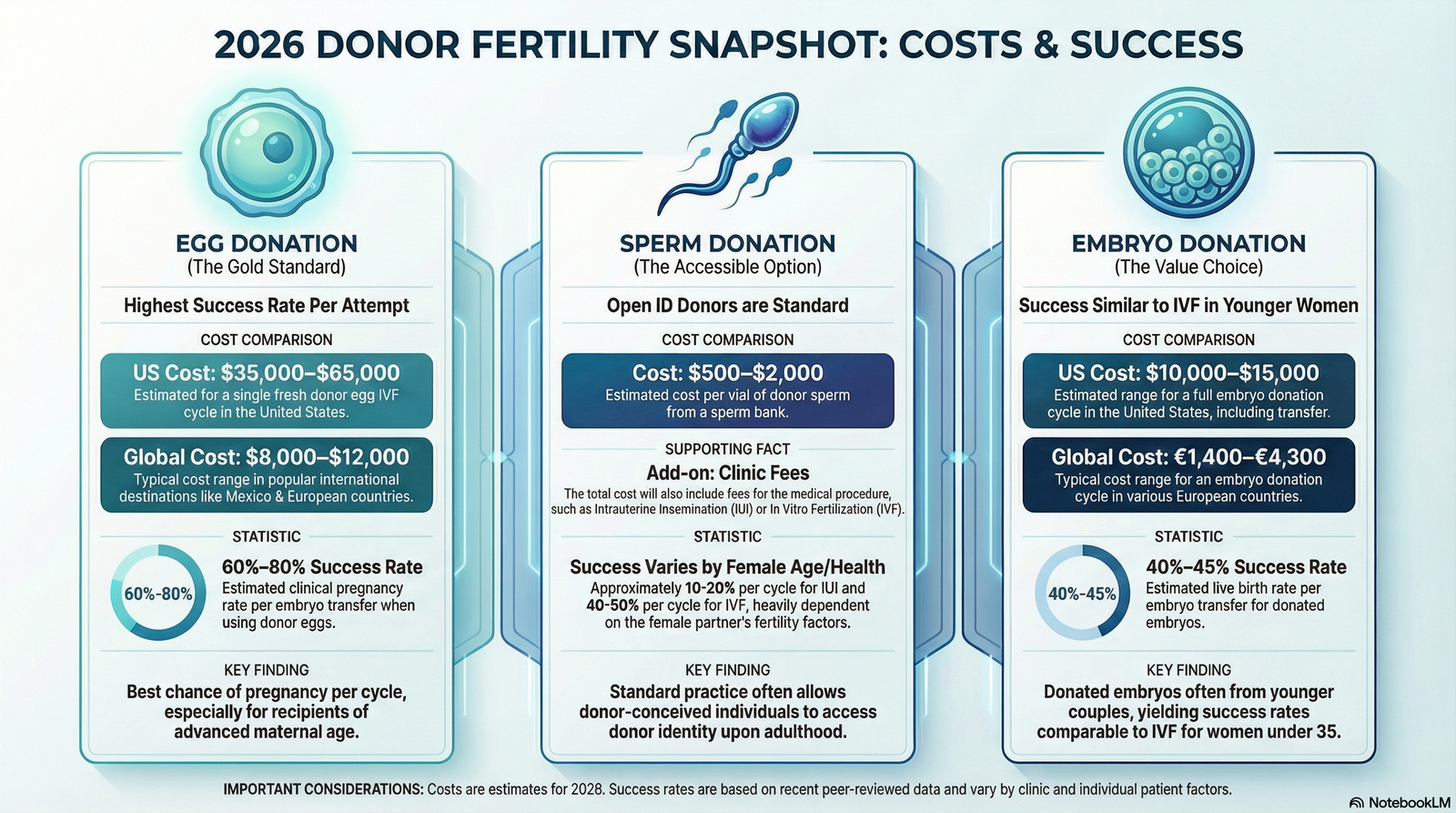
2026 donor fertility overview, showing typical timelines, costs, and success rates for donor eggs, sperm, and embryos.
| Region | Standard IVF (Own Eggs) | Egg Donation Cycle | Sperm Vial | Embryo Adoption |
|---|---|---|---|---|
| USA | $15,000 – $25,000 | $35,000 – $65,000 | $500 – $2,000 | $10,000 – $15,000 |
| Mexico | $5,000 – $8,200 | $8,000 – $12,000 | Around $1,000 (includes IUI) | $5,000 – $10,000 |
| Spain | €3,740 – €5,985 | €6,150 – €9,495 | €400 – €500 | €2,950 – €4,300 |
| Balkans | €2,155 – €3,000 | €5,000 – €7,600 | €300 – €1,000 | €1,169 – €2,500 |
Egg donation: where the money goes
If you use donor eggs, your largest line item will almost always be the donor package itself. In US-style pricing, you will often see a base donor fee of around $25,000 for a fresh cycle. That base cost usually covers the donor search, screening, compensation, and legal work, but not your own clinic’s IVF fees.
When you add everything together, a typical US fresh donor cycle includes:
- Agency fee: $8,000 – $17,000 for recruiting, screening, and managing the donor cycle.
- Donor compensation: $10,000 – $40,000, sometimes more – for high-demand or proven donors.
- Screening: $450 – $1,000 for psychological, infectious disease, and genetic testing.
- Legal: $500 – $1,500 for contracts and parentage agreements.
- Clinic and lab: additional IVF costs, sometimes billed as a separate package.
- Medications: often $3,000 – $7,000 for the donor’s controlled ovarian stimulation cycle and for your lining preparation.
Unlike the itemized billing common in the U.S., many international destinations have shifted to transparent “flat-fee” pricing to simplify the process for traveling patients. This model bundles the donor recruitment, medical procedures, and laboratory fees into one predictable number, making destinations like Slovakia, Spain, or Mexico highly competitive with U.S. programs.
Sperm donor costs and vial types
Donor sperm prices look much smaller on paper, but they add up across several cycles. In 2026, a single vial from a major sperm bank usually costs between $500 and $2,000, depending on the type of vial and the donor profile.
Banks now label and price vials by how you plan to use them:
- ART vials: Designed for IVF or ICSI, commonly with at least 1 million motile sperm per vial.
- Insemination or platinum vials: For IUI or at-home insemination, with much higher counts, often above 20 million motile sperm, commonly priced around $1,500 to $1,700 per vial.
- Open ID donors: Identity-release donors are donors who consent to have their identifying information shared with the donor-conceived child once they reach legal adulthood (typically age 18). These donor options carry a higher premium because they require more extensive psychological counseling, more rigorous long-term administrative tracking by the bank, and a higher level of commitment from the donor to remain contactable for decades.
In 2026, the vial price is only one component of a multi-layered budget. The total investment will shift significantly based on the procedure that aligns with your family’s needs, either intrauterine insemination (IUI), in vitro fertilization (IVF), or reciprocal IVF for same-sex female couples. It is vital to factor in the often-unquoted “lab-side” expenses, such as the mandatory infectious disease screening, sperm washing, and the recurring costs of cryogenic storage (often $300–$800 per year), which clinics routinely manage as separate financial obligations.
More research on safety and risks
3 in 10 vs. 1 in 10 – IVF and preterm birth: A recent sibling study highlights a surprising “safety” benefit of using donor eggs. While IVF pregnancies using a patient’s own eggs showed a 12% preterm birth rate (compared to 3.5% in their unassisted pregnancies), donor egg pregnancies remained remarkably similar to unassisted ones, appearing relatively unaffected by the typical IVF-related increase in prematurity. For patients of advanced reproductive age, donor eggs may actually mitigate certain perinatal risks seen in traditional IVF. However, it is important to note that donor egg cycles do carry a higher association with preeclampsia and are large for gestational age (LGA) babies, requiring specialized third-trimester monitoring. Source: Fertility and Sterility (PMID: 39675413).
3 times higher preeclampsia risk – why clinics watch you closely: A large meta-analysis found that donor egg pregnancies had roughly three times higher risk of preeclampsia compared with IVF pregnancies using the intended mother’s own eggs. That does not mean you will get preeclampsia, but it does mean your care team should manage your pregnancy as high-risk and monitor blood pressure and symptoms closely. Source: Journal of Assisted Reproduction and Genetics (PMID: 27007875).
27% better pregnancy rates with donor sperm: A 64-study meta-analysis showed that using donor sperm increased clinical pregnancy rates by about 27% and reduced very early losses compared with partner sperm in similar treatments. This is reassuring if you are moving to donor sperm because of severe male factor infertility or a serious male genetic condition. Source: Frontiers in Endocrinology (PMID: 40771274).
Safety and screening standards are strong: Modern donor guidelines from professional societies describe strict screening, quarantine, and retesting rules. With a 35-day quarantine and repeat testing, the risk of missing infections such as HIV or hepatitis B in a donor sample falls below 1 in a million. Source: Fertility and Sterility (PMID: 38970576).
These findings explain why donor cycles are priced as premium treatments and why clinics often follow more intensive monitoring plans in donor pregnancies.
Embryo adoption and donation costs
Embryo adoption or donation sits in the middle ground between donor eggs and donor sperm for both cost and complexity. Instead of creating new embryos, you adopt existing embryos that other patients donated after completing their own families.
Typical costs include:
- In the United States: $5,000 to $10,000 for medical donation (clinic-led) or $11,000 to $15,000 for agency-led adoption (which includes matching, counseling, legal work, and transfer).
- In Europe: One embryo transfer costs range from €1,400 to €4,300, with the most budget-friendly options found in Central and Eastern Europe.
- Medications: Budget an additional $400 to $1,500 for uterine lining preparation.
- Preimplantation genetic testing factor (genetic screening): In 2026, many clinics offer tiered bundles based on whether the embryos have undergone PGT-A (chromosomal screening). Non-PGT Bundles: These are often the most affordable entry point. You may be offered a “cohort” of two untested embryos for a lower price. While this reduces upfront costs, it may carry a higher risk of implantation failure or miscarriage if the embryos are chromosomally abnormal. PGT-Screened Bundles: These carry a higher associated cost, often adding $3,000 to $5,000 in the US or €1,500 to €2,500 in Europe. However, because these embryos are confirmed “euploid” (chromosomally normal), they typically offer the highest pregnancy rates per transfer (often 60%–70%) and a significantly lower risk of miscarriage.
Because there is no donor stimulation or egg retrieval involved, the clinical process is significantly simpler and swifter. While clinical pregnancy rates for non-tested embryos often land between 45% and 55%, PGT-tested embryos push those odds higher (between 56% and 70%). If you are a cost-conscious patient wishing to eliminate the high fees of double-donation IVF, adopting an embryo remains one of the most effective and inclusive paths to parenthood.
Bundles, guarantees, and refund programs
A single failed cycle can wipe out years of savings, so many clinics now build packages that spread risk across several rounds. You pay more upfront, but if you need multiple transfers, the cost per live birth can end up lower than paying for each cycle separately.
- Multi-cycle packages: three donor egg cycles with or without PGT-A testing, often bundled with discounts on extra transfers.
- Refund programs: a clear promise that if you do not have a live birth after a fixed number of cycles, you receive a large part of your money back.
- Blastocyst guarantees: programs that promise a minimum number of usable blastocysts from a donor, with replacement eggs if the lab cannot reach that number.
For example, some programs in Mexico offer three-cycle packages with PGT-A starting at $10,000 (excluding medications) and report cumulative success rates reaching 96% by the third or fourth attempt. Similarly, in Spain, some clinics bundle three donor cycles into a single “Live Birth Guarantee” plan for roughly €20,000 to €21,000, often featuring a refund clause if a baby isn’t brought home. While these multi-cycle paths require a larger upfront investment, they provide a financial safety net for those committed to continuing treatment until they achieve success.
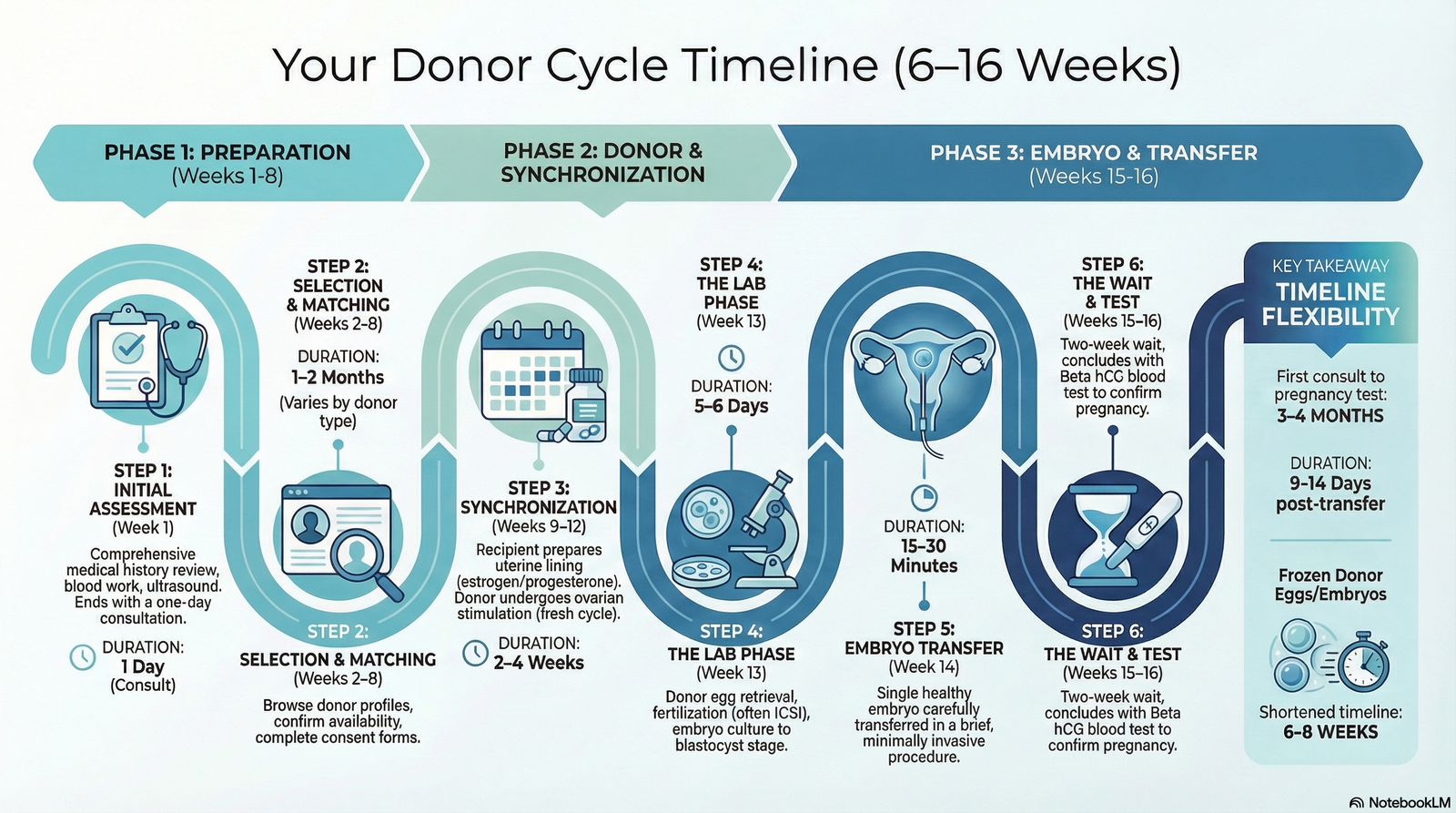
Typical 2026 donor treatment timeline from first consult to pregnancy test, usually 6 to 16 weeks, depending on donor path.
Global price comparison by country
Once you know you will need donor gametes, the next big question is where to go. You may have one clinic at home, another contact in Mexico, and two more in Europe, all quoting different prices in different currencies and bundles.
The table above gives you broad ranges, but you still need to look at what each package includes. Some questions to answer for each clinic are:
- Does this price include donor stimulation, retrieval, ICSI, and one transfer, or only part of that?
- How many eggs or embryos does this package guarantee?
- Are medications included, partly included, or billed entirely separately?
- Does the clinic include genetic compatibility testing and PGT-A, or is that extra?
- How many follow-up transfers from the same cycle are included in the price?
Eligibility rules and extra fees to expect
Every country operates under a unique legal framework that dictates who can donate and who is eligible for treatment. These regulations often quietly add time and cost to your plan, especially for solo parents, LGBTQ+ couples, and those who are over age 50, as they may need a cross-border trip to find a destination that fully supports their path to parenthood.
- BMI limits for donors: donors are usually accepted only if their BMI is under 29 or 30.
- Age limits for recipients: many clinics set an upper age limit for treatment. While many programs in the U.S. and Europe typically set this limit at 49 or 50, some destinations, such as Greece (up to 54) and North Cyprus (up to 55), offer more flexibility for those of advanced reproductive age. These limits often depend on a thorough cardiovascular and health screening to ensure a healthy pregnancy.
- Notarial deeds and court documents: in Greece, single women and unmarried couples often pay a fixed-fee of approximately €160 for a notarial deed before treatment.
- Medical infertility proof: in some countries, such as Croatia, unmarried women must show a medical infertility diagnosis to access donor sperm.
In addition to legal and clinical fees, intended parents should budget for logistical essentials such as donor travel, insurance, and document translation. While these journey-related costs may seem modest individually, they collectively represent a $2,000 to $5,000 layer of your total treatment price tag.
Fresh vs frozen donors and package types
Another decision you face is whether to choose a fresh donor cycle or a frozen cohort. Both options can work well when a strong lab runs the program, but they have different financial profiles.
Frozen eggs: In the US, a batch of six vitrified donor eggs often starts at around $21,000. You know exactly how many eggs you are getting, the donor has already completed her part, and your cycle can begin as soon as your own body is ready. With modern vitrification survival rates now exceeding 90%, this path is ideal for those prioritizing a lower entry price and a faster timeline to transfer.
Fresh donor cycles: These cycles typically range from $35,000 to $65,000 once you factor in agency fees and clinical medical work. In return, you usually receive all eggs retrieved from a single donor (typically 12 to 20+ eggs). While the upfront cost is higher, this route often yields more embryos, which can provide multiple attempts or the chance for biological siblings.
Traveling for treatment versus shipping embryos
Once you add in flights and hotels, it can feel tempting to ship embryos back home instead of traveling for transfer. Both options have pros and cons.
- Travel for transfer: you pay for flights, accommodation, and time off work, but you avoid the paperwork, permits, and shipping costs for moving embryos across borders.
- Ship embryos: you stay close to home for the pregnancy, but you pay for cryo couriers, export and import permits, and sometimes extra storage fees while papers are processed.
Shipping costs usually range between €600 and $2,250 per shipment. When you add that to legal and storage fees, total costs can be 50% to 70% higher than just doing the transfer in the donor’s country, especially if your clinic abroad already offers very low package prices. If you have strong medical reasons to initiate a round of treatment at a local clinic, shipping still makes sense; however, if you are medically fit to travel, a short trip could actually save a lot.
What a donor cycle timeline looks like in 2026
Knowing the steps and how long they take helps you organize work, childcare, and travel. While every clinic operates on a slightly different timeframe, most donor cycles follow this six-to-eight-week pattern from the initial assessment to the final pregnancy test:
- Initial assessment (1 day): medical history review, blood work, and a baseline ultrasound scan.
- Donor selection and legal workflow (1 to 4 months): reviewing donor profiles, confirming availability, and finalizing legal consents.
- Uterine preparation (2 to 4 weeks): your lining is synchronized and thickened using estrogen, followed by progesterone support.
- Retrieval and fertilization (1 day): the donor undergoes an egg retrieval; the lab performs ICSI (intracytoplasmic sperm injection) to fertilize the mature eggs.
- Embryo culture (5 to 6 days): embryos grow to the blastocyst stage in the lab.
- Embryo transfer (15 to 30 minutes): one embryo is placed into your uterus in a quick, outpatient procedure.
- Pregnancy test (9 to 14 days later): A beta-hCG blood test is performed to confirm if implantation was successful. If the test is positive, your doctor will schedule an early pregnancy viability scan during week 6 to week 8. This ultrasound confirms the location of the pregnancy, the number of gestational sacs, and the presence of a fetal heartbeat.
Note on Timing: If the first scan is performed early (around week 6) and cardiac activity is not yet detected, it does not necessarily indicate a problem. Embryonic development can vary by a few days; in such cases, a follow-up scan is typically scheduled one week later to confirm progress.
OVU expert guidance: how to think about value, not just price
How to use these numbers to make a real decision
When you compare programs, look beyond the “headline” prices, or, if negotiating the bundles with IVF case managers virtually, beyond the initially “announced” cost for the bundle of services and donor-related expenses you need. Ask each clinic for their live birth rate per started cycle, specific to your diagnosis, not just per transfer. You can then calculate an approximate “cost per baby” by dividing the total package price by the success rate.
Additionally, factor in how many embryos or blastocysts you are likely to get per a single full cycle, because every extra embryo can mean another chance without paying for a new donor cycle, requiring only frozen embryo transfer (FET). Finally, balance the financial side with the emotional one. For many prospective parents and solo-parents-by-choice, staying close to home during the treatment and pregnancy is worth a higher premium. For others, traveling to a high-performing international clinic is the key that makes a treatment financially possible.
Want help comparing clinics and costs?
If this feels like a full-time job, and honestly it can, our advisors can collect clear, itemized quotes from verified clinics and map your likely timelines – at no cost to you.

Why trust this guide? The OVU commitment
You are probably juggling hope, timelines, and a lot of tabs open in your browser. And you deserve clear, current, human advice. At OVU, we review clinic protocols, compare real quotes, and talk to people who have done this - intended parents and gestational carriers - so we can give you practical steps, not just theory. If you want help comparing options without sales pressure, we will gather itemized quotes and success data that match your exact situation. You decide, we will bring the info to your table.
Frequently Asked Questions
How much should I budget for medications?
Medication costs are rarely included in the base treatment price and vary significantly depending on the type of cycle. For a fresh donor egg cycle, you should budget between $3,000 and $7,000. This cost covers the high-dose stimulation medications for the donor and the hormonal preparation for the recipient. Note that many international “all-inclusive” packages now include the donor’s medications, which could bring your out-of-pocket cost down to the recipient-only range. For a frozen embryo transfer, you should budget $400 to $1,500 (or similar in euros if you have your treatment cycle in Europe) for the estrogen and progesterone needed to prepare the uterine lining.
Does insurance cover donor eggs or sperm?
Standard insurance plans rarely cover donor compensation or agency fees, even if they cover the medical side of IVF. While some policies may reimburse for clinical steps – such as your monitoring scans or the embryo transfer – the donor and bank fees are almost always an additional expense. Before committing to any bundle or signing a contract, always request a written verification of benefits from your clinic’s billing team and your insurance provider to understand exactly where your coverage stops and your self-pay obligations begin.
Is there usually a waitlist for donors?
In large international hubs such as Spain, Mexico, the Czech Republic, Georgia, and Greece, there is often no waitlist for Caucasian donor profiles. However, the global availability of donors does not yet reflect the diversity of all intended parents. If you are seeking a donor of Black, Asian, or specific multi-racial ethnicity, or if you have highly specific requirements regarding education or physical traits, you may face a waitlist of 2 to 6 months. In these cases, your clinic may recommend using an international egg bank to expand your options and find a representative match more swiftly.
Can I choose the baby’s gender?
In some countries, including the United States, Mexico, and Cyprus, clinics can use PGT-A (preimplantation genetic testing for aneuploidies) to identify the chromosomal sex of each embryo. This allows intended parents to select an embryo for family balancing. However, many other destinations, including most of Europe, strictly prohibit sex selection unless it is medically necessary to prevent sex-linked genetic disorders. Because these laws are often tied to national bioethics acts, it is essential to verify the current regulations in your specific destination before starting your cycle.
What are the success rates for women over 45 who use donor eggs?
When using donor eggs, success is primarily driven by the age and health of the donor rather than the recipient. Because donors are typically in their twenties, many clinics report live birth rates of 50% to 70% per embryo transfer for those over 45. While the “age of the uterus” has a minimal impact on these statistics, your overall health, uterine environment, and the number of available embryos remain vital factors. Your medical team will perform a thorough health screening to ensure your body can safely support a healthy pregnancy.
Is using a directed (known) donor always more cost-effective?
Not necessarily. While you may avoid a standard agency matching fee, you are responsible for the donor’s full medical screening, psychological evaluation, medications, and travel expenses. Furthermore, you must fund separate legal counsel for both yourself and your donor to ensure parental rights are fully protected. These costs often exceed $10,000 to $15,000. When comparing options, look at the “total cost of care” rather than just the agency fee, as the logistical coordination of a directed donor can sometimes match the price of a streamlined agency package.
How long can frozen sperm, eggs, or embryos stay in storage?
Technically, there is no biological “expiration date” for cryopreserved materials; when stored correctly in liquid nitrogen, they can remain viable for decades. However, the legislation varies significantly by country. For instance, several European hubs have strict 10-year caps, while the UK recently expanded its storage limits to 55 years. It is essential to discuss local storage laws and your clinic’s policy on “disposition” (what happens to embryos in the event of death or divorce) to ensure your long-term family goals are protected.
Reference List 10 sources
Journal Article (Research): Havrljenko J, Kopitovic V, Trninic Pjevic A, et al. In vitro fertilization outcomes in donor oocyte cycles compared to the autologous cycles in the Poseidon 4 group of poor ovarian responders. Medicina (Kaunas). 2025;61(2):303. PMID: 40005420. Available from: https://pubmed.ncbi.nlm.nih.gov/40005420/
Journal Article (Research): Robin FK, Andrade GM, Bos-Mikich A, et al. Donor oocyte cycle characteristics and outcomes: factors potentially linked with successful endings. JBRA Assisted Reproduction. 2023;27(2):185–190. PMID: 37014939. Available from: https://pubmed.ncbi.nlm.nih.gov/37014939/
Journal Article (Research): Rahav-Koren R, Shalev-Ram H, Haikin-Herzberger E, et al. In vitro fertilization with autologous oocyte or donor egg vs unassisted conception: a sibling analysis of perinatal outcomes. Fertility and Sterility. 2024;122(4):XXX–XXX. PMID: 39675413. Available from: https://pubmed.ncbi.nlm.nih.gov/39675413/
Journal Article (Research): Tsai S, Ma X, Spring S, Spandorfer S. Outcomes of in vitro fertilization cycles with embryo donation compared with double gamete donation using cryopreserved donor oocytes. Fertility and Sterility. 2025;XXX(XX):XXX–XXX. PMID: 40618984. Available from: https://pubmed.ncbi.nlm.nih.gov/40618984/
Journal Article (Research): Kawwass JF, Crawford S, Hipp HS, et al. Embryo donation: national trends and outcomes, 2000 through 2013. American Journal of Obstetrics and Gynecology. 2016;215(6):747.e1–747.e5. PMID: 27393270. Available from: https://pubmed.ncbi.nlm.nih.gov/27393270/
Journal Article (Systematic Review & Meta-Analysis): Blázquez A, García D, Rodríguez A, Vassena R, Figueras F, Vernaeve V. Is oocyte donation a risk factor for preeclampsia? A systematic review and meta-analysis. Journal of Assisted Reproduction and Genetics. 2016;33(7):855–863. PMID: 27007875. Available from: https://pubmed.ncbi.nlm.nih.gov/27007875/
Journal Article (Systematic Review & Meta-Analysis): Liu J, Xue Y, Zhang L, et al. Obstetric and perinatal outcomes in pregnancies conceived with donor versus partner sperm: a systematic review and meta-analysis. Frontiers in Endocrinology. 2025;16:1590261. PMID: 40771274. Available from: https://pubmed.ncbi.nlm.nih.gov/40771274/
Committee Opinion (Guidance): Practice Committee of the American Society for Reproductive Medicine. Evidence-based outcomes after oocyte cryopreservation for donor oocyte in vitro fertilization and planned oocyte cryopreservation: a guideline. Fertility and Sterility. 2021;116(1):36–47. PMID: 34148587. Available from: https://pubmed.ncbi.nlm.nih.gov/34148587/
Committee Opinion (Guidance): Practice Committee of the American Society for Reproductive Medicine. Gamete and embryo donation guidance. Fertility and Sterility. 2024;122(4):799–813. PMID: 38970576. Available from: https://pubmed.ncbi.nlm.nih.gov/38970576/
Journal Article (Review): Caradeux J, Fernández B, Ávila F, Valenzuela A, Mondion M, Figueras F. Pregnancies through oocyte donation. A mini review of pathways involved in placental dysfunction. Frontiers in Medicine. 2024;11:1338516. PMID: 38298815. Available from: https://pubmed.ncbi.nlm.nih.gov/38298815/
Final thoughts
Stepping into donor treatment is not just a financial decision. You are also deciding how much uncertainty you can tolerate, how you feel about genetics, and how far you are willing to travel. We understand that looking at a $50,000 price tag when you already feel tired and heartbroken can be overwhelming, but it is important to remember that this cost represents a pathway, not a barrier.
The good news is that you have more options than ever. You can stay close to home and pay a premium for convenience, or you can travel and cut your bill by half or more. You can choose a known donor or an anonymous one, a fresh donor or a frozen cohort, a single embryo adoption or a multi-cycle baby plan. None of these choices is right for everyone. The right plan is the one that fits your values, your health and your budget, and still leaves you with the energy to be present for the child you are working so hard to meet.
Ready to see real numbers for your situation?
You do not have to decode clinic brochures alone. Talk with an OVU advisor to compare donor programs, countries and refund plans side-by-side so you can make a clear decision that feels right for you.