


Dr. Sony Sherpa (MBBS)
In addition to her clinical experience, Dr. Sherpa is a published medical researcher and holistic health advocate. Her dual expertise in emergency care and alternative therapies brings a unique lens to medically reviewed content—ensuring it is both accurate and accessible.
If you have just been diagnosed with infertility, you might feel confused by the sudden influx of medical abbreviations and terminology, often without a clear understanding of what is hidden behind these terms or what to expect moving forward. It is completely normal to feel lost or extremely nervous when trying to learn the differences among natural, mini-stim, and intensive-stim protocols. You may even catch yourself feeling like a bundle of nerves when reading about modified or converted cycles or wondering whether you should start with in vitro fertilization directly or intrauterine insemination as a non-invasive option. However, this technical language is simply a tool for your care, and it doesn’t define your entire future. Soon, this will be just one chapter of your story, and nothing more.
One of the most common first steps is intrauterine insemination (IUI), often called artificial insemination. It is a non-invasive, lower-cost fertility treatment where prepared, concentrated sperm are placed directly inside your uterus around the time of ovulation. You actually have three main paths to choose from. You can use a natural cycle, a medicated or modified cycle, or you can convert a planned IVF cycle into an IUI. Understanding how these options differ helps you and your doctor create a plan that suits your body, budget, and timeline.
Your chances with IUI are real and measurable. Success rates usually range from 10% to 20% per cycle, and for women under 30, they can reach 20% to 25%. While the goal is a healthy pregnancy, safety is equally prioritized. Professional groups like the American Society for Reproductive Medicine (ASRM) offer clear guidelines, such as recommending the cancellation of IUI cycles if more than two follicles reach 16 mm to minimize the risks associated with multiple births. This guide pulls those numbers together so you can see where you stand and what to discuss with your team.
IUI places washed sperm directly into your uterus around the time of ovulation (the release of a mature oocyte). Natural cycles rely on your body’s spontaneous ovulation, while modified or stimulated cycles use medication to encourage the growth of one or more follicles. If an IVF cycle shows a poor response to medication, your doctor may suggest converting to IUI to avoid a total cancellation. Conversely, if you over-respond to IUI medications and develop too many mature follicles, your care team may recommend converting to IVF. This allows them to retrieve the extra eggs and control the number of embryos transferred, effectively lowering the risk of twins or triplets.
Most pregnancies from IUI happen in the first three to four cycles. If you have not conceived after several well-timed IUIs with good-quality sperm, your doctor will usually suggest moving to a more intensive IUI protocol if the previous cycles were non-stimulated or used minimal stimulation or IVF.
If tracking natural cycles before discussing IUI options, you can use our free ovulation calculator, which estimates your fertile window from your last period and cycle length.
What the latest research shows
Recent studies follow thousands of IUI and IVF cycles across different ages, diagnoses, and stimulation protocols. They show that for many couples with unexplained infertility, IUI with ovarian stimulation can perform surprisingly close to IVF in terms of live birth at a fraction of the cost. Other research explains when it makes sense to convert a weak IVF cycle to IUI or to upgrade a high-risk IUI cycle to IVF instead of cancelling.
Large datasets, including more than 50,000 IUI cycles, also show why clinics are strict about cancelling when too many follicles grow. Pregnancy rates only rise slightly with more follicles, but the risk of multiple pregnancy can jump from about 4 percent to more than 30 percent. These numbers are there to protect you and your future baby, not to block your progress.
In This Guide
From 10% to 20% on average.
Success rates for women under 30 using the partner’s sperm in IUI: 20% to 25%.
Medicated IUI: $1,000 to $5,500.
IVF: $10,000 to $20,000+.
Active treatment for about 2 weeks.
Pregnancy test in 14 days after the IUI procedure.
Quick facts: success, cost, and safety
If you are just starting to research IUI, three questions usually come up first: what are my chances, what is the cost, and how safe is this compared with IVF?
On average, IUI leads to pregnancy in about one out of every five cycles for younger women, and closer to one out of ten cycles for women in their late thirties. A medicated IUI cycle usually costs between $1,000 and $5,500, compared with $10,000 to $20,000+ for a single IVF cycle. The main extra risk with stimulated IUI is twins or triplets, which is why ASRM advises cancelling cycles in younger women when too many follicles grow.
Latest research insights
50% vs. 43% – IVF vs stimulated IUI for unexplained infertility: In couples with unexplained infertility, about half of the women who did IVF and just over four in ten who did IUI with stimulation had a baby over the study period. Researchers did not find strong evidence that IVF led to a faster baby than well-run IUI with stimulation. This gives you room to weigh cost, invasiveness, and your preferences rather than assuming IVF is always better. Source: Human Reproduction Update (PMID: 38148104).
16% vs. 7% – When irregular cycles respond better: In a study of almost 6,000 IUI cycles, women with irregular periods but normal hormone levels had about a 16 per cent live-birth rate per cycle, compared with about 7 per cent for women with regular cycles, after adjusting for other factors. If your periods are irregular, IUI with stimulation can sometimes double your per-cycle chance. Source: Frontiers in Endocrinology (PMID: 39444447).
26% vs. 30% – Low-cost IVF from high response IUI: For women who over-responded to an IUI protocol and were switched into a mild, low-dose IVF cycle, about 26 percent took home a baby per cycle, close to 30 percent with standard IVF. This shows that a lighter, less expensive IVF approach in a high-response setting can perform nearly as well as full-dose IVF. Source: Journal of Multidisciplinary Healthcare (PMID: 21655339).
7% live birth – IVF converted to IUI does not always mean zero chance: In more than 200 IVF cycles with poor ovarian response that were converted to IUI, about 7 out of 100 cycles still led to a baby. For some poor responders, switching to IUI instead of cancelling the whole cycle keeps a meaningful chance without paying for egg retrieval and lab work. Source: Journal of Gynecology Obstetrics and Human Reproduction (PMID: 32535238).
These findings come from peer-reviewed research. Your results depend on your age, diagnosis, and treatment protocol. In medicated IUI cycles, your response to stimulation may also affect the final decision, especially if you are a high responder. Talk through how these numbers apply to your unique case with your fertility specialist.
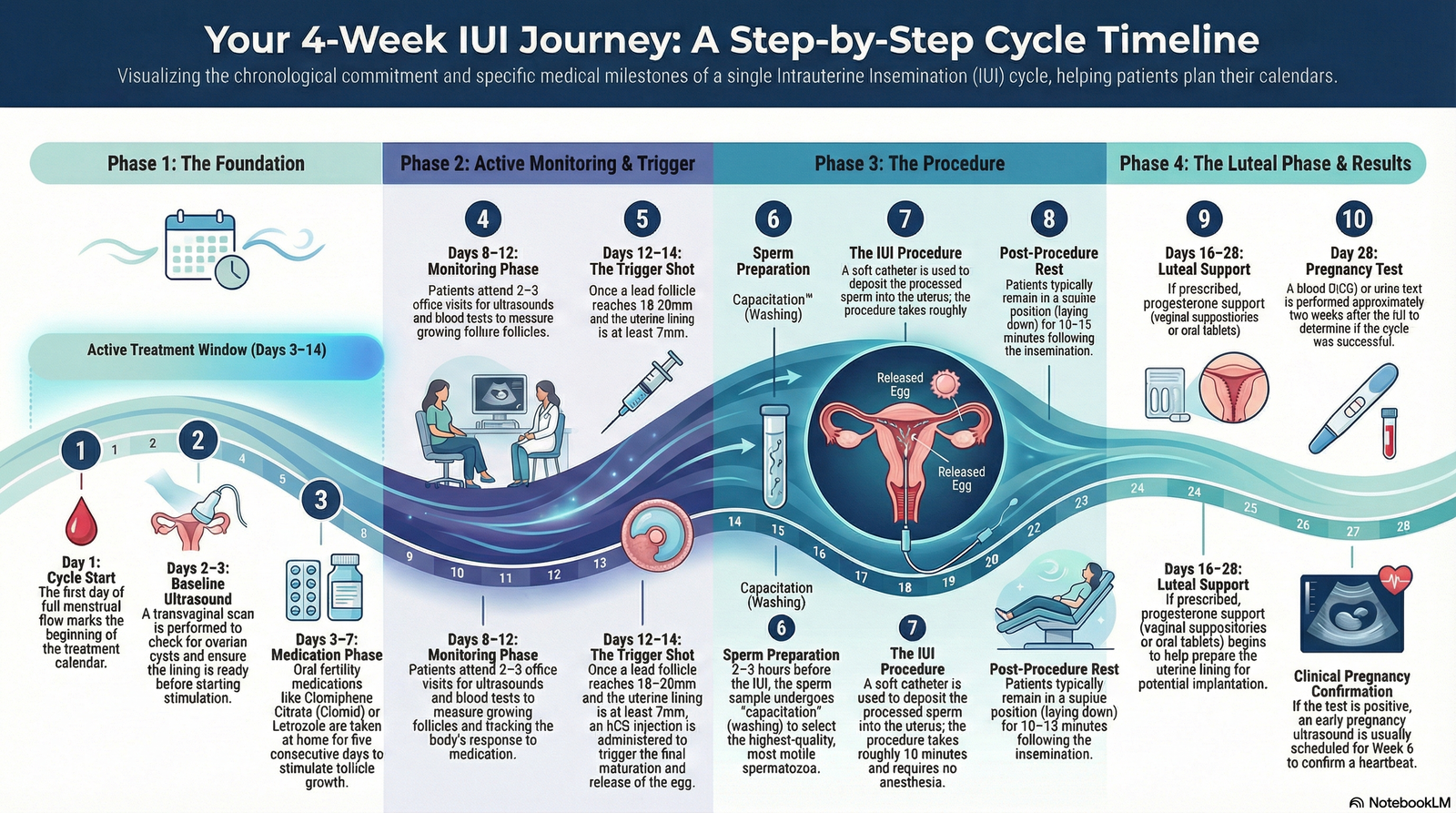
IUI timeline from baseline ultrasound to pregnancy test, usually spread over about four weeks.
| Option | Typical Cost Per Cycle | Invasiveness | Per Cycle Success (Younger Women) |
|---|---|---|---|
| Natural Cycle IUI | $500 to $2,000 | Low, no fertility drugs are used to stimulate the growth of multiple oocyte-containing ovarian follicles. The whole cycle follows natural ovulation. | Around 10% to 18% |
| Medicated IUI | $1,000 to $5,500 | Low to moderate, oral or injectable drugs are used to stimulate several oocyte-containing follicles to grow. The ovarian response to stimulation is monitored by blood tests and ultrasound scans, and the doses of medications might be changed, depending on the ovarian response. | Around 15% to 25% |
| IVF Cycle | $10,000 to $20,000+ | High, follicular aspiration with egg retrieval to collect the mature eggs from the ovaries, and lab fertilization are involved to create an embryo. Then, an embryo is placed back into the intended mother’s uterus. | Often 40% to 50%+ |
If you look at cost per baby instead of cost per cycle, IVF can still win in some age groups despite the higher price per cycle, especially after 38. For younger women, IUI often gives a better balance of cost, time, and invasiveness in the first few treatment attempts.
IUI process step-by-step
If you are considering IUI, you probably want to know exactly what will happen and when. Most clinics follow a similar sequence to time sperm and eggs as closely as possible.
Step 1: Initial consult and planning
Your specialist listens to your story, reviews prior tests, and asks about your cycles, past pregnancies, surgeries, and your partner’s semen history. Together, you decide whether IUI fits your situation and what extra testing you still need.
Step 2: Screening and baseline checks
You complete basic health checks like blood pressure, height, weight, and lab tests for infections such as HIV, syphilis, and hepatitis B and C. Your doctor arranges a baseline ultrasound on day 2 or 3 of your period to check your ovaries and uterus and make sure there are no large cysts.
Step 3: Ovarian stimulation, if used
In medicated cycles, you take tablets like Clomiphene Citrate (Clomid) or Letrozole for five days, usually on days 3 to 7 or 5 to 9, to grow more than one follicle. If you are using injectables, you take small daily injections of gonadotropins and attend more frequent monitoring visits.
Step 4: Follicle monitoring
Your doctor tracks the number and size of follicles with a transvaginal ultrasound. You see how your body responds in real time. If your response is too low or too strong, the team can adjust medication, cancel, or convert the cycle rather than moving ahead blindly.
Step 5: Triggering ovulation
When your lead follicle reaches around 18 to 20 mm, your team decides whether to rely on your natural LH surge or to use an hCG trigger shot to time ovulation. With a trigger shot, ovulation usually happens about 36 hours later, so clinics plan IUI within that window.
Step 6: Sperm preparation
On the day of IUI, the lab receives a fresh partner sample or thaws a vial of donor sperm. They then wash the sample to remove semen fluid that causes cramping, debris, and slow or dead sperm. The goal is a small volume with a high concentration of strong swimmers.
Step 7: Insemination
You lie on an exam table as you would for a Pap smear. Your doctor places a speculum, passes a thin, flexible catheter through your cervix, and injects the washed sperm high into the uterus. The whole procedure takes about 5 to 10 minutes. Most clinics ask you to rest on the table for another 10 to 15 minutes afterwards.
Step 8: Luteal support if needed
Depending on the protocol, your doctor might prescribe progesterone after IUI to support the uterine lining, especially if you used injectable gonadotropins. For many Clomid-only cycles, extra progesterone does not change outcomes and is not always used.
Step 9: Two-week wait and pregnancy test
About 14 to 15 days after IUI, you do a urine or blood test to check for pregnancy. This period can be emotionally tough, especially after earlier disappointments. It can help to agree ahead of time how often you will test and when to call the clinic with results.
Safety, cancellation, and multiple pregnancy risk
4% vs. 32% – Why follicle limits matter: In a large analysis of more than 50,000 stimulated IUI cycles, women under 38 with one mature follicle had about a 15 to 22 percent pregnancy rate and a multiple pregnancy rate around 4 percent. With five follicles, pregnancies rose only slightly, but multiples jumped to about 32 percent. This is why your team cancels or converts when they see too many big follicles. Source: Fertility and Sterility / ASRM Committee Opinion.
14% twin rate, 0 triplets – Converted IVF cycles: When IVF cycles with poor response were converted to IUI with between one and four mature follicles, about 7 percent of cycles led to a baby. Among 21 pregnancies, 3 were twins, and none were triplets, a multiple rate of 14 percent. This study shows that conversion can carry an acceptable twin risk when closely monitored. Source: Journal of Gynecology Obstetrics and Human Reproduction (PMID: 32535238).
COS can raise multiples without a clear benefit for male factor: In isolated male factor infertility, adding controlled ovarian stimulation to IUI increased multiple pregnancy rates, especially when two or more pre-ovulatory follicles grew, without clearly improving live birth. In that study, natural cycle IUI often produced similar outcomes, with no multiple pregnancies. Source: Reproductive Biology and Endocrinology (PMID: 33740990).
Cycle cancellations feel frustrating at the moment. In practice, they are one of the main ways clinics protect you from the medical and emotional cost of higher-order multiples.
Sperm options and lab techniques
The source of sperm changes the logistics of your cycle and sometimes your odds of success. You will usually discuss three questions at your consult: partner versus donor sperm, fresh versus frozen, and which lab preparation method your clinic uses.
IUI with partner sperm (IUI-P)
This option suits couples where the semen analysis is normal or only mildly abnormal. Clinics often look for an inseminating motile count of at least 1 million motile sperm after washing. Below that, IUI success falls, and IVF with ICSI may be a better use of money and time.
IUI with donor sperm (DS-IUI)
Donor sperm is widely used for single women by choice, same-sex female couples, and couples with severe male-factor infertility. Banks freeze and quarantine donor samples for at least six months, then repeat infectious disease testing. On your IUI day, the lab thaws a prepared vial that is already screened and ready to wash and use.
Fresh versus frozen sperm
Fresh partner sperm often performs slightly better than frozen samples. One study reported pregnancy rates around 13.6% with fresh versus 10% with frozen IUI cycles. Modern IUI-ready frozen vials, washed before freezing, still give excellent results and save time and stress on procedure day.
Density gradient versus simple wash
Labs commonly use either density gradient centrifugation (DG) or a simple wash (SW). DG removes more debris and dead sperm, so many labs prefer it. Large series, however, have not shown a clear difference in clinical pregnancy or live birth between DG and a well-done simple wash. You can ask which method your clinic uses, but you do not need to fixate on this detail.
Natural vs. modified vs. stimulated IUI
Your choice between natural, modified, and stimulated IUI shapes how much medication, monitoring, and control your cycle will involve. It also affects your twin risk and your per cycle chances.
| Protocol Type | Medication | Monitoring Level | Timing Method |
|---|---|---|---|
| Natural Cycle | None | Low, at-home LH kits or a few at-clinic ultrasound scans | Natural LH surge |
| Modified Natural | Oral tablets, Clomid or Letrozole | Moderate, ultrasound monitoring and a few blood tests might be required | OPK or hCG trigger |
| Stimulated IUI | Injectable gonadotropins | High, ultrasound and bloodwork | Planned hCG trigger |
| IVF to IUI Conversion | Full-dose gonadotropins | Very high | hCG trigger |
Natural cycle IUI
In a natural cycle, you skip fertility drugs and let your body produce a single follicle. You or your clinic tracks your LH surge with home tests or bloodwork and times IUI to that natural signal. Large registries report clinical pregnancy rates around 18.7% per cycle in some groups, especially in younger women and donor sperm cycles. The big advantage is a much lower risk of twins.
Modified or stimulated IUI
In stimulated cycles, you use oral tablets or injectables to grow two or three follicles. Women with unexplained infertility or irregular cycles often see a clear benefit. In one study, women with irregular periods but normal hormone levels had a 16% live birth rate per cycle after stimulation compared with around 7% in regular-cycle women after matching for other factors. The trade-off is a higher multiple pregnancy rate, around 10.8% in some series, compared with 2.4% for natural cycles.
Letrozole timing
When you use Letrozole, timing your trigger shot matters. Data suggest better outcomes when clinics wait until estradiol (E2) levels rise back to a more natural peri-ovulatory range, around 125 to 150 pg/mL, usually more than two days after the last pill.
Lead follicle size on Clomid
With Clomid cycles, several groups report the best results when the largest follicle measures around 21 to 22 mm at trigger. Smaller follicles can still work, but this range seems to balance egg maturity and a receptive uterine lining.
Conversion strategies between IUI and IVF
One of the biggest advantages of modern fertility care is flexibility. Your doctor can rescue weak IVF cycles by converting them to IUI and can sometimes save high-risk IUI cycles by converting them to IVF instead of cancelling. These moves are based on follicle count, hormone levels, your age, and how many cycles you have already completed.
Rescue strategy: converting IVF to IUI in poor responders
If you start an IVF cycle and your ovaries produce only one or two follicles, it can feel like the whole plan is collapsing. Instead of cancelling outright or paying for egg retrieval and lab work for a single egg, your team can sometimes convert that cycle into IUI.
Why conversion to IUI can be reasonable
- Cost and safety: You avoid anesthesia, egg retrieval, and lab fertilization fees while still using the follicles you grew.
- Similar odds with a single follicle: When only one follicle develops, live birth rates sit in the same low range, roughly 3% to 5%, whether you proceed with IVF or convert to IUI.
- Avoiding no transfer cycles: In poor-response IVF cycles, there is about a 24% chance you will end up without any embryo to transfer. Conversion uses the cycle rather than ending with nothing.
Once you have two or more follicles, the balance shifts. A systematic review of poor responders found that continuing IVF tends to give higher pregnancy and live birth rates than converting to IUI when at least two follicles grow. One study reported that with three follicles, women were about 2.6 times more likely to have a live birth with IVF compared with conversion to IUI.
Going the other way: converting high-response IUI to IVF
Sometimes your body goes into overdrive on what was meant to be a gentle IUI cycle. Instead of the planned two follicles, ultrasound shows five or more large follicles, or your estradiol level rises above about 1,500 pg/mL. At that point, proceeding with IUI carries a high risk of twins or triplets.
In the past, most clinics simply cancelled these cycles. Now, many offer rescue IVF instead. You switch from an IUI plan to egg retrieval. The lab fertilizes eggs and then transfers one or two embryos. This lets you benefit from the strong response while limiting multiple pregnancy risks.
Studies report good results in these converted cycles, often with implantation rates similar to or better than those seen in standard IVF patients. So if your IUI response looks too strong, rescue IVF can turn a disappointing ultrasound into a real opportunity.
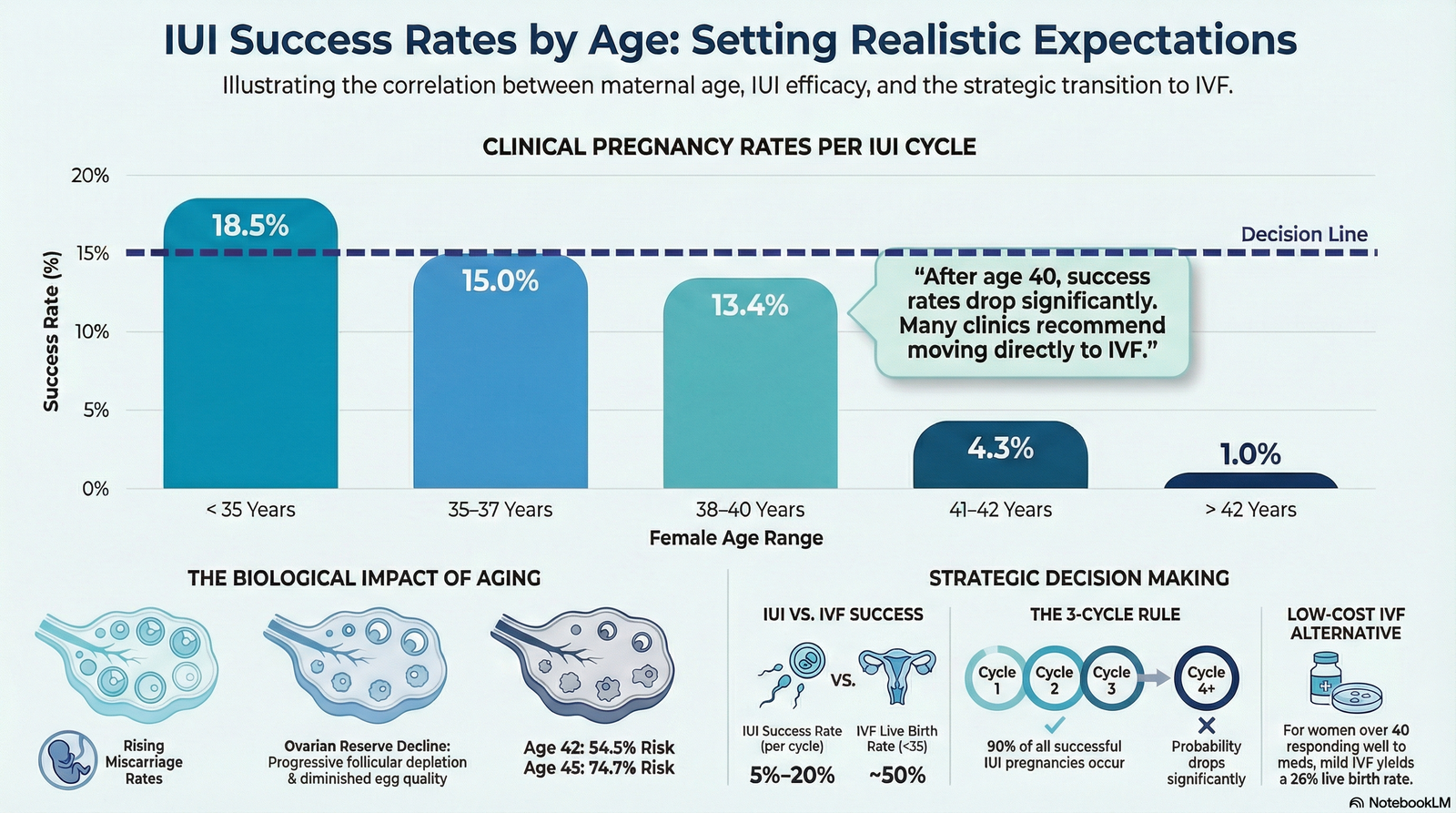
Clinical pregnancy rates per IUI cycle drop with age, especially after 37 to 38.
Success rates by age, follicles, and sperm count
You deserve clear numbers as you decide how many IUIs to try and when to move on to IVF. IUI success depends strongly on age, how many follicles you grow, and post-wash sperm count.
By age, clinical pregnancy per cycle
- Under 35 years: About 11.5% to 18.5% per cycle.
- 35 to 37 years: About 9.2% to 15.0% per cycle.
- 38 to 40 years: About 7.3% to 13.4% per cycle.
- 41 to 42 years: Around 4.3% per cycle.
- Over 42 years: Around 1.0% per cycle, so most clinics recommend IVF or donor egg at this stage.
By follicle count
- For women under 38, one follicle gives a 15% to 22% pregnancy chance with a 4% twin risk.
- With five follicles, pregnancy rates only increase slightly, while the risk of multiple pregnancy rises to around 32%.
In other words, more follicles do not always serve you. After a certain point, risk grows faster than benefit.
By sperm count, post-wash total motile sperm count (TMSC)
- Above 9 million: Best pregnancy rates.
- 4 to 5 million: Still a decent chance.
- Below 0.25 million: Pregnancies still occur, around 4% in one series, but IVF with ICSI usually offers a much higher chance.
Your numbers are not a judgment on you. They are simply data you and your specialist can use to decide between continuing IUI or moving to IVF.
Is IUI right for you?
IUI is not right for everyone, and you should not feel like you have failed if your doctor suggests going straight to IVF. The best choice depends on your tubes, your ovarian reserve, sperm numbers, age, and how fast you want to move.
Situations where IUI often makes sense
- You have at least one open fallopian tube.
- Your partner has at least 1 million motile sperm after washing.
- You are under 40 with unexplained infertility.
- You are a single woman or in a same-sex relationship, and you ovulate on your own or with tablets.
- You have ethical or religious reasons to avoid IVF.
Situations where IVF is usually better from the start
- Both tubes are blocked or removed.
- There is severe male factor infertility, such as a very low count or motility.
- You have stage III or IV endometriosis.
- You have very low ovarian reserve and limited time to try treatments.
- You are over 42 and want to maximize your chance per cycle.
If you feel stuck between doing one more IUI and making the leap to IVF, that is very common. A good consult where you walk through your age, test results, and finances almost always makes the next step clearer.
Want help comparing clinics and costs?
If this already feels like a full-time job, you are not imagining it. Our advisors can collect clear, itemized quotes from verified clinics and map out your likely timeline at no cost to you.

Why trust this guide? The OVU commitment
You are probably juggling hope, timelines, and a lot of tabs open in your browser. And you deserve clear, current, human advice. At OVU, we review clinic protocols, compare real quotes, and talk to people who have done this - intended parents and gestational carriers - so we can give you practical steps, not just theory. If you want help comparing options without sales pressure, we will gather itemized quotes and success data that match your exact situation. You decide, we will bring the info to your table.
Frequently Asked Questions
Does IUI hurt?
Most women describe IUI as similar to a Pap smear. You might feel mild cramping when the catheter passes through your cervix or when the sperm is injected, but the discomfort is brief. If you feel sharp pain during the procedure, tell your doctor immediately so they can adjust.
Is there a magic number of follicles?
For most women under 40, two mature follicles reach an optimal level. Your chance of pregnancy goes up compared with one follicle, and your risk of triplets stays low. More follicles may add a little benefit for pregnancy rates, but the risk of multiple pregnancies rises quickly after that point.
How many IUI cycles should I try before IVF?
Most pregnancies from IUI happen early. Around 90 percent of IUI pregnancies occur within the first three or four cycles. If you have not conceived after four well-timed IUIs, many clinics will recommend a serious talk about moving to IVF instead of repeating more IUIs on autopilot.
Can I exercise after IUI?
Yes. Most clinics let you return to normal daily activity the same day. You may be asked to lie down for 10 to 15 minutes right after the insemination, then you can stand up and move around. Gentle movement is fine unless your doctor gives you specific restrictions.
Does my BMI affect IUI success?
High BMI has a clearer impact on IVF success than on IUI. Studies suggest that higher BMI does not sharply lower IUI pregnancy rates the way it can affect IVF outcomes. Your clinic may still talk with you about weight and general health, but IUI can work across a wide BMI range.
Is a double IUI better than a single IUI in one cycle?
For unexplained infertility, large studies do not show a clear advantage to doing two IUIs in the same cycle compared with one well-timed IUI. Some clinics still offer double IUI for specific situations like male factor infertility, but for many couples, a single, well-timed IUI is enough.
Does sperm morphology predict IUI success?
Older approaches put a lot of weight on sperm morphology, especially the strict Kruger criteria. Newer research shows that morphology alone is a weak predictor for IUI. Even men with less than 1 percent normal forms can see success if the total motile sperm count is strong enough.
Reference List 8 sources
Journal Article (Systematic Review & Meta-Analysis): Lai S, de Bruin JP, Wang R, et al. IVF versus IUI with ovarian stimulation for unexplained infertility: a collaborative individual participant data meta-analysis. Hum Reprod Update. 2024;30(2):174-186. PMID: 38148104. Available from: https://pubmed.ncbi.nlm.nih.gov/38148104/
Journal Article (Research): Li X, Long W, et al. Improved reproductive outcomes in normogonadotropic oligomenorrheic women undergoing ovarian stimulation with intrauterine insemination: a retrospective cohort analysis of real-world data. Front Endocrinol (Lausanne). 2024;15:1441796. PMID: 39444447. Available from: https://pubmed.ncbi.nlm.nih.gov/39444447/
Journal Article (Comparative Study): Aletebi F. High response intrauterine insemination cycles converted to low-cost in vitro fertilization. J Multidiscip Healthc. 2011;4:119-124. PMID: 21655339. Available from: https://pubmed.ncbi.nlm.nih.gov/21655339/
Journal Article (Research): Verhaeghe C, Abnoun S, May Panloup P, et al. Conversion of in vitro fertilization cycles to intrauterine inseminations in patients with a poor ovarian response: risk of multiple pregnancies. J Gynecol Obstet Hum Reprod. 2020;49(8):101831. PMID: 32535238. Available from: https://pubmed.ncbi.nlm.nih.gov/32535238/
Journal Article (Systematic Review): Fujii S, et al. Conversion to IUI versus continuance with IVF in low responder patients: a systematic review. Eur J Obstet Gynecol Reprod Biol. 2018;227:35-40. PMID: 29885573. Available from: https://pubmed.ncbi.nlm.nih.gov/29885573/
Journal Article (Research): Tang Y, He QD, Zhang TT, et al. Controlled ovarian stimulation should not be preferred for male infertility treated with intrauterine insemination: a retrospective study. Reprod Biol Endocrinol. 2021;19(1):45. PMID: 33740990. Available from: https://pubmed.ncbi.nlm.nih.gov/33740990/
Journal Article (Research): Merviel P, Heraud MH, Grenier N, et al. IVF conversion to IUI in poor responders: an observational study. Fertil Steril. 2010;93(1):79-88. PMID: 20499076. Available from: https://pubmed.ncbi.nlm.nih.gov/20499076/
Committee Opinion (Guidance): Practice Committee of the American Society for Reproductive Medicine. Multiple gestation associated with infertility therapy: a committee opinion. Fertil Steril. 2022;117(6):1184-1194. Available from: https://www.asrm.org/practice-guidance/practice-committee-documents/multiple-gestation-associated-with-infertility-therapy-a-committee-opinion-2022/
Final thoughts
Intrauterine insemination is more than just a simpler alternative to IVF; it is a versatile tool that can be tailored to your unique case. Whether you choose a natural cycle to avoid ovarian stimulation medications or a medicated cycle to increase the number of available oocytes, IUI is a treatment option with its own distinct strengths.
We know that cancelled cycles or the setback of a poor follicular response can feel as though the rules are constantly changing. In reality, protocols like cancelling a high-risk IUI or converting between IUI and IVF exist to protect your health and provide flexible ways to move forward. These are strategic course corrections, not signs of failure.
When you understand the data regarding costs, timelines, and success rates, you can walk into your next appointment ready for an informed conversation about which path fits you best. Whether that is a natural IUI, a modified protocol, or a converted cycle, you do not have to make that decision in isolation. Your medical team is there to help you navigate the safest and most effective route toward the healthy, singleton pregnancy you are working for.
Need help planning your next step?
If you want a second set of eyes on clinic quotes or protocols, you can talk with an OVU advisor. They can help you compare IUI and IVF options across trusted clinics and build a clear plan that fits your budget and your timeline.
Related articles

Male Fertility Surgery: TESE, Micro-TESE, and Sperm Retrieval
Male Fertility & Andrology Your guide to male fertility surgery and sperm retrieval options Last Updated: 03 July 2026 Medically Reviewed 16 min read Evidence-based The road to fatherhood often feels steep when you hear the word “infertility”. It is frustrating, lonely, and sometimes scary. At the same time, modern fertility medicine now gives many men a real chance to have a biological child, even when the semen analysis shows no sperm at all. Non-obstructive azoospermia (NOA) means there is no sperm in the ejaculate because the testicles are not making enough mature sperm. This affects about 1% of men
19 min read
Fertility Surgery for Women: Techniques to Improve IVF Success
IVF & Fertility Surgery Your guide to fertility surgery and IVF success Last Updated: 01 July 2026 Medically Reviewed 17 min read Evidence-based For many women, the path to motherhood through in vitro fertilization (IVF) is full of hope and pressure at the same time. You invest money, time, and energy, and you still wonder if your body is truly ready to support an embryo. Think of your uterus as a first home for your baby. Before moving in, you would check the structure and clear out anything that might cause harm. Fertility surgery works in a similar way; it
16 min read
What is Time-Lapse Imaging? Watching Embryo Development 24/7
IVF & Fertility Treatments Your guide to time-lapse embryo imaging in IVF Last Updated: 30 June 2026 Medically Reviewed 14 min read Evidence-based Wondering if watching your embryos grow around the clock is worth the extra money? You are not the only one asking that. For years, your clinic could only check embryo growth a few times a day, like peeking at single snapshots in a photo album. Time-lapse imaging (TLI) changes that. Instead of a few snapshots, your embryos get their own continuous movie. A small camera inside the incubator records images every few minutes while your embryos stay
17 min read