


Dr. Sony Sherpa (MBBS)
In addition to her clinical experience, Dr. Sherpa is a published medical researcher and holistic health advocate. Her dual expertise in emergency care and alternative therapies brings a unique lens to medically reviewed content—ensuring it is both accurate and accessible.
The sticker price for IVF is scary. When you first start looking into fertility treatment, you run into medical jargon and fuzzy estimates that make a hard time feel even more confusing. You might be asking yourself if your insurance covers IVF, how you will manage the gap between what you can afford and what clinics charge, and whether you are the only one struggling with these issues.
You are not. Infertility affects about 1 in 8 couples, but only around 24% have enough financial access to the care they need to conceive. At the same time, you see stories of families spending forty to sixty thousand dollars or more on treatment, which can feel impossible when you are just trying to get clear numbers.
We understand this feels overwhelming and unfair. In this guide, you will see what IVF really costs in the United States, how those costs break down into clinic fees, medications, and add-ons, and where expert guidance and policy changes are already shifting the math in your favor.
In the United States, a single IVF cycle usually costs between $12,000 and $25,000 before medications and add-ons. When you include medications, possible genetic testing, and at least one embryo transfer, the total for one complete attempt often lands between $19,000 and $29,700. Most people need 2 to 3 cycles to have a baby, so many families end up spending $40,000 to $60,000 in total.
Next step: Ask your clinic for a written, itemized quote that separates base fees, medications, testing, and storage so you can see exactly where your money will go.
What the Latest Research Shows About IVF Costs and Coverage
Recent studies in journals including Fertility and Sterility, Fertility and Sterility Reports, and Reproductive Biology and Endocrinology have mapped how costs, insurance coverage, and access to IVF relate in the United States. These data sets include tens of thousands of IVF cycles from hundreds of clinics.
132% Higher Use – Coverage Opens Doors: In US states with strong IVF insurance mandates, people used IVF more than twice as often as in states without these laws. When coverage is built into insurance, many more couples feel able to move forward rather than delay or give up. Source: Fertility and Sterility (PMID: 35283088).
35% vs. 33% – Better Results With Coverage: States with comprehensive IVF coverage had about a 35% live birth rate per cycle compared with 33% in states without similar mandates. They also had fewer embryos transferred and fewer twins or triplets, which means safer pregnancies without giving up success. Source: Fertility and Sterility (PMID: 35283088).
Under $14 Per Month – Insurers Real Cost: A national review estimated the average cost of one IVF cycle in the US at about $9,200. Yet adding IVF coverage to an insurance plan raised monthly premiums by roughly $1 to $14 per member. Source: Journal of Reproductive Medicine (PMID: 20120898).
$19,000 vs. $900 – The IVF Price Shock: In one US study, couples using IVF had a median out-of-pocket bill of about $19,000, compared with under $1,000 for fertility medications alone. Source: Fertility and Sterility (PMID: 24018235).
These findings come from peer-reviewed research. Your own numbers depend on your clinic, state laws, insurance plan, and treatment plan. Use them as a starting point for real conversations with your fertility team and insurance provider.
In This Guide
- IVF Cost Quick Facts in the USA
- Clinic Fees, Medications, and Add-ons
- IVF Cost Comparison Table
- State Insurance Mandates and Coverage Gaps
- Federal Actions and Employer Benefits
- Donor Eggs, Surrogacy, and LGBTQ Plus Costs
- Egg Freezing, Genetic Testing, and the Cost of Waiting
- Money-Saving Strategies That Really Help
- What To Budget For Beyond the Clinic Bill
- Frequently Asked Questions
Base IVF in the US: $12,000 to $25,000 per cycle.
All in per attempt: $19,000 to $29,700.
Average 2.3 cycles to live birth.
Total spend for many families: $40,000 to $60,000.
Only 20 to 21 states have infertility mandates.
IVF use is 132% higher in states with strong coverage.
IVF Cost Quick Facts in the USA
If you only remember a few numbers, let them be these. In the United States, the base cost of an IVF cycle usually falls between $12,000 and $25,000, depending on your clinic and location. Once you add medications, possible genetic testing, and at least one embryo transfer, your total for one complete attempt often climbs into the $19,000 to $29,700 range.
Most people do not have a baby from the very first transfer. Across large data sets, the average number of cycles needed for a live birth is about 2.3, which means many families see total IVF costs in the range of $40,000 to $60,000. For women under 35, the live birth rate per started cycle is now roughly 52%, which is encouraging, but also shows why planning for more than one attempt is wise.
What These Numbers Mean For You
52% – Your Chances Per Cycle: If you are under 35, you have about a one-in-two chance of having a baby per started cycle. This is hopeful, yet it still means many people need more than one try.
2.3 Cycles – Plan for More Than One: Budgeting for at least two to three cycles can keep you from feeling blindsided if the first transfer does not work.
271% Higher Cost – Why US Patients Feel Stuck: One international review found US IVF costs more than two and a half times the average in other developed countries. That helps explain why cost feels like such a high wall to climb.
If you are looking at these numbers and feeling your stomach drop, you are not alone. This is exactly why it helps to break the process into smaller cost pieces and look for every possible way to bring your total down.
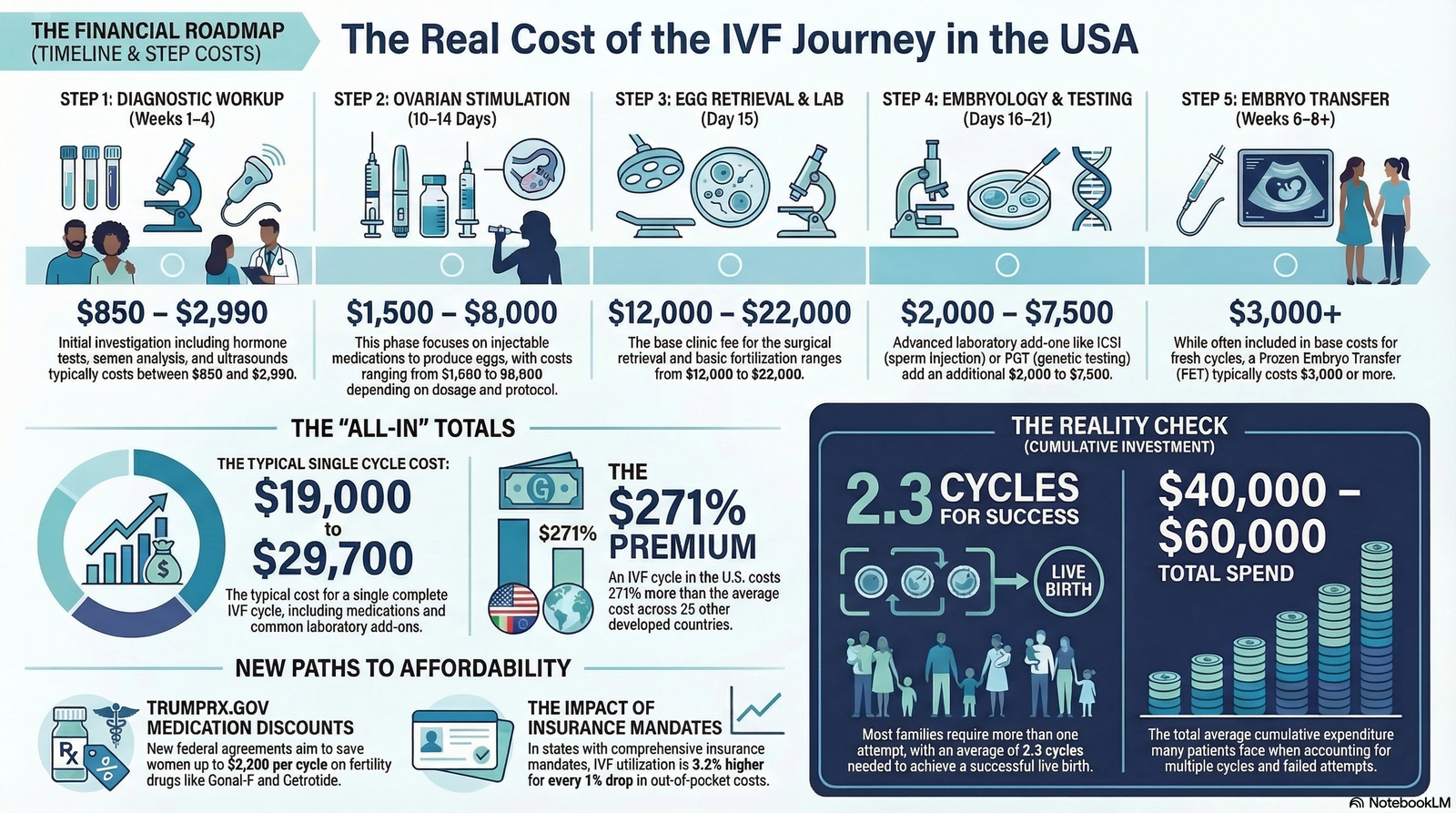
IVF in the USA at a glance: process timeline, major cost buckets, and average total spend over multiple cycles.
Clinic Fees, Medications, and Add-ons
If you are trying to build a realistic fertility budget, you need to know where every dollar goes. The price you see in a clinic ad usually covers only the main procedures, like egg retrieval and embryo transfer. It rarely includes the tests, medications, or add-ons that often double or triple your total bill.
The good news is that once you see the pieces laid out, you can decide which items are essential now, which can wait, and where you might save.
Clinic and Lab Fees ($12,000 to $22,000)
This part pays for the medical team and lab work that make IVF possible. At most clinics, the fee includes:
- In cycle monitoring: Regular bloodwork and ultrasounds to track how your follicles are growing.
- Egg retrieval: A short surgical procedure under anesthesia, where your doctor collects the eggs.
- Embryology services: Fertilizing the eggs and growing embryos safely in the lab.
- Fresh embryo transfer: Placing an embryo back into your uterus.
The Medication Piece ($1,500 to $8,000)
Medications are one of the biggest uncertainties in your total bill. Your doses depend on your age, ovarian reserve, and body mass index. A typical stimulation protocol includes:
- Injectable FSH or hMG (Gonal F or Menopur): These drugs tell your ovaries to grow multiple eggs in one cycle.
- Trigger shot (Ovidrel): This dose finishes egg maturation right before retrieval.
- Progesterone: This hormone supports your uterine lining so an embryo can implant and stay.
Common Add-ons and How They Change Costs
Your clinic may suggest extra procedures to improve your odds. Ask what each one costs and whether your situation truly calls for it now.
- ICSI (Intracytoplasmic Sperm Injection): Often used for male factor infertility, usually about $1,500 on top of the base IVF fee.
- Assisted hatching: Around $500, used to help the embryo break out of its shell and implant.
- PGT (Preimplantation Genetic Testing): Screens embryos for chromosomal issues, often adding $3,000 to $6,000.
- Embryo freezing and storage: Usually $500 to $1,200, plus yearly storage fees of $500 to $1,000.
IVF Cost Comparison Table
Here is a simple way to see how these pieces stack up for three common IVF scenarios in the United States.
| Scenario | Base Clinic Fees | Medications | Add ons | Estimated Total Per Attempt |
|---|---|---|---|---|
| Standard IVF | $12,000 | $3,000 | $0 to $1,000 | $15,000 to $16,000 |
| IVF with ICSI and PGT | $15,000 | $4,000 to $6,000 | $4,500 to $7,500 | $23,500 to $28,500 |
| Donor Egg IVF | $12,000 to $18,000 | $3,000 to $5,000 | $18,000 to $35,000 (donor eggs) | $33,000 to $58,000 |
How To Read This Cost Table
Standard IVF: If you are younger with no male factor issues, your total per attempt may stay closer to the standard range.
ICSI and PGT: If you have male factor infertility or want genetic testing, your add-ons can almost double your costs per attempt.
Donor Eggs: Donor eggs are the single biggest cost jump in IVF, and they also raise legal and emotional questions. Plan for a separate, detailed talk with your clinic and, if needed, a lawyer.
State Insurance Mandates and Coverage Gaps
If you live in a state with a strong infertility mandate, you may have far more coverage than someone in a neighboring state. State infertility laws are the main way access expands without a federal standard. The details vary a lot, so you need to look at the exact wording that applies to you.
States With Stronger Mandates
Right now, states such as Massachusetts, New Jersey, Connecticut, Illinois, Maryland, Rhode Island, Delaware, and New York are often seen as the best for IVF coverage.
- Massachusetts: No dollar lifetime cap and no set limit on the number of treatment cycles.
- Maryland: Lifetime maximum of $100,000 and a required 2-year period of infertility before benefits begin.
- New Jersey: Covers up to 4 cycles for women under 46 but excludes embryo storage costs.
- Rhode Island: Lifetime cap of $100,000 and coverage for women between 25 and 42.
- Illinois: Covers up to 4 cycles, plus 2 more after a live birth, for a lifetime total of 6 cycles.
- New York: Large group plans with 100 or more employees must cover 3 IVF cycles.
States With Offer or Limited Mandates
- California and Texas: Insurers must offer fertility coverage to employers, but IVF is often carved out or tied to strict rules, such as a 5-year history of infertility.
- Arkansas and Hawaii: One cycle limits and specific rules, such as needing to use a husband’s sperm.
The ERISA Loophole
If you work for a large company that is self-insured, your plan may be exempt from state mandates under the federal Employee Retirement Income Security Act, known as ERISA. In practice, this means you could live in Massachusetts and still have no IVF coverage if your employer funds its own plan. You need to check your actual plan document and summary, not just assume coverage based on your state.
Insurance and Access: What Research Tells Us
7 in 10 Policies – Coverage With Strings: A review of 58 major US insurers found that about 7 in 10 IVF policies included some coverage, but many added strict rules, such as a required infertility diagnosis and cycle caps. Source: Fertility and Sterility Reports (PMID: 36542313).
132% Higher Use – Mandates Matter: In states with comprehensive IVF mandates, IVF use was more than twice as high, with slightly better outcomes and fewer multiple births. Source: Fertility and Sterility (PMID: 35283088).
Lower Multiple Pregnancy Risk: When coverage improves, clinics and patients feel less pressure to transfer multiple embryos at once, which leads to safer singleton pregnancies without losing success. Source: New England Journal of Medicine (PMID: 12200554).
If you feel stuck by your coverage right now, this research shows that policy really does change what is possible. It is worth pushing your employer and state lawmakers to do better.
Federal Actions and Employer Benefit Trends
If your state or insurance plan is not giving you much, slow but real changes at the federal and employer level can still shift your out-of-pocket costs.
The Most Favored Nation Drug Deal
New federal efforts aim to pull US drug prices closer to the levels other developed countries pay. A large agreement with EMD Serono focuses on lowering fertility drug costs, which now make up about 20% of a typical IVF bill.
- Gonal F Pen: Under the deal, a pen can cost as little as $168, depending on the dose.
- Cetrotide: Prices have dropped from $316 to around $22.50.
- Ovidrel: Costs have come down from $251 to roughly $84.
- Discounts for lower-income patients: Women with incomes below 550% of the federal poverty level can qualify for deep discounts when they buy through government portals.
New Employer Fertility Benefit Options
The Departments of Labor and Health and Human Services have introduced a fertility benefit option that lets employers offer a separate fertility package, similar to dental or vision insurance. This matters because about 70% of large employers now offer some type of IVF coverage, compared with roughly 32% of all employers. If you work for a mid-size or large company, there is a good chance your HR team can expand or add fertility coverage if they know staff are asking for it.
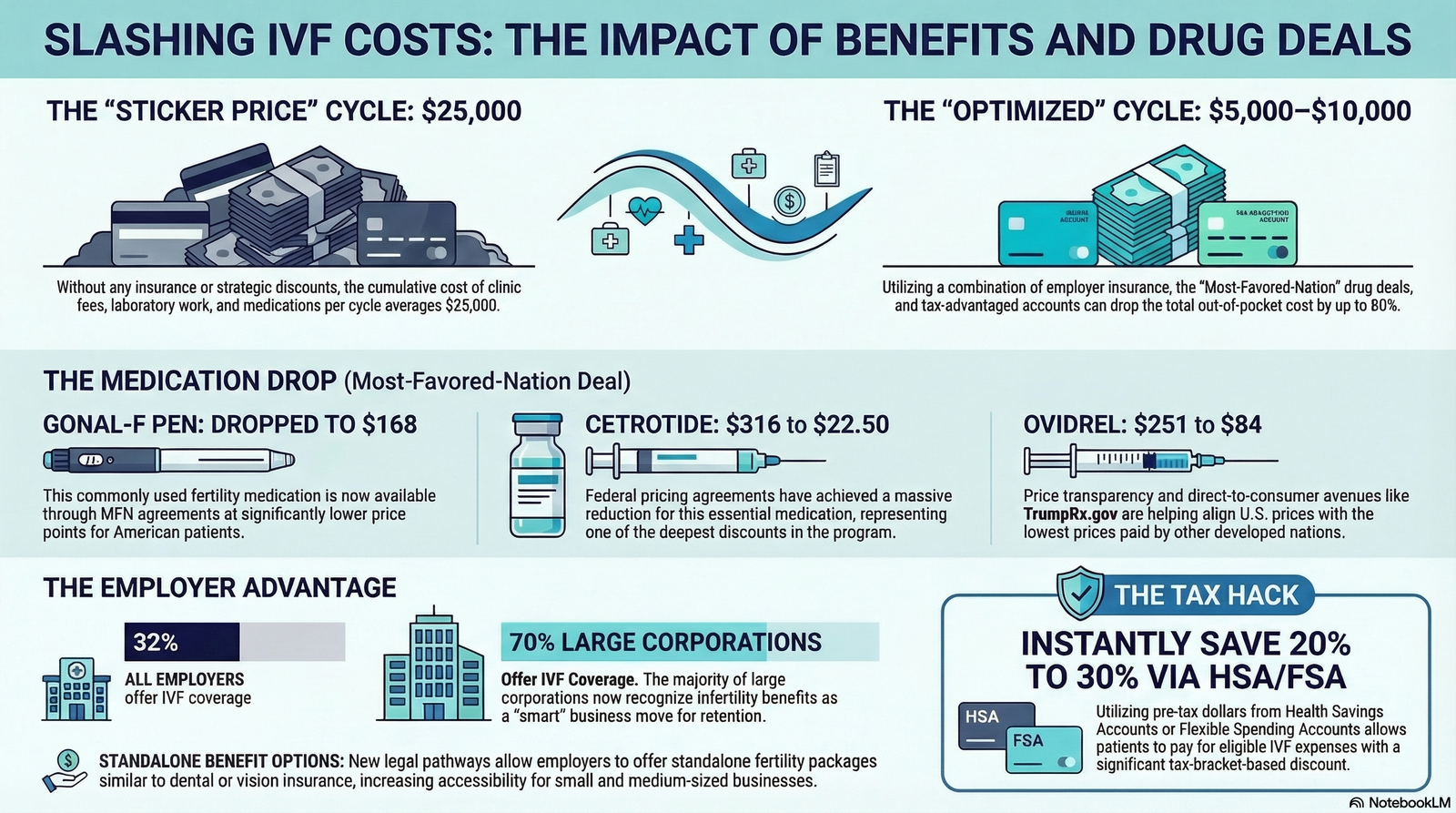
How drug pricing and employer benefits can bring down your out of pocket IVF costs over multiple cycles.
Donor Eggs, Surrogacy, and LGBTQ Plus Family Building Costs
Not every path to parenthood looks like a standard IVF cycle. If you need donor eggs, donor sperm, reciprocal IVF, or a gestational carrier, your budget changes in a big way. You deserve to see these numbers clearly before you commit.
Donor Eggs and Donor Sperm
If you need donor eggs, your total cost rises sharply.
- Donor eggs: A frozen set of 6 to 8 eggs usually costs $18,000 to $35,000.
- Fresh donor cycle: Often $40,000 or more, including donor pay and medical screening.
- Donor sperm: Vials generally cost $400 to $2,200 each. Clinics often suggest buying at least two vials per retrieval cycle.
Reciprocal IVF (RIVF)
If you are in a same sex female couple, reciprocal IVF lets one partner provide the eggs while the other carries the pregnancy. Many couples see this as a way to share both the physical and emotional load.
- National average: Total costs usually land between $21,000 and $25,000, including legal fees.
- Regional differences: Some clinics advertise packages from around $8,290, but you still need to budget another $500 to $2,000 for legal work.
Gestational Surrogacy
Gestational surrogacy is the most expensive route to parenthood in the US. A full surrogacy journey often reaches $100,000 to $150,000.
- Agency fees: Matching, coordination, and support typically start around $15,000.
- Surrogate reimbursement: Often $18,000 to $33,000, covering the surrogate’s time, lost income, and pregnancy-related expenses.
Planning For Third-Party Reproduction Costs
Big Jumps, Big Decisions: Donor eggs, surrogacy, and legal work can double or triple your overall costs compared with a standard cycle.
Layered Teams: These paths bring lawyers, agencies, and extra counselors into the picture, and each team member has fees.
Why This Matters: If you know you may need donor eggs or a surrogate later, it can be worth freezing eggs or embryos earlier, while you still have more choices and lower costs.
Egg Freezing, Genetic Testing, and the Cost of Waiting
If you are delaying pregnancy for work, education, or personal reasons, you pay two types of costs: money and time. The older you are when you freeze eggs or start IVF, the more cycles you usually need, and the more you spend on medications.
Egg Freezing ($8,000 to $15,000)
The average egg freezing cycle costs $11,000, not counting storage fees.
- Storage fees: Plan for $500 to $1,000 per year to keep eggs frozen.
- Thaw and use later: When you return to use those eggs, the thaw, fertilization, and transfer process usually adds another $8,200 to $13,115.
- Age and cycles: Women over 37 often need more than one freezing cycle to bank a safer number of eggs.
The Value of Genetic Testing
Preimplantation genetic testing (PGT) adds $3,000 to $6,000 to your upfront costs, but for some families, it prevents decades of medical bills and emotional stress.
- Sickle cell disease: Using IVF with PGT M to transfer only embryos without sickle cell disease leads to an estimated lifetime savings of about $137,594 compared with caring for an affected child.
- Huntington disease: For a theoretical group of 3,851 couples at risk, PGT M avoids passing on the disease and saves more than $46 million in healthcare costs.
Money-Saving Strategies That Really Help
The numbers can feel impossible at first, but there are practical ways to lower what you pay and spread costs out so IVF feels more manageable. You deserve to know every tool you can use.
- Travel for care: More than 10,000 people each year travel to lower-cost clinics such as CNY Fertility. Even after flights and hotels, many couples save tens of thousands of dollars.
- Use pre-tax dollars: If you have an HSA or FSA, you can pay for eligible IVF costs with pre-tax money and often save 20% to 30%, depending on your tax bracket.
- Look at low-interest financing: Companies like Future Family, CapexMD, and LendingClub offer fertility loans with terms up to 60 months. Some clinics partner with lenders and offer 0% interest for the first 12 months if you qualify.
- Ask about bundled packages and refunds: Shared risk or guaranteed success programs may give up to a 75% refund if you do not have a live birth after several cycles.
- Apply for grants: Groups such as Baby Quest Foundation, the Cade Foundation, and the Nest Egg Foundation offer grants that can cover part or most of your treatment.
- Use generic medications where possible: Ask your doctor about lower-cost versions of fertility drugs, such as generic clomiphene.
- Ask about military discounts: Many clinics offer 5% to 10% discounts for active duty service members and veterans.
What To Budget For Beyond the Clinic Bill
When you build your baby budget, you also need to plan for the smaller line items that sneak up on you. These costs may not show up on a clinic flyer, but they show up on your credit card.
- Initial diagnostic workup: Before you start a cycle, you go through tests such as AMH, FSH, and semen analysis. Across the US, this bundle averages about $1,559, but ranges from roughly $835 in Oregon to $2,986 in Alaska.
- HSG (hysterosalpingogram): This X-ray of your tubes and uterus is often the single most expensive diagnostic test, usually $750 to $1,000.
- Time off work: IVF comes with early morning monitoring visits. If your job is not flexible, build in the cost of lost wages or unpaid time off.
- Psychological and genetic counseling: Clinics often require counseling for donor egg or donor sperm cycles and for some genetic situations. Sessions usually cost $150 to $400 each.
Want help comparing clinics and costs?
If this feels like a full time job, and honestly it can, our advisors can collect clear, itemized quotes from verified clinics and map out your options at no cost to you.

Why trust this guide? The OVU commitment
You are probably juggling hope, timelines, and a lot of tabs open in your browser. And you deserve clear, current, human advice. At OVU, we review clinic protocols, compare real quotes, and talk to people who have done this - intended parents and gestational carriers - so we can give you practical steps, not just theory. If you want help comparing options without sales pressure, we will gather itemized quotes and success data that match your exact situation. You decide, we will bring the info to your table.
Frequently Asked Questions
Does insurance ever cover medications if it does not cover the IVF procedure?
Yes. Some plans pay for diagnostic tests and medications even when they exclude the IVF procedure. Ask your insurer to look up specific billing codes, such as 58970 for IVF and S4042 for IUI, and ask them to spell out exactly what they cover for you.
Is IVF cheaper in Canada than in the United States?
Yes. A single IVF cycle in Canada usually runs $7,700 to $11,100 CAD, which is lower than the $15,000 or more you often see in the United States. Some US patients choose cross-border care for this reason, although travel costs and wait times also matter.
What is a freeze-all cycle?
In a freeze-all cycle, the clinic freezes all embryos after retrieval instead of doing a fresh transfer right away. You then pay a separate transfer fee later, often $3,000 to $6,000, but this approach can improve safety and outcomes for certain patients, especially if your hormones were very high during stimulation.
How much do storage fees for eggs, sperm, or embryos cost?
Storage usually runs between $500 and $1,200 per year. Some long-term storage companies offer rates closer to $200 per year if you commit to several years at once. Ask your clinic whether they store on site or partner with an outside facility, and who bills you.
Can I use a loan to cover more than just the clinic fees?
Yes. Most fertility-focused loans from partners such as Future Family can also cover medications, genetic testing, and donor services, not just the clinic bill. Before you sign, confirm which vendors they can pay directly so you are not surprised later.
Are there specific grants for cancer patients who need fertility preservation?
Yes. Programs such as Livestrong Fertility and Team Maggie for a Cure offer grants to help you freeze eggs, sperm, or embryos before chemotherapy or other treatments that can damage fertility. Your oncology team and fertility clinic can help you apply quickly, since timing is often tight.
Does age change how much I spend on IVF medications?
Yes. As you get older, you often need higher hormone doses to get the same number of eggs, which can push your medication bill toward the higher end of the $3,000 to $8,000 range. If you are in your late thirties or early forties, it can help to ask your doctor for a best-case and worst-case medication estimate before you start.
Reference List 7 sources
Journal Article (Research): In vitro fertilization: a cross-sectional analysis of 58 US insurance companies. Fertility and Sterility Reports. 2022;[online ahead of print]. PMID: 36542313. Available from: https://pubmed.ncbi.nlm.nih.gov/36542313/
Journal Article (Research): Impact of comprehensive state insurance mandates on in vitro fertilization utilization, embryo transfer practices, and outcomes in the United States. Fertility and Sterility. 2022;[online ahead of print]. PMID: 35283088. Available from: https://pubmed.ncbi.nlm.nih.gov/35283088/
Journal Article (Research): Willingness to pay for in vitro fertilization: results from a national sample of reproductive-aged adults in the US. Fertility and Sterility Reports. 2024;[online ahead of print]. PMID: 40465151. Available from: https://pubmed.ncbi.nlm.nih.gov/40465151/
Journal Article (Review): Omurtag KR, Styer AK, Session D, Toth TL. Economic implications of insurance coverage for in vitro fertilization in the United States: a review. Journal of Reproductive Medicine. 2009;54(11–12):661–668. PMID: 20120898. Available from: https://pubmed.ncbi.nlm.nih.gov/20120898/
Journal Article (Research): Out-of-pocket fertility patient expense: data from a multicenter US study. Fertility and Sterility. 2014;[volume and pages not listed]. PMID: 24018235. Available from: https://pubmed.ncbi.nlm.nih.gov/24018235/
Journal Article (Research): Jain T, Harlow BL, Hornstein MD. Insurance coverage and outcomes of in vitro fertilization. New England Journal of Medicine. 2002;347(9):661–666. PMID: 12200554. Available from: https://pubmed.ncbi.nlm.nih.gov/12200554/
Journal Article (Review): Peipert BJ, Montoya MN, Bedrick BS, Seifer DB, Jain T. Impact of in vitro fertilization state mandates for third-party insurance coverage in the United States: a review and critical assessment. Reproductive Biology and Endocrinology. 2022;20(1):111. PMID: 35927756. Available from: https://pubmed.ncbi.nlm.nih.gov/35927756/
Final Thoughts
The money side of infertility is more than a headache. It is a real barrier that forces many people to choose between financial stability and the hope of a child. That is a heavy, unfair choice to carry, especially when you are already managing appointments, injections, and the emotional ups and downs of each cycle.
At the same time, the picture is not completely bleak. New state mandates in places like Delaware and New York, lower drug prices, and better employer benefits are slowly changing what is possible. When you understand where the costs come from and which levers you can pull, you gain back some control.
Many people compare the cost of IVF to buying a car. It is a major expense, but one that families often decide to finance because the end result matters that much. Parents who have been through IVF will tell you that while the bills were painful, the child in their arms made the numbers fade into the background.
If you are in the middle of this, you deserve straight answers, transparent pricing, and support. Ask clinics for itemized quotes. Push your employer and insurer to spell out exactly what they cover. Use every tool you can, from grants and pre-tax accounts to travel options and payment plans. Your path to parenthood is personal, and you have more options for affording it than you might think.
Ready to see real IVF quotes for you?
If you want help turning these numbers into a concrete plan, our team can match you with verified clinics, share itemized cost estimates, and highlight lower-cost options that fit your situation.
Related articles

Employer Fertility Benefits: How to Read the Fine Print and Protect Your Budget
Fertility Benefits & Financing Your guide to understanding employer fertility benefits, costs, and coverage gaps Last Updated: 22 July 2026 Medically Reviewed 14 min read Evidence-based If you are trying to build your family and running into roadblocks, it probably feels like you are living in two worlds. In one, friends seem to get pregnant without thinking about it. In the other, you are juggling clinic visits, lab results, and bills that look more like a mortgage down payment than a medical copay. It is an exhausting place to live. The numbers behind what you are feeling are stark. The
19 min read
Fertility Grants & Scholarships: How to Actually Afford IVF
Fertility Costs & Financing Your guide to fertility grants, IVF costs, and real-world budgeting Last Updated: 19 July 2026 Medically Reviewed 16 min read Evidence-based I know the sticker price of fertility treatment is terrifying. When you first get that folder from your clinic, it is easy to feel completely overwhelmed. Very few of us can easily set aside $25,000 for a single IVF cycle, especially when that investment comes with no guarantees. This financial pressure forces a difficult internal dialogue: “How are we going to pay for this?” or even worse, “Are we paying for treatment or paying to
16 min read
Fertility Financing Options: How To Pay For IVF Without Losing Your Mind
Fertility Costs & Financing Your guide to fertility treatment costs and financing options Last Updated: 16 July 2026 Medically Reviewed 20 min read Evidence-based If you have just opened a clinic estimate and seen figures like $20,000 or $30,000, you might feel a wave of embarrassment or anxiety. It is natural to hesitate before rushing into treatment when your mind is overwhelmed by the thought of affording it all without taking on a second job or starting a side business just to cover the costs. You aren’t just thinking about the medications and procedures; you’re wondering how to pay for
16 min read