

Dr. Sony Sherpa (MBBS)
In addition to her clinical experience, Dr. Sherpa is a published medical researcher and holistic health advocate. Her dual expertise in emergency care and alternative therapies brings a unique lens to medically reviewed content—ensuring it is both accurate and accessible.
Staring at an IVF calendar and thinking, where do I even start? You are not alone, especially if it is your first cycle of IVF treatment.
IVF isn’t guesswork; it follows a clearly envisaged and time–framed strategy from the first consultation to embryo transfer or embryo vitrification (in cases when deferred transfer, also known as delayed frozen embryo transfer, is preferred). This guide map the steps, the usual timing, and what your actual days look like.
Most IVF cycles take about 6–8 weeks from consultation to pregnancy test, with 8–14 days of stimulation and 3–5 monitoring visits.
Most IVF cycles take about 6–8 weeks from consultation to pregnancy test. Expect 8–14 days of stimulation with 3–5 monitoring visits (baseline ultrasound scans and blood tests), a trigger shot, egg retrieval (day 0), 5–6 days of lab work (embryo cultivation), and either a fresh transfer (day 5) or a frozen transfer in the next cycle.
Next step: Ask your clinic about antagonist protocols, freeze–all vs. fresh, and FET scheduling to map your exact dates.
In This Guide
- What’s the full IVF timeline, step by step?
- How does the IVF calendar look week by week?
- Which meds and tests happen on which days?
- What are the realistic 2025 costs and success rates?
- Can I see a sample day-by-day plan?
- When is the pregnancy test and first ultrasound?
- What if I’m low on reserve? Is Duo - Stim faster?
Stimulation: 8 to 12 days
Trigger to retrieval: 24 to 40 hours
Transfer: Day 2 to Day 5
Sometimes Day 6 or Day 7
Pregnancy test: Day 13–14 after retrieval
Alternate: Day 9 and Day 12 after transfer
Ultrasound: Weeks 5–7 of pregnancy
Heartbeat check follows
IVF cycle (USA): $12,000 to $15,000
Other countries: from ~$3,000
Meds per cycle: $1,500 to $3,000
ICSI: $1,500 to $4,500
Under 35: 41%–43% per cycle
35-37: 33%–36%
38-40: 23%–27%
40+: 13%–18%

What's the full IVF timeline, step by step?
The In Vitro Fertilization (IVF) process follows a precise, sequential timeline. The key strategies include initial consultation and screening, ovarian stimulation and follicle monitoring, trigger injection (trigger shot) and ultrasound–guided egg retrieval, fertilization (conventional or intracytoplasmic sperm injection), embryo culture, mock embryo transfer (if necessary), embryo transfer (or vitrification), and finally, early pregnancy testing.
If the pregnancy test is positive, an early pregnancy ultrasound scan is then scheduled to confirm the presence of an embryonic gestational sac and cardiac activity and to estimate the number of viable embryos in cases where multiple embryo transfer was performed.
Step 1 - Consultation and planning
Because every case is unique, the basic treatment protocol is tailored according to individual needs. Your fertility specialist will review your medical history and all past tests to establish your specific protocol. A baseline screening may be performed during this initial visit or scheduled shortly afterwards.
Step 2 - Female fertility assessment
This assessment confirms clinical suitability to proceed and provides the essential diagnostic data required for individualized medication dosing.
The evaluation typically includes:
General Physical Examination and Vitals: Standard health check.
Breast, Pelvic Examination, and Papanicolaou (Pap) Smear: Routine gynecological screening.
Transvaginal Ultrasound: Performed to assess uterine, endometrial, tubal, or ovarian health and rule out abnormalities.
Infection Screening and Cytology Samples: Laboratory tests to detect potential infections.
Ovarian Reserve Assessment: This crucial component helps determine the expected ovarian response to stimulation:
Antral Follicle Count (AFC): Performed via ultrasound, typically on cycle day 3–6. An AFC between 6 and 12 is often a common starting point.
Hormone Panel: Includes Anti–Müllerian Hormone (AMH), Follicle–Stimulating Hormone (FSH), Luteinizing Hormone (LH), and Estradiol (). Some clinics also access progesterone (P4) on baseline day 3.
Genetic Testing: Performed if clinically indicated, which may include Primary Ovarian Insufficiency (POI) panels.
Other Essential Laboratory Tests: May include blood group and status, Complete Blood Count (CBC), coagulation studies, prolactin, Thyroid–Stimulating Hormone (TSH), and screenings for sexually transmitted infections (STIs).
The results gathered from this comprehensive assessment are used by your fertility specialist to precisely fine–tune your stimulation protocol and medication dosage.
Step 3 - Male fertility assessment
Simultaneously with the final screening, a semen analysis is performed, whether using a partner or donor sample. The laboratory assesses sperm concentration, motility, and morphology to guide the optimal fertilization method. Following the review of all diagnostic tests (including any genetic testing), your fertility specialist will finalize your individualized stimulation protocol, including specific medication types and dosages. Adhering closely to the schedule is essential, so all cycle dates should be accurately recorded.
Step 4 - Controlled ovarian stimulation
You will begin daily hormonal injections. The goal is to stimulate the growth of multiple ovarian follicles, rather than the single dominant follicle typical for a natural cycle. Most stimulation phases last 8–12 days.
You will use FSH–based meds, plus medication that prevents early or spontaneous ovulation. Dosages can change mid–cycle (in case of poor or hyper–response) and are determined by transvaginal ultrasound monitoring.
Step 5 - Monitoring and bloodwork
Every few days you will have ultrasounds and hormone checks. Follicles get measured, and estradiol and progesterone levels are tracked. If the response is slow, the dose may rise. If the response is brisk, the dose may drop.
Step 6 - Trigger shot timing
When several follicles reach about 16–18 mm in size, the trigger shot is scheduled.
When several follicles reach about 16–18 mm in size, the trigger shot is scheduled. A trigger shot prompts final maturation and sets the clock. Ovulation follows roughly 24–36, sometimes 36–40 hours after the trigger. Retrieval is scheduled accordingly. A dual trigger (using both hCG and a GnRH agonist) may be used in specific cases, based on your protocol.
Step 7 - Egg retrieval
Retrieval happens under ultrasound guidance, with a thin aspiration needle. It lasts about 15–30 minutes total. You will have anaesthesia for comfort. Following the retrieval, you will be moved to a recovery area for a brief period of post–operative rest and monitoring.
Step 8 - Sperm collection and preparation
Semen is collected the same day as the oocyte retrieval. The lab “capacitates ” sperm using techniques like density gradient or swim–up to isolate the highest quality sperm. Sometimes both are combined. These methods, such as density gradient or swim–up, isolate the most motile, morphologically normal sperm.
And then the magic step takes place. Fertilization.
Step 9 - Fertilization
IVF or ICSI. Conventional IVF places eggs with sperm in a dish. ICSI injects a single motile sperm into each mature egg. Your embryologist may switch to ICSI if there is a clear indication.
Fertilization is checked about 18–24 hours later. A normally fertilized day–1 embryo (zygote) displays two pronuclei under the microscope.
Step 10 - Embryo culture and selection
Embryos are grown in carefully designed media for 2–6 days. Embryologists watch development closely, sometimes with time–lapse imaging. Not every embryo reaches the blastocyst stage. Not every embryo is suitable for transfer or freezing.
Selection typically happens between day 2 and day 5. Sometimes up to day 6. Scoring looks at cleavage, regularity, and fragmentation.
Step 11 - Embryo transfer
The embryo transfer procedure is usually a swift and minimally invasive process that lasts around 20 minutes. It is commonly performed between Day 2 and Day 5 of embryo culture, with Day 5 (blastocyst stage) being the most frequent timing when viable blastocysts are available. In some cases, the transfer may occur on Day 6.
A soft catheter passes through the cervix into the uterus. Ultrasound helps guide placement. You will rest briefly afterwards. Then you will be able to go home.
Step 12 - Vitrification of remaining embryos
Any good–quality embryos that are not transferred during the current cycle are vitrified and stored in cryogenic tanks for future use. The survival rate of embryos upon warming is now highly successful, making deferred or frozen embryo transfer (FET) cycles a highly viable option. Frozen embryo transfer (FET) cycles eliminate the need for stimulation and retrieval, making subsequent cycles shorter and less invasive.
Step 13 - Pregnancy testing
There are two common timing patterns:
- Option one: beta–hCG testing on day 13–14 after retrieval.
- Option two: blood tests on day 9 and day 12 after transfer.
Clinics use one approach or the other.
High beta suggests implantation. Low or falling levels can signal a problem. This stage can be emotionally challenging.
Step 14 - Early ultrasound
If the beta is positive, the first scan is usually at weeks 5–7 of pregnancy, which is about 3–5 weeks after transfer. The scan confirms the location and number of sacs and checks for a heartbeat.
| Stage | Typical Window | Key Actions |
|---|---|---|
| Consultation + Baseline | Week 1–2 | History, baseline labs, ultrasound, finalize protocol |
| Stimulation | Week 2–4 | Daily injections 8–12 days, 2–4 monitoring visits |
| Trigger → Retrieval | End of Week 3 or 4 | Trigger when follicles ~16–18 mm, retrieval 24–40 hours later |
| Lab Days | Week 4 | Fertilization check at 18–24 hours, culture to day 2–5 |
| Embryo Transfer | Week 4 | On transfer days 2–5, vitrify unused suitable embryos |
| Testing | Weeks 5–6 | Beta–hCG timing per clinic, early ultrasound at weeks 5–7 |
Which meds and monitoring happen on which days?
Optimal Timing for Trigger Shot
A 2024 multicenter RCT of 1,847 patients (PMID: 38432291)
Important finding: Trigger timing when 3+ follicles reach 17–18mm (rather than waiting for 20mm) results in similar oocyte yield (11.2 vs 11.5) but significantly lower OHSS risk (2.1% vs 5.8%).
In simple terms, meds grow follicles, blockers prevent early ovulation, and the trigger finishes maturation. Monitoring makes sure it is all synced.
- Stimulation days 1–5: daily FSH injections, first check around day 4–6
- Stimulation days 6–10: add ovulation blocker as instructed, adjust dose per scans
- Trigger day: single or dual trigger when follicles reach ~16–18 mm
- Retrieval: 24–40 hours after trigger
- Fertilization check: 18–24 hours after IVF or ICSI
- Transfer: commonly day 2–5 post–retrieval
Here is what actually happens. Your visit frequency tightens as follicles near maturity. That is why schedules shift a bit. Totally normal.
What are the realistic 2025 costs and success rates?
I know that number looks scary. Let’s break it down. A standard IVF cycle in the USA is commonly $12,000 to $15,000. In some countries, programs start around $3,000. Medications run about $1,500 to $3,000 per cycle.
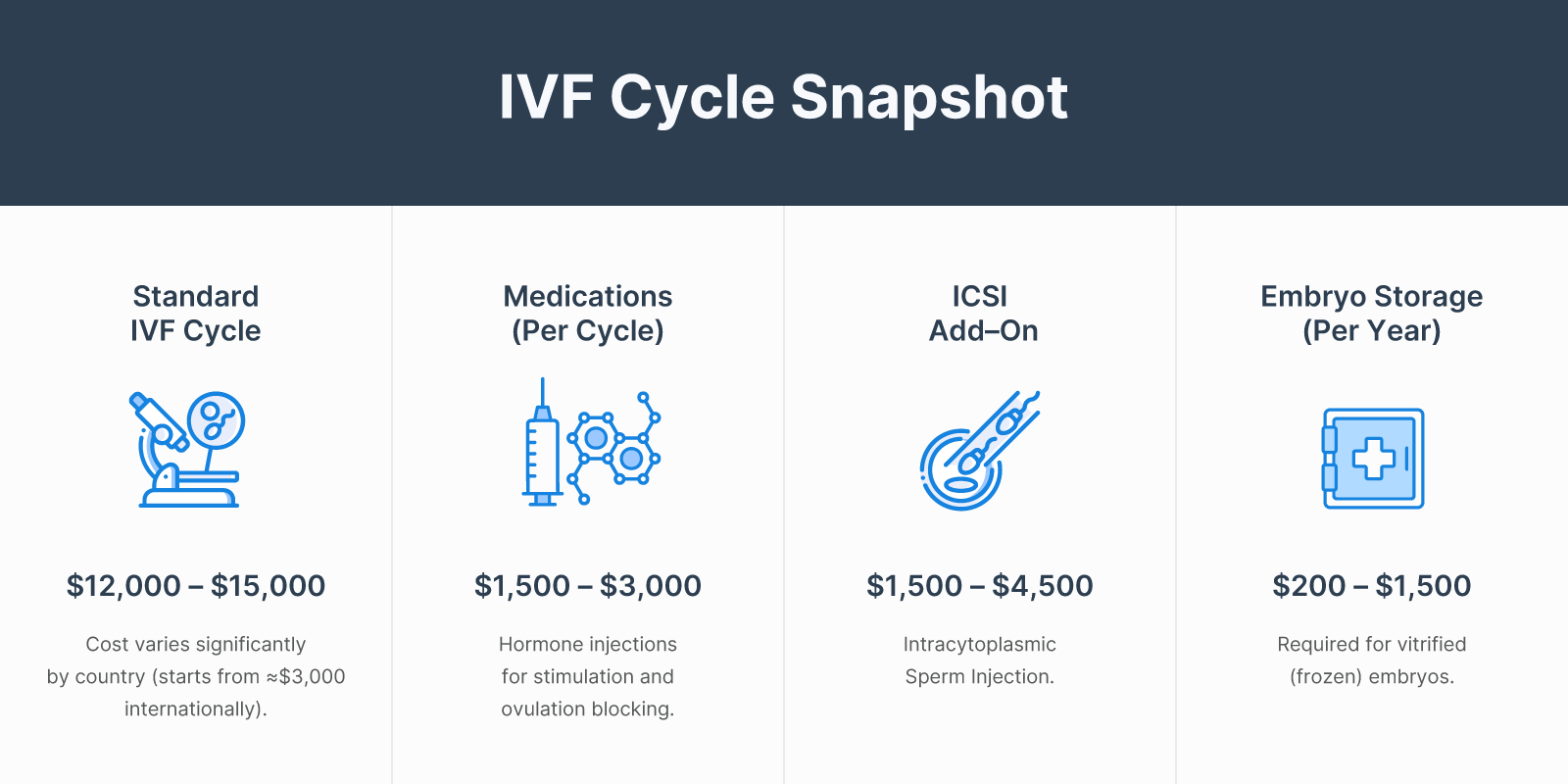
IVF cycle (USA): about $12,000–$15,000
- Other countries: from roughly $3,000
- Medications per cycle: about $1,500–$3,000
- ICSI add–on when needed: about $1,500–$4,500
- Embryo storage per year: about $200–$1,500
It is important to be transparent: additional services can become costly. Always request detailed quotes. The average success rates for live births per initiated cycle are as follows: for individuals under 35, approximately 41%–43%, for those aged 35–37, around 33%–36%, for ages 38–40, about 23%–27%, and for those over 40, roughly 13%–18%. This trend is commonly observed across most clinics.

Why trust this guide? The OVU commitment
At OVU, our mission is clarity, compassion, and data-driven guidance. Our patient advocates and editorial team create every guide to help you make confident choices with accurate information.
- Vetted global network: Access to 6,000+ leading clinics across 25 countries.
- Patient-first support: Unbiased guidance from a team that has supported over 10,000 journeys.
- Data you can use: Current success figures and policy updates reviewed for 2025.
Want help comparing clinics and costs?
If this feels like a full-time job (and honestly, it can), our advisors can collect clear, itemized quotes from verified clinics and map your timeline—at no cost to you.
Frequently Asked Questions
How long does an IVF cycle take from first consult to pregnancy test?
Expect the entire IVF process to take around 6 to 8 weeks. The stimulation phase usually lasts between 8 to 12 days. After the trigger shot, egg retrieval occurs within 24 to 40 hours. The embryo transfer typically happens 2 to 5 days after retrieval. Clinics will conduct pregnancy tests either 13 to 14 days after retrieval or on days 9 and 12 following the transfer. Your clinic will clarify which testing schedule they follow.
When exactly is the trigger shot given in IVF?
The trigger shot is given when several follicles reach 16–18 mm in size. Depending on your treatment plan, either a single hCG trigger or a dual trigger may be used. Egg retrieval is scheduled about 24–36 hours later, sometimes up to 40 hours, to ensure the oocytes are mature without triggering early ovulation.
Which day is embryo transfer most common on?
Transfers typically occur between day 2 and day 5 after egg retrieval, with day 5 blastocyst transfers being quite common. In some cases, transfers may take place on day 6 or day 7, depending on how the embryos develop and the lab’s evaluation. Your embryology team will coordinate the timing with you.
What are typical IVF costs I should budget for in 2025?
In the United States, a typical IVF cycle generally costs between $12,000 and $15,000, while in some other countries prices can start as low as $3,000. The cost of medications for each cycle usually ranges from $1,500 to $3,000. If ICSI is necessary, it can add an additional $1,500 to $4,500 to the total cost. Moreover, storing embryos typically costs around $200 to $1,500 per year. It is important to request detailed quotes from clinics before purchasing the bundle, signing the papers, and starting the program. Age is the most significant factor influencing the costs, and clinics tend to have similar pricing structures. For more information on national statistics, you can check the CDC ART data portal.
Do I need ICSI or is conventional IVF enough?
Conventional IVF places eggs with prepared sperm in a dish; ICSI injects a single motile sperm into each mature egg. Clinics recommend ICSI when there is a clear indication, like certain male factor issues or prior problems with fertilization. Your lab may decide right before fertilization if an upgrade to ICSI is needed.
When is the first ultrasound done after a positive test?
Most clinics schedule the first ultrasound at weeks 5–7 of pregnancy, which is about 3–5 weeks after embryo transfer. This scan confirms the pregnancy location, the number of sacs, and checks for a heartbeat. If the heartbeat is present and normal, that is great news.
What should I do next to get started?
Get ready to take charge of your project. Here are some straightforward steps to keep everything organized and on schedule.
- Book a consult and ask for a written protocol draft
- Schedule baseline labs and ultrasound for cycle day 2–3
- Set reminders for monitoring visits and the trigger window
- Confirm your clinic's pregnancy test timing (day 13–14 after retrieval vs day 9 and day 12 after transfer)
- Request itemized pricing, including meds, ICSI, freezing, and storage
Monitoring Frequency and Outcomes
Retrospective analysis of 5,213 cycles (2024) (PMID: 38975213)
Important finding: Cycles with 3–5 monitoring visits had similar outcomes to those with 6+ visits (live birth: 41.2% vs 40.8%), suggesting less frequent monitoring may be appropriate for many patients without compromising success rates.
Related articles

Male Fertility Surgery: TESE, Micro-TESE, and Sperm Retrieval
Male Fertility & Andrology Your guide to male fertility surgery and sperm retrieval options Last Updated: 03 July 2026 Medically Reviewed 16 min read Evidence-based The road to fatherhood often feels steep when you hear the word “infertility”. It is frustrating, lonely, and sometimes scary. At the same time, modern fertility medicine now gives many men a real chance to have a biological child, even when the semen analysis shows no sperm at all. Non-obstructive azoospermia (NOA) means there is no sperm in the ejaculate because the testicles are not making enough mature sperm. This affects about 1% of men
19 min read
Fertility Surgery for Women: Techniques to Improve IVF Success
IVF & Fertility Surgery Your guide to fertility surgery and IVF success Last Updated: 01 July 2026 Medically Reviewed 17 min read Evidence-based For many women, the path to motherhood through in vitro fertilization (IVF) is full of hope and pressure at the same time. You invest money, time, and energy, and you still wonder if your body is truly ready to support an embryo. Think of your uterus as a first home for your baby. Before moving in, you would check the structure and clear out anything that might cause harm. Fertility surgery works in a similar way; it
16 min read
What is Time-Lapse Imaging? Watching Embryo Development 24/7
IVF & Fertility Treatments Your guide to time-lapse embryo imaging in IVF Last Updated: 30 June 2026 Medically Reviewed 14 min read Evidence-based Wondering if watching your embryos grow around the clock is worth the extra money? You are not the only one asking that. For years, your clinic could only check embryo growth a few times a day, like peeking at single snapshots in a photo album. Time-lapse imaging (TLI) changes that. Instead of a few snapshots, your embryos get their own continuous movie. A small camera inside the incubator records images every few minutes while your embryos stay
17 min read