


Dr. Sony Sherpa (MBBS)
In addition to her clinical experience, Dr. Sherpa is a published medical researcher and holistic health advocate. Her dual expertise in emergency care and alternative therapies brings a unique lens to medically reviewed content—ensuring it is both accurate and accessible.
If you are staring at IVF costs and wondering how anyone actually pays for this, you are not alone. Many patients look at their bank accounts and feel a wall between them and the child they want. It is common to feel stressed, embarrassed, or even guilty about money when all you want is a chance to build your family.
Infertility affects about one in six couples, yet fewer than one in four have enough financial access to the full range of fertility services they need. At the same time, all fertility treatments together account for less than one percent of total healthcare spending. That gap between how big this feels to you and how small it looks on a national balance sheet is a big part of why this feels so unfair.
This guide walks you through the real numbers behind IUI, IVF, egg freezing, donor conception, and surrogacy, plus insurance rules and financing options. The goal is simple. You should finish with a clear sense of what treatments cost in 2026, how many cycles to plan for, and which levers you can pull, so money is less likely to decide whether you become a parent.
In 2026, a truly all-in IVF cycle in the U.S. (using the intended mother’s own eggs) typically costs between $20,000 and $25,000, though high-end clinics can reach $36,000. Cycles involving egg donation are significantly more expensive, often reaching $69,000 for a single round. Because most patients require two or three cycles to achieve a successful pregnancy, those using their own eggs should plan for a total budget of $40,000 to $75,000+ without insurance, while those requiring egg donation should expect a starting point closer to $100,000+ for multiple attempts.
If you feel overwhelmed by those numbers, remember that you still have levers you can pull. Insurance mandates, medical tourism, shared risk programs, and grants can cut your out-of-pocket costs by 30 to 70 percent when you choose the right bundle of medical services and tailor it to your situation.
What Recent Research Says About Costs and Coverage
Economic studies show that, for a typical 30-year-old, it costs about $27,000 in IVF fees to achieve one live birth. This benchmark helps you judge whether add-ons are worth paying for or whether you are better off putting that same money toward another full IVF cycle.
Large national data sets also show that strong insurance mandates keep more patients in care. In states with broad IVF coverage, only about two in ten patients stop after a failed cycle, compared with almost three in ten in states without such coverage. International research from Japan and China reaches the same conclusion. When insurance starts paying a fair share, more people seek treatment earlier and stay in care long enough to have a real chance at success.
From a policy view, several studies show that fertility coverage usually raises overall premiums by less than one percent, which is far lower than the costs many families now carry on credit cards and personal loans.
In This Guide
- Understanding Treatment Costs in 2026
- Quick Cost Ranges by Region
- IVF Cost Breakdown
- IUI Costs and ROI
- Egg Freezing Costs
- Donor Egg, Sperm, and Embryo Costs
- Surrogacy Cost Breakdown
- Hidden and Overlooked Costs
- Insurance Coverage: State Guide
- Financing Options, Loans, and Grants
- Employer Fertility Benefits
- Medical Tourism and Lower Cost Countries
- Cost vs. Success Rate Decisions
- Negotiating with Clinics
- Tax Deductions, HSA, and FSA
- Lower Cost Treatment Options
- Frequently Asked Questions
The United States: $20,000 to $25,000 per cycle when you include medications and testing.
Most patients need around 2 to 3 IVF cycles to reach a live birth.
Only one in four Americans currently has meaningful fertility coverage.
Understanding Treatment Costs in 2026
If you are just starting to research treatment, the range of numbers can feel random and unfair. You might see an ad for a $3,999 IVF cycle one minute and then a $25,000 quote from a large clinic the next. The truth sits in the details. Many low sticker prices leave out lab work, medications, or even the transfer itself.
Your costs depend on three main drivers. First is the type of treatment, such as IUI, IVF with your own eggs, or IVF with donor eggs. Second is where you have treatment, because prices vary widely between cities and countries. Third is how many cycles you ultimately need to have a baby.
Quick Cost Ranges by Region
Here is a snapshot of what you can expect to pay per cycle for major treatments in different parts of the world.
| Treatment Type | United States (Avg) | Mexico / Latin Am. | Europe (Balkans/Czech) | SE Asia (Thailand/Bali) |
|---|---|---|---|---|
| IUI | $1,200 – $4,000 | $300 – $1,000 | €200 – €1,300 | $300 – $950 |
| IVF (Own Eggs) | $15,000 – $25,000 | $5,000 – $8,200 | €1,970 – €6,000 | $3,500 – $8,000 |
| Egg Donation IVF | $35,000 – $69,000 | $8,000 – $12,000 | €4,460 – €7,600 | $7,000 – $10,000 |
| Egg Freezing | $8,000 – $15,000 | $6,600 – $7,000 | €1,900 – €2,700 | $2,500 – $4,000 |
| Surrogacy (Total) | $150,000 – $225,000 | $52,000 – $79,000 | €36,000 – €139,000 | N/A |
These ranges are wide on purpose. They give you a realistic frame for your budget and also show how much you can save by changing location or treatment type. The rest of this guide explains how to read these numbers and how to bring them closer to what you can afford.
IVF Cost Breakdown
If you are considering IVF, it helps to know exactly what sits inside that big number on the quote. Many clinics promote a base cycle price that sounds manageable, then layer on fees for lab work, medications, and procedures that are almost always needed in real life.
The Medical Cycle ($7,000 – $15,000)
This part of your bill usually covers the core medical work:
- Monitoring visits with ultrasounds and blood work
- The egg retrieval procedure in the operating room
- Anesthesia during retrieval
- Standard lab fertilization of your eggs
- One fresh embryo transfer
Large brand-name centers such as CCRM often charge more. A single fresh cycle there ranges from about $12,660 to $20,855. When you compare clinics, always ask what exactly sits inside that medical cycle fee.
Lab Add-ons That Often Feel Mandatory
Once your cycle starts, some lab services show up on your bill even though they look optional on paper.
- ICSI (Intracytoplasmic Sperm Injection): This is when the embryologist injects a single sperm into each egg. Clinics often use it for male factor infertility or previous fertilization problems. It adds $1,500 to $3,000.
- Assisted hatching: A lab step that helps an embryo break out of its shell before implantation. It costs $500 to $1,072.
- PGT (Preimplantation Genetic Testing): PGT screens embryos for chromosome issues. It costs $3,000 to $8,700, depending on how many embryos you test.
Medications ($1,500 – $8,000)
Medication is often the biggest wild card in your budget. Your doctor sets your dose based on your age and ovarian reserve, and you do not know the exact pharmacy bill until the prescription runs.
A typical stimulation plan costs around $2,500 in medications. High-dose protocols or longer cycles can push that total over $7,000. If you want to keep this piece under control, ask your clinic upfront about generic options, pharmacy discounts, and manufacturer assistance programs.
Cost per Baby, Not Just per Cycle
A single IVF cycle gives you about a 20 to 35 percent chance of a live birth, depending mostly on your age. Most patients need around 2.5 cycles to have a baby. That means the true cost per successful pregnancy in the United States often sits above $40,000 and can reach $61,000 or more in high-cost states, such as California.
When planning your budget, consider how many tries you can realistically fund, not just the first round’s price. This shift alone can make your decisions feel more grounded and less reactive.
Latest Research Insights
$27,000 Per Baby – Your Add-On Price Limit: A 2023 analysis found that, for a 30-year-old, it costs about $27,000 in IVF fees to achieve one live birth. Any extra test or add-on that costs more than this amount per extra baby is usually a worse value than putting that same money toward another full IVF cycle. This gives you a simple benchmark when clinics suggest extra procedures. Source: Human Reproduction (PMID: 38148026).
21 Percent Lower Treatment Cost, Same Baby Chance: In women over 35, a lower-drug IVF protocol using clomiphene plus gonadotropins gave almost the same chance of a baby as a standard higher-drug protocol. But the lower drug approach cut average treatment costs by about 21 percent per patient. This means you may not need the most expensive stimulation plan to maintain your strong odds. Source: Scientific Reports (PMID: 38839827).
Almost $20,000 Saved in Single vs. Double Transfer: One cost study compared the cost of transferring one embryo at a time with the cost of transferring two embryos at once. The average total cost per baby was $38,600 with single embryo strategies, versus roughly $58,100 when two embryos were used together. Choosing single embryo transfer can protect your health and your wallet while still leading to a healthy baby. Source: Fertility and Sterility (PMID: 26604068).
$3.5 Million Saved per 250 Patients: Economic models show that, in systems without broad infertility coverage, single embryo transfer can save around $3.5 million in medical costs for every 250 patients compared with routine double transfer. Most savings come from avoiding complications linked to twins and higher-order multiples. Source: Health Economics Review (PMID: 38767759).
These findings come from peer-reviewed research. Your results depend on your personal situation. Talk with your fertility specialist about how these numbers apply to you.
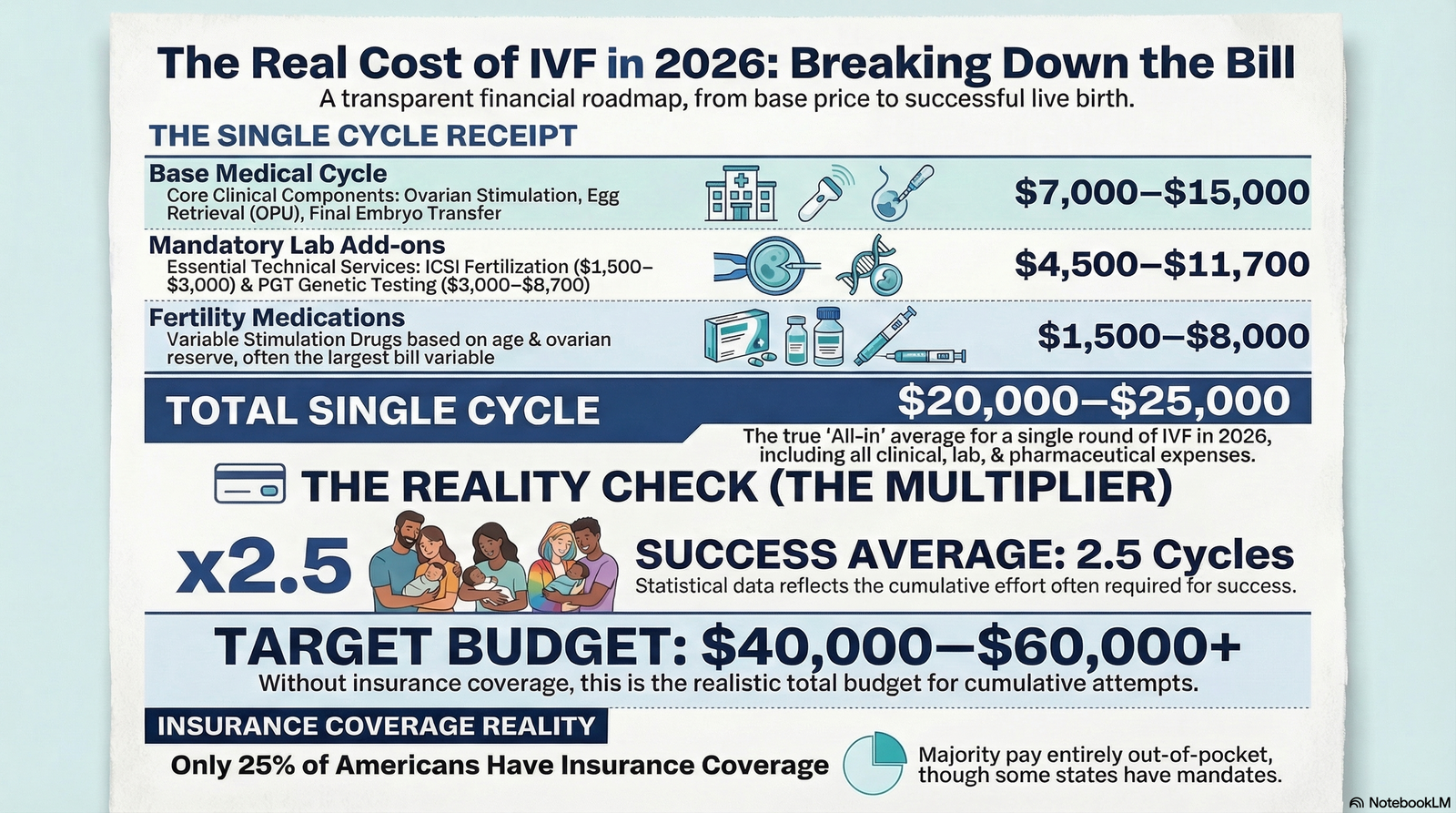
IVF Costs 2026: From base cycle fees to medications and lab add-ons, most patients plan for 2 to 3 cycles.
IUI Costs and ROI
Many couples start with intrauterine insemination because it feels less intense, and the upfront bill is lower. An IUI cycle in the United States without insurance usually costs between $1,200 and $2,350.
IUI success rates sit around 7.9 to 15 percent per cycle. IVF offers higher odds per attempt. Some economic research shows that, for many couples with unexplained infertility, IVF is actually more cost-effective than several rounds of IUI when you look at cost per live birth rather than cost per cycle.
Average live birth rates per started cycle sit around 20.7 percent for IVF and around 7.9 percent for IUI. UK guidance now tells doctors to send couples with more than two years of unexplained infertility straight to IVF. If you are choosing between IUI and IVF, ask your doctor to show you both the expected cost per cycle and the likely cost per baby for your age and diagnosis.
Egg Freezing Costs
If you know you want a child in the future, but your life or career does not fit the pregnancy yet, egg freezing can help you buy time. It is still a major financial decision, and you deserve a full picture of what it involves.
- Cycle cost: One egg freezing cycle averages about $11,000 out of pocket, with a range from $8,000 to $15,000.
- Medications: Stimulation drugs usually add $3,500 to $4,000.
- Storage fees: Clinics or storage facilities charge $500 to $1,200 per year to keep your eggs frozen.
- Future use: When you return to use your eggs, you pay for thawing, fertilization (often with ICSI), and transfer. That phase adds another $8,000 to $13,000.
If you are considering egg freezing, try to budget for the full path, including the day you come back to use your eggs, not just the first retrieval.
Donor Costs: Egg, Sperm, and Embryo
Once you bring donor sperm, donor eggs, or donated embryos into your plan, the financial picture changes again. You pay for your own treatment and for donor compensation, screening, and agency work.
- Sperm donor: $400 to $2,200 per vial. Most clinics suggest at least two vials per retrieval cycle.
- Egg donor, frozen: $18,000 to $38,698 per cycle. A standard batch of 6 to 8 frozen eggs usually includes the donor’s payment and her retrieval costs.
- Egg donor, fresh: $25,000 to $40,000 or more. Fresh cycles are more complex but often create more embryos for future siblings.
- Embryo donation: This is usually the least expensive donor route. Program fees run from $5,000 to $15,000, plus $3,000 to $6,000 for your transfer cycle.
If you know you will need a donor, ask the clinic to put every donor-related cost on a single sheet, including agency fees, travel for the donor, legal work, and future storage.
Surrogacy Cost Breakdown
Surrogacy is often both emotionally and financially heavy. If your stomach drops when you see these numbers, that feeling is completely valid. Total costs in the United States usually range between $175,000 and $225,000.
- Agency fees: $15,000 to $50,000 for screening, matching, and coordination.
- Surrogate compensation: $40,000 to $60,000 for a first-time surrogate. Experienced carriers often receive $5,000 to $10,000 more.
- Legal fees: $7,000 to $19,000 for contracts and for securing your parental rights.
- Medical procedures: $20,000 to $50,000 to create embryos and complete transfers.
- Prenatal and delivery care: $19,000 to $29,000 over the course of pregnancy and birth.
- Contingency fund: An extra 10 to 20 percent for surprises such as lost wages during bed rest at about $250 per week and a planned or emergency C-section with a bill of $4,000 or more.
If surrogacy is part of your path, building that extra buffer into your first budget can save you from painful choices later if something unexpected happens.
Hidden and Overlooked Costs
Even when clinics offer package pricing, some costs often sit outside that neat box. These surprise items can stretch your budget if you do not see them coming.
- Anesthesia fees: $500 to $1,500 per retrieval, sometimes billed by a separate group.
- Diagnostic testing: Early workups such as HSG, hormone panels, and semen analysis can cost $2,300 to $4,000 before treatment officially begins.
- Embryo management extras: Extended culture to the blastocyst stage or products such as embryo glue during transfer can add around $670 or more.
- Cryostorage: After a first free or discounted year, storing embryos or sperm usually costs $500 to $1,435 per year.
- Travel and logistics: If you travel for care, you need to factor in flights, two to four weeks in a hotel, local transport, and any medical visa fees.
When you ask for a quote, request a separate section for likely extras so that you understand the full range before you sign anything.
Insurance Coverage: State Guide
In the United States, your zip code and your employer shape your benefits. That reality feels unfair, and many patients only discover what is covered after a painful denial.
By 2027, twenty-one states will have some form of infertility coverage law. Some tell insurers to cover IVF. Others ask insurers only to offer coverage that employers can choose to add or skip.
States with Broad IVF Mandates
Some states require strong IVF coverage with clear rules on how much you get:
- Connecticut: Up to two IVF cycles for people under 40.
- Illinois: Up to four cycles, plus two more for a second pregnancy, with a lifetime max of six.
- Maryland: Up to three cycles per live birth, with a $100,000 lifetime cap.
- Massachusetts: Very broad coverage with no fixed upper limit on retrievals, though insurers still follow clinical guidelines.
- New Jersey: Covers four completed egg retrievals for people under 46.
- New York: Covers three IVF cycles for people on large group plans with at least 100 employees.
- Rhode Island: Lifetime cap of $100,000 for women aged 25 to 40.
- Colorado, Delaware, and Maine: Also require strong IVF coverage for many plans.
New for 2026: California (SB 729)
From January 1, 2026, California Senate Bill 729 requires most small and large group health plans to cover infertility diagnosis and treatment. That coverage includes up to three egg retrievals and unlimited embryo transfers.
The law also updates the definition of infertility so that LGBTQ+ people and single parents are better included. If you live or work in California, ask your HR team how this law affects your specific plan and whether any waiting periods or exclusions apply.
Partial or Offer Mandates
Other states offer narrower protections:
- Arkansas: Lifetime maximum of $15,000, and health maintenance organizations are exempt.
- Hawaii: One IVF benefit per lifetime and a five-year infertility history requirement.
- Texas: Insurers must offer coverage to employers, but employers do not have to buy it.
If you live in one of these states, your plan may or may not cover IVF, so always check your actual policy documents instead of assuming coverage from the law alone.
How Coverage Changes Your Real Costs
Two in Ten vs. Three in Ten Quit Treatment: In US states with strong IVF insurance mandates, about two in ten patients stopped treatment after a failed cycle. In states without broad mandates, closer to three in ten stopped. When insurance pays a fair share, more people can stay in care long enough to have a real chance at success. Source: American Journal of Obstetrics and Gynecology (PMID: 36368429).
277 Percent Higher Use with Full Coverage: Global data show that IVF use is almost three times higher in regions with full insurance coverage than in areas without it. When fertility care is treated like other medical care, more couples move from research to action instead of delaying for years because of money. Source: Scientific Reports (PMID: 38580689).
Twenty Three Percent More Younger Patients: After Japan added IVF to national insurance in 2022, the number of people aged 25 to 34 receiving treatment rose by about 23 percent. Earlier treatment often means higher success rates and fewer total cycles, which can lower your long-term costs. Source: Journal of Obstetrics and Gynaecology Research (PMID: 40229928).
Less Than One Percent of Premiums: Ethics guidance from professional societies notes that adding infertility coverage usually raises employer health premiums by less than one percent. This is far lower than the out of pocket costs many patients carry on credit cards now. Source: An Ethics Committee opinion. Fertility and Sterility.
These insights focus on how coverage shapes access and cost. Your own premiums, copays, and deductibles depend on your specific plan and employer.
Financing Options, Loans, and Grants
If your insurance does not cover much, you still have options. It is normal to feel stressed here. You do not have to figure out the money side alone, and many families use a mix of savings, loans, and grants.
Fertility-Focused Lenders
Some lenders work almost entirely in fertility care and know how to coordinate with clinics.
- Future Family: Loans up to $50,000, with promotional interest as low as zero percent for 12 months at some clinics. Includes 24-hour nurse support.
- CapexMD: Works through clinics and can bundle in medications and genetic testing.
- CNY Fertile Financing: In-house financing with no credit check and zero percent interest, with a 25 percent down payment requirement.
- LendingClub: Fixed-rate medical loans built for fertility care, with no penalty for paying off early.
If you consider a loan, focus on three numbers. Look at your monthly payment, your total repayment over the life of the loan, and how many cycles that money will realistically cover.
Shared Risk and Refund Programs
Shared risk programs trade a higher upfront fee for more tries and some protection if treatment does not work.
- BUNDL Guard: One flat fee covers two to three retrieval cycles. If you do not have a baby, you get a 100 percent refund.
- Shady Grove Shared Risk: Lets you try up to six fresh cycles and unlimited frozen transfers for one fee, with a 100 percent refund if you do not bring home a baby.
- Sunfish Gold: Offers a partial refund of up to $15,000 if you do not have a successful outcome.
If your clinic offers one of these plans, ask them to compare it side by side with paying for single cycles. Then decide which path gives you the most peace of mind for your situation.
2026 Fertility Grants
Grants do not require repayment, which is a huge relief, but they are competitive. Most charge a small application fee of around $50.
- Baby Quest Foundation: Two grant cycles each year, including a January to March 2026 window. Open to all family types.
- Cade Foundation Family Building Grant: Awards up to $10,000. The spring 2026 deadline is March 31.
- Journey to Parenthood: Accepts applications from August through October 2026. Awards up to $10,000.
- Hopeful Mama Foundation: Grants from $500 to $5,000. The 2026 cycle opens April 1.
If you apply, give yourself time to write an honest application and gather your medical records. It can feel vulnerable to share your story on paper, but your voice matters here.
Employer Fertility Benefits
Your real fertility coverage may not be obvious from your main insurance card. Many employers now work with separate fertility benefit companies that sit on top of your basic health plan.
- Progyny and Maven: Common in tech and large companies. They use Smart Cycles that bundle services and often include medications, egg freezing, and donor support.
- Carrot Fertility: Offers global fertility benefits that you can use at many clinics, including support for IVF, egg freezing, and sometimes surrogacy.
Log in to your benefits portal and search for these names. If you see them, ask HR for a simple one-page summary of what they cover. Many patients discover that they have more help than they thought.
Medical Tourism and Lower Cost Countries
If local prices feel out of reach, you are not the only one looking abroad. Many couples and individuals cut their fertility bills by half or more by traveling for care. The trade-off is more planning and time away from home.
- Mexico: IVF cycles cost $5,000 to $8,000. Travel from the United States is shorter and often cheaper than flying to Europe or Asia.
- Czech Republic: IVF starts at about €1,970, roughly $2,100. Clinics offer strong lab standards and short wait times.
- Spain: IVF ranges from €3,740 to €5,985. Many clinics offer guarantee-style programs tied to pregnancy or live birth.
- China: IVF cycles cost $4,000 to $6,000. All patients must show a marriage certificate.
- Thailand: IVF ranges from $4,500 to $8,000, with clear package pricing that often includes many extras.
If you look at medical tourism, including travel costs, days off work, and the chance that you may need more than one trip. Some people combine treatment with remote work to soften the impact.
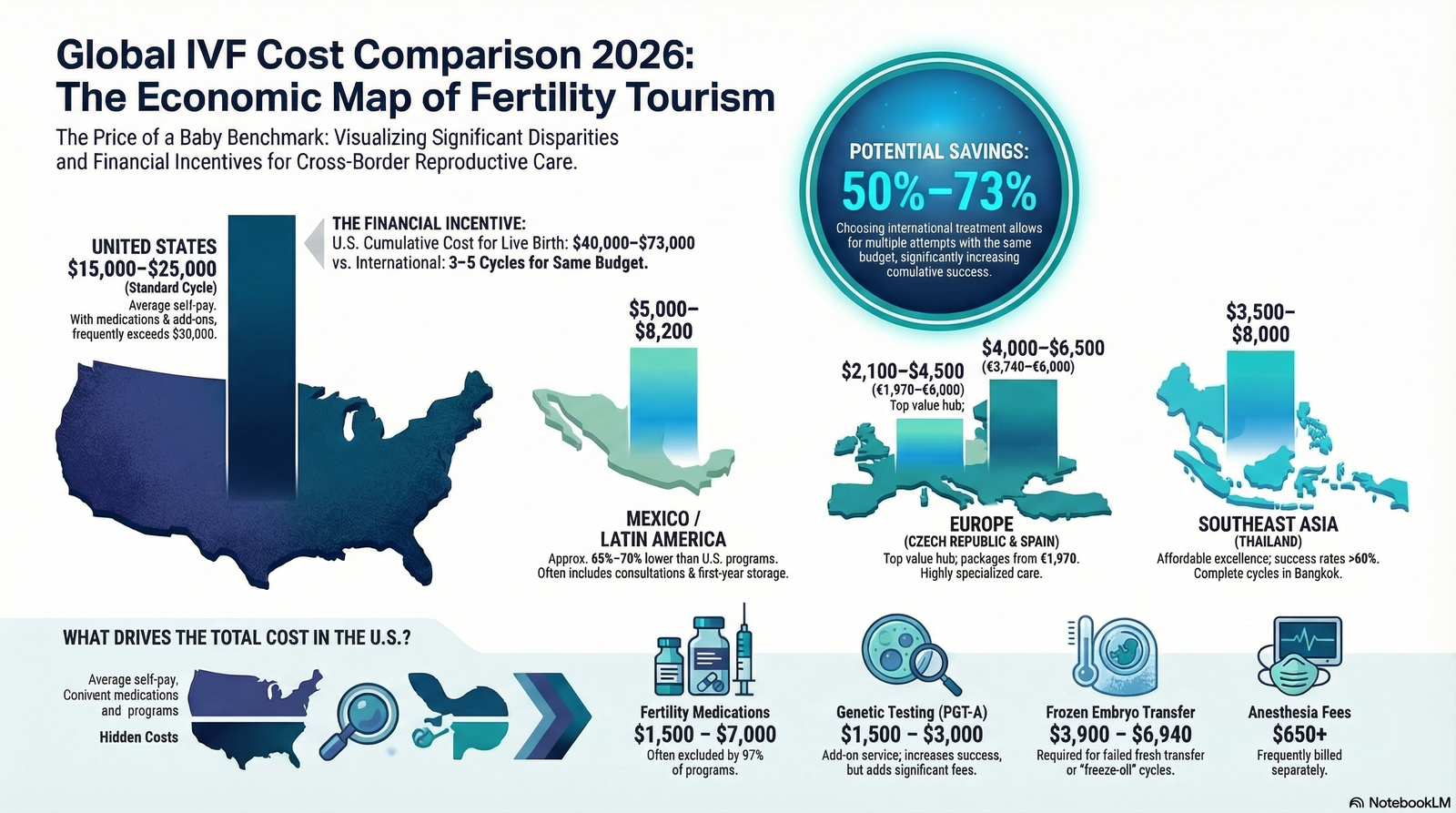
Global IVF price ranges in 2026: many patients save 50 percent or more by choosing high quality clinics abroad.
Cost vs. Success Rate Decisions
Your real goal is not the cheapest cycle on paper. It is the path that gives you the best chance of a healthy baby with the least total strain on your body, your time, and your bank account.
- PGT and time to success: PGT costs at least $3,000, but it can lower miscarriage risk and help you avoid multiple failed transfers. For some patients, that saves both money and emotional energy in the long run.
- Single vs. double embryo transfer: Single embryo transfer usually leads to lower total medical costs than double transfer, even if the price per cycle looks similar. Studies show close to $20,000 less in total medical spending per baby with single embryo transfer because twin pregnancies bring more intensive prenatal care and more NICU stays.
- Cumulative success: After three IVF cycles, many patients reach a 60 to 90 percent chance of success, depending on age and diagnosis. Clinics often discount three-cycle packages by 10 to 19 percent compared with paying for each cycle separately.
Ask your clinic to show you the cost per expected live birth, not just cost per cycle. That shift in framing can make your choices much clearer.
Negotiating with Clinics
You are allowed to ask for better pricing. You are not being difficult. You are protecting your family’s finances.
- Bundle lab fees: Ask if the clinic can turn ICSI, assisted hatching, and cryopreservation into a single package price. This is often cheaper than paying line by line.
- Cash discounts: Many clinics knock around five percent off if you pay in full before treatment starts.
- Income-based discounts: Some groups offer sliding scale pricing for households under certain income levels, such as $115,000.
- Medication discount programs: Ask if your clinic works with manufacturer programs such as EMD Serono Compassionate Care. These can cut medication costs by up to half based on income or military status.
Always ask the clinic to list all discounts and financial aid options in writing so that you can compare them clearly at home.
Tax Deductions, HSA, and FSA
You can soften your out of pocket costs by using tax tools that already exist.
- HSA and FSA: Paying for IVF or egg freezing through a Health Savings Account or Flexible Spending Account uses pre-tax dollars. That can save you 20 to 30 percent, depending on your tax bracket.
- Fertility tax credits: Some regions offer direct credits. For example, Ontario has offered a refundable credit of 25 percent of eligible fertility costs up to $5,000. Check the current rules where you live for 2025 and 2026, because these programs change over time.
If the tax side feels confusing, a short meeting with a tax professional can reveal savings you might otherwise leave on the table.
Lower Cost Treatment Options
If money is the main thing standing between you and treatment right now, you still have paths that lower the initial price, even though they reduce your odds per cycle.
- Natural cycle IVF: Uses your natural ovulation and skips stimulation drugs. In the United States, this can cost $7,900 or less, and in the Czech Republic, it can be as low as €720. Success rates per retrieval are lower because you usually get just one egg.
- Mild stimulation or mini IVF: Uses smaller doses of medication to keep drug costs around $1,000 to $2,000. You create fewer eggs but pay less per round.
- Balkan clinics: Countries such as Bulgaria and Albania offer IVF from €1,175 to €2,900, which can cut your total cost if you can manage travel.
If you choose a lower-cost protocol, plan for the chance that you will need more cycles and build that into your budget.
How OVU Advisors Help You Use These Numbers
Fertility pricing is not just about one clinic quote. It is about how many cycles you may need, what your insurance will really pay, and whether a shared risk or travel option makes more sense for you.
When you work with an OVU advisor, you get real, itemized quotes from multiple clinics, not just headline prices. Your advisor helps you map out a three-cycle plan if that is what you need and shows you how to combine insurance, pre-tax accounts, financing, and grants so that you are not making every decision alone under pressure.
Want help comparing clinics and costs?
If this feels like a full-time job, and it often does, our advisors can collect clear, itemized quotes from verified clinics and map your timeline at no cost to you.

Why trust this guide? The OVU commitment
You are probably juggling hope, timelines, and a lot of tabs open in your browser. And you deserve clear, current, human advice. At OVU, we review clinic protocols, compare real quotes, and talk to people who have done this - intended parents and gestational carriers - so we can give you practical steps, not just theory. If you want help comparing options without sales pressure, we will gather itemized quotes and success data that match your exact situation. You decide, we will bring the info to your table.
Frequently Asked Questions
How much does a single IVF cycle cost in 2026?
In the United States, expect to pay between $20,000 and $25,000 for an all-in IVF cycle that includes medications, at least one transfer, and common lab testing such as PGT. If a quote looks much lower than this range, ask what has been left out of the number you first see.
Does insurance cover IVF in 2026?
One in four Americans has some level of fertility coverage. Check whether your state has a mandate, and then confirm whether your employer plan is fully insured or self-insured under ERISA. Ask your HR team for a written summary of your fertility benefits and for any lifetime maximums or cycle limits.
Are there interest-free payment plans for IVF?
Yes. Lenders such as Future Family and some clinics, including CNY, offer zero percent interest windows, often for 12 months, for people who meet their criteria. Always read the terms so that you understand what happens if you need more time than the promotional period.
Where is the cheapest place to have IVF?
For those seeking the lowest costs, countries like the Czech Republic and Mexico offer high clinical standards for a fraction of U.S. prices. In the Czech Republic, all-inclusive bundles often start around €4,500 ($4,900), while Mexico typically ranges from $5,000 to $8,000 per cycle. However, a “cross-border” budget must also account for international travel, extended time off work, and the possibility of multiple trips for retrieval and subsequent embryo transfers.
How can I improve my chances of getting a fertility grant?
Start early, read the rules for each grant carefully, and be honest and specific in your story. Have your medical records ready, follow the instructions exactly, and apply to more than one program if you can manage the fees and paperwork.
Is a multi-cycle IVF guarantee worth the cost?
If you are under 35 with good ovarian reserve, a shared risk plan can be a good fit. You pay more at the start, but you get multiple cycles and a full or partial refund if you do not take home a baby. If you are older or have a complex diagnosis, ask how often people in your situation receive refunds before you decide.
Is international surrogacy safe and legal?
Safety and legal security depend on the country and the team you choose. Countries with clear surrogacy laws, such as Greece and Mexico, tend to offer stronger protection than places where rules are vague or changing. Always work with experienced agencies and lawyers who focus on cross-border cases.
Reference List 8 sources
Journal Article (Cost-Effectiveness Study): Feng Q, Li W, Callander EJ, Wang R, Mol BW. Applying a simplified economic evaluation approach to evaluate infertility treatments in clinical practice. Human Reproduction. 2023;[online ahead of print]. PMID: 38148026. Available from: https://pubmed.ncbi.nlm.nih.gov/38148026/
Journal Article (Comparative Study): Li Y, Luo D, Li T, Ding H, Liu Y. The cumulative live birth rate and cost effectiveness of the clomiphene and gonadotropin cotreatment protocol versus the mid luteal GnRH agonist protocol in women over 35 years old. Scientific Reports. 2024;14(1). PMID: 38839827. Available from: https://pubmed.ncbi.nlm.nih.gov/38839827/
Journal Article (Research): Lee JC, DeSantis CE, Yartel AK, Kissin DM, Kawwass JF. Association of state insurance coverage mandates with assisted reproductive technology care discontinuation. American Journal of Obstetrics and Gynecology. 2023;228(3):315.e1–315.e14. PMID: 36368429. Available from: https://pubmed.ncbi.nlm.nih.gov/36368429/
Journal Article (Cost-Effectiveness Study): Huang R, Yu JY, He WC, Liu RH, et al. Feasibility analysis of China's medical insurance coverage of assisted reproductive technology. Scientific Reports. 2024;14(1):7998. PMID: 38580689. Available from: https://pubmed.ncbi.nlm.nih.gov/38580689/
Journal Article (Research): Wada A, Yamada M, et al. Impact of insurance coverage on access to assisted reproductive technology: A nationwide survey in Japan (the IZANAMI project). Journal of Obstetrics and Gynaecology Research. 2025;51(4):e16292. PMID: 40229928. Available from: https://pubmed.ncbi.nlm.nih.gov/40229928/
Journal Article (Systematic Review & Meta-Analysis): Si Y, Tan T, Pu K. Systematic review of the economic evaluation model of assisted reproductive technology. Health Economics Review. 2024;14(1):34. PMID: 38767759. Available from: https://pubmed.ncbi.nlm.nih.gov/38767759/
Journal Article (Cost-Effectiveness Study): Crawford S, Boulet SL, Mneimneh AS, et al. Costs of achieving live birth from assisted reproductive technology: a comparison of sequential single and double embryo transfer approaches. Fertility and Sterility. 2016;105(3). PMID: 26604068. Available from: https://pubmed.ncbi.nlm.nih.gov/26604068/
Ethics Committee Opinion: Ethics Committee of the American Society for Reproductive Medicine. Disparities in access to effective treatment for infertility in the United States: an Ethics Committee opinion. Fertility and Sterility. 2021;116(1):54–63. Available from: https://www.asrm.org/practice-guidance/ethics-opinions/disparities-in-access-to-effective-treatment-for-infertility-in-the-united-states-an-ethics-committee-opinion-2021/
Final Thoughts
Trying to build your family while watching every dollar is exhausting. If you feel like you have to choose between your financial health and your dream of a baby, that is a heavy place to stand. Your feelings here are real and valid.
The good news is that you have more tools than you may realize. State mandates, employer benefits, pre tax accounts, grants, lower cost clinics, and shared risk programs can all move the numbers in your favor. When you combine them with clear quotes and a realistic plan for how many cycles you may need, the path often looks less impossible.
You do not have to solve this alone. The more you ask questions, request itemized quotes, and compare options, the more control you take back from the price tags. Every dollar you protect is one more resource you can keep for your health, your future baby, and your peace of mind.
Ready to map out your own fertility budget?
If you want a clear, side by side view of clinics, costs, and likely scenarios for two or three cycles, talk with an OVU advisor. You will get transparent quotes and a plan that fits your life, not a generic brochure.