


Dr. Sony Sherpa (MBBS)
In addition to her clinical experience, Dr. Sherpa is a published medical researcher and holistic health advocate. Her dual expertise in emergency care and alternative therapies brings a unique lens to medically reviewed content—ensuring it is both accurate and accessible.
Have you ever looked at your partner and pictured the baby you hope to hold one day, with tiny features that remind you of both of you? Maybe you see your eyes, their smile, or the same soft curls you had as a child. If you are dealing with severe infertility, repeated IVF failures, or a medical condition that makes pregnancy unsafe, that picture can feel painfully far away.
Surrogacy offers a clear path towards having that child. Once you start searching online, though, you run into conflicting rules, confusing nuances, legal hurdles, and uncertainties. Some countries welcome you, others ban surrogacy outright, and many sit in legal gray zones. One wrong assumption can cost you time, money, and legal security.
This guide walks you through the current and expected 2026 legal framework for international surrogacy, country by country. You will see which destinations actually fit your family, your budget, and your risk tolerance, based on law, medical practice, and how parentage is recognized.
Surrogacy is fully legal and regulated in only a few countries, partly allowed or unregulated in others, and completely banned in many more. Some countries legalized surrogacy for medical indications for locals and foreigners, others only for citizens, some for citizens and legal residents, and others prohibit such arrangements for all, regardless of citizenship and residence. If you are considering international surrogacy for 2026, the most realistic options include Mexico, Colombia, Argentina, Canada, Greece, Cyprus, some programs in the Czech Republic and Albania, the UAE for residents, Iran, and Georgia for a limited time. Each country has strict rules about who qualifies, how parentage is recognized, and whether you can use donor eggs or sperm.
Your safest path is to choose a country where surrogacy is clearly regulated, parentage is recognized in writing, and your home country will accept the foreign birth certificate when you bring your baby home.
What the Latest Research Shows
Large studies of gestational carrier pregnancies now give a much clearer picture of safety and success. Outcomes are similar to, and sometimes better than, other IVF pregnancies when surrogates are healthy and carefully screened.
Research also shows that single-embryo transfer, guideline-based screening, and modern frozen embryo transfer protocols reduce serious complications for both the carrier and the baby.
In this guide, you will see how these medical findings connect directly to national laws, clinic practices, and your own legal choices.
In This Guide
About 1 in 6 people worldwide face infertility. Cross-border fertility travel is constantly rising.
The global surrogacy market is projected to reach $129 billion by 2032, with rapid growth after 2029.
North America and Europe account for roughly 55% of surrogacy-related patient inquiries.
Global Trends and Quick Facts
Infertility now affects about 1 in 6 people worldwide. Surrogacy and third-party reproduction have moved into the mainstream, with the commercial market projected to hit $129 billion by 2032—a nearly 25 percent annual increase.
Many intended parents from North America and Europe seek surrogacy services abroad, driven by local legal restrictions or the search for more affordable care. Depending on the destination’s laws, these arrangements may involve commercial surrogacy, where carriers receive financial compensation, or altruistic models, where only medical and related expenses are reimbursed. Together, those regions account for about 55 percent of global patient inquiries. More than 60 percent of fertility patients at large clinics consider some form of treatment overseas.
This shift toward international care is fueled by three main forces: lower costs, legal access to surrogacy and donors, and inclusive laws that recognize single parents and LGBTQ+ families. As a result, new regional hubs have emerged. Latin America has become a major destination, with Mexico and Colombia leading the way. Meanwhile, Europe continues to attract parents to Spain and Greece, and interest is growing in the Middle East, particularly the UAE.
Latest Research Insights
28,000 Pregnancies, Similar Outcomes: A large review of more than 28,000 gestational carrier pregnancies found that outcomes were similar to, and sometimes better than, other IVF pregnancies, even though many people assume surrogacy is higher risk. Most problems came from IVF itself and from conceiving twins after embryo transfer, not from the fact that a surrogate carried the baby. This shows that, with proper screening and clinical care, surrogacy can be medically safe.
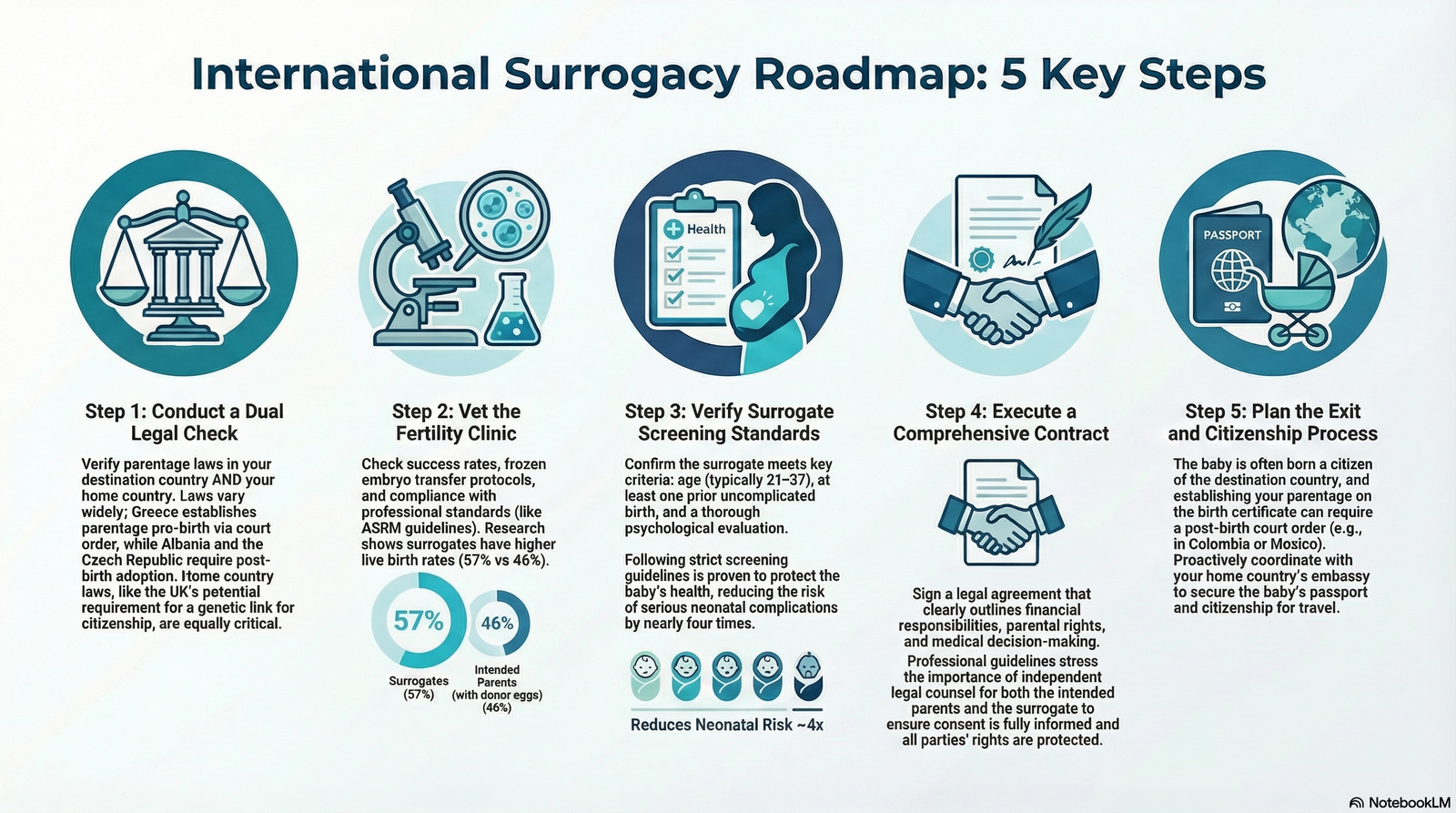
57% vs 46%, The Success Gap: In donor-egg IVF cycles, live birth rates reached about 57 percent when embryos went to gestational carriers, compared with about 46 percent when they went to intended mothers. Babies born through surrogates were less likely to have low birthweight. This means that a healthy, well-screened uterus can make a real difference.
These findings come from peer-reviewed research. Your own results will depend on your medical history, embryo quality, and the clinic you choose.
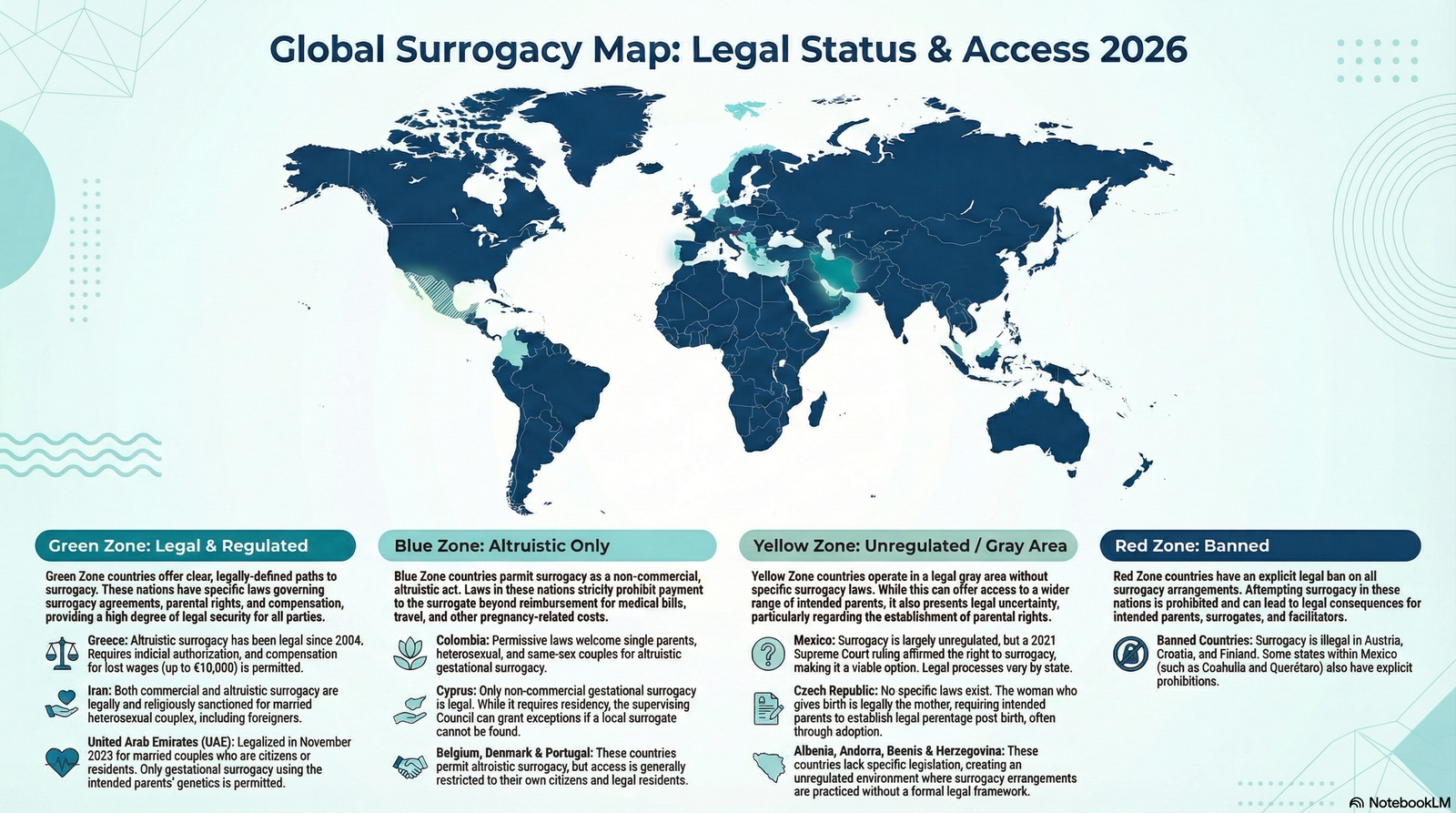
Popular surrogacy destinations and how they connect to different regions of the world.
Legal Status by Country
When you look at international surrogacy, you are really comparing three things at once. You need to know whether the surrogacy process is legal. You need to know who the law recognizes as the legal parents. You also need to know how your home country will legalize that foreign birth certificate when you come home.
The table below gives you a high-level snapshot of how major destinations treat surrogacy for 2026.
Country | Surrogacy Status | Commercial Allowed? | Who Is Eligible? | Legal Parentage Recognized? |
|---|---|---|---|---|
Greece | Legal, altruistic gestational surrogacy | No, compensation capped at €10,000 | Married or unmarried heterosexual couples, single women | Pre-birth court order names intended parents as legal parents. |
Canada | Legal, altruistic | No, reimbursement only | Singles, LGBTQ+ families, heterosexual couples | In many provinces, intended parents recognized at birth as legal parents. |
Mexico | Legal, with state level differences | Yes, commercial or compensated | Singles, LGBTQ+ families, foreign nationals | Pre-birth orders in some states, post-birth Amparo often used. |
Argentina | Not regulated but commonly practiced | Yes, negotiated compensation | Singles, same sex couples, heterosexual couples | In Buenos Aires, intended parents often named on birth certificate. |
Colombia | Legal, altruistic gestational surrogacy | No, reimbursement only | Singles, same sex couples, heterosexual couples | Post-birth court process recognizes intended parents as legal parents. |
Cyprus | Legal, non commercial gestational surrogacy | No, commercial deals are criminal | Mainly residents, with limited exceptions | Intended parents recognized from embryo transfer. |
UAE | Newly legal since 2023 | No, reimbursement model | Married resident couples using their own gametes | Court order after birth. |
Iran | Legal with religious approval | Yes, commercial and altruistic | Married heterosexual couples only | Surrogate is recognized as a legal mother first as she gives the birth to the baby, then she transfer her parental rights to the intended parents through court. |
Czech Republic | Not regulated, gray area | No, commercial surrogacy banned | Heterosexual couples | Birth mother is legal mother; later transfer is complex. |
Georgia | Legal, commercial, changing for foreigners | Yes, for now | Heterosexual couples only | Intended parents are recognized as legal parents. |
Guidelines That Protect You and Your Surrogate
Strict Screening, Safer Pregnancies: Professional guidelines from ASRM say that a gestational carrier should be a healthy woman with at least one uncomplicated prior pregnancy, full medical records, and a detailed psychological evaluation. Programs that follow these rules see fewer complications for both the surrogate and the baby.
Four Times Higher Risk Without Rules: When clinics ignored basic criteria, such as age limits and prior obstetric history, babies were almost four times more likely to need neonatal intensive care. This is why you need to ask any agency exactly how they screen carriers, not just what their success rate is.
When you look at countries later in this guide, pay close attention to which ones tie their surrogacy laws to these kinds of medical and ethical standards.
Medical Safety and Research Insights
When you compare legal frameworks, you are also deciding whose health system will care for your surrogate and your baby. You want to know not only if surrogacy is allowed but also whether clinics follow evidence-based protocols.
Good data now shows that well-managed surrogacy can be safe and can lead to excellent outcomes, especially when clinics use single embryo transfer, frozen embryo transfer protocols, and full carrier screening. These choices lower the chance of early birth, emergency cesarean birth, and intensive care admissions.
Frozen embryo transfers have become the norm in many surrogacy programs. Large trials show that frozen transfers can match or improve live birth rates and reduce serious high blood pressure problems in pregnancy compared to fresh transfers. That is important for your surrogate’s safety and for the long-term health of your baby.
Typical Costs and Program Types
Once you understand where surrogacy is legal, your next question is usually cost. Prices vary widely between countries and even between clinics in the same city. Costs also rise when you add egg donation or a guaranteed live birth program.
The table below gives you a rough picture of how base IVF surrogacy programs compare by destination.
Typical surrogacy program costs by country, including IVF and carrier compensation.
Destination | Self Cycle, Non Guaranteed | Guaranteed Program With Donor | Sibling Guarantee Programs |
|---|---|---|---|
Iran | $19,000 USD | $29,000 USD | Not available |
Georgia | $36,900 USD | $59,000–$69,000 USD | $119,000–$139,000 USD |
UAE | $39,000–$69,000 USD | Not available | Not available |
Argentina | $55,000 USD | $79,000–$100,000 USD | $119,000–$139,900 USD |
Colombia | $60,000 USD | $66,000–$77,000 USD | $125,900–$139,000 USD |
Mexico | $56,000–$60,000 USD | $70,900–$79,900 USD | $135,900–$139,900 USD |
Greece | $50,000 USD | $79,000–$84,000 USD | Not available |
Czech Republic | €50,000–€60,000 EUR | €80,000–€109,000 EUR | Not available |
Canada | $79,000 CAD | $100,000–$139,000 CAD | Not available |
If you already have frozen embryos at a clinic abroad, you usually pay less because you skip stimulation and egg retrieval. For example, surrogacy-only programs with frozen embryo transfer often cost about $52,800–$62,900 USD in Mexico, around $49,000 USD in Argentina, and about €50,000 in Cyprus.
Pros and Cons by Destination
Once you see the legal map and cost ranges, the next step is to weigh the pros and cons. You are not just choosing a number on a spreadsheet. You are choosing how clear your parentage will be, how safe the medical care looks, and how your own values match the country’s laws.
The table below summarizes some of the key advantages and risks of major destinations.
Destination | Key Benefits | Key Risks or Challenges |
|---|---|---|
Greece | Pre-birth court order, clear laws, open to single women | Established compensation cap, excludes single men and male couples, finding an altruistic surrogate might be challenging. |
Canada | Legal parentage at birth, inclusive of LGBTQ+ families and singles | Altruistic only, longer matching, higher overall costs. |
Mexico | Commercial surrogacy allowed, broad eligibility, lower costs than US or Canada | State laws differ, may need post-birth Amparo trial. |
Colombia | Inclusive policy, rights are based approach, clear genetic link rule | No double donation, recognition as legal parents comes after the birth by the court. |
Argentina | Inclusive legal culture, practice based recognition in Buenos Aires | National law lacks a comprehensive framework for surrogacy. |
UAE | New legal option for residents, strong hospital infrastructure | Only for married heterosexual residents, using donor gametes to create an embryo is banned both for IVF and surrogacy. |
Georgia | Clear commercial surrogacy rules, automatic parentage for heterosexual couples | Restricts access to heterosexual couples, planned foreigner ban adds uncertainty to those who wished to initiate arrangement in the country. |
Albania | Inclusive for singles and LGBTQ+ families, relatively low costs | Unregulated space, mandatory adoption, same-sex couples adopt a child born via surrogacy as individuals. |
Countries Where Surrogacy Is Not an Option
Some countries are simply off the table. Austria and Croatia ban surrogacy outright. In Croatia, anyone involved in a surrogacy arrangement can face criminal penalties. France and Finland also prohibit surrogacy. In Belgium and Denmark, surrogacy is allowed only in very narrow, mostly domestic situations, and foreign birth certificates may not be recognized.
If you live in one of these countries, you need a lawyer who understands both the destination law and your home country’s rules for recognizing foreign births and parentage orders.
Top Clinics and Example Programs
The clinic and agency you choose will shape your whole experience. You want a team that knows the law, follows clinical guidelines, and treats both you and your surrogate with respect. Use the lists below as a starting point for your own research, not as a final ranking.
Greece
- Serum IVF Center
- Assisting Nature
- Pelargos IVF
- GMG – IO LIFE
Cyprus
- Dogus Fertility Clinic Cyprus
- IVF Cyprus
- British Cyprus IVF Hospital
- North Cyprus IVF Centre
Canada
- Surrogacy in Canada Online
- Dr. Tanya Williams Fertility Centre
- NewLife Fertility Centre
- ReproMed Fertility
- The Toronto Institute for Reproductive Medicine
- Anova Fertility & Reproductive Health
- Pacific Centre for Reproductive Medicine
Argentina
- Fertility Argentina
- Halitus Instituto Medico
- Fertilab
- Fertilis
- In Vitro Buenos Aires
Colombia
- Celagem (Bogota, Medellin)
- inSer – Instituto de Fertilidad Humana (Bogotá, Medellín, Pereira, Cartagena)
How to Use These Clinic Lists
When you reach out to any clinic or agency, ask three direct questions. First, how do they screen and approve surrogates? Second, how is parentage recognized under local law, and which court orders will you receive? Third, how will your home country treat those documents when you arrive at the airport with your baby?
Clinics that answer clearly and provide sample contracts and court decisions give you a much safer starting point than those that offer only marketing promises and headline success rates.
Frequently Asked Questions
Is gender selection for family balancing legal?
Most countries ban choosing a baby’s sex for personal preference. Some destinations, such as Mexico and Cyprus, allow gender selection in certain IVF and surrogacy settings when local law does not forbid it, and clinic ethics committees agree. Everywhere, clinicians may use gender selection to avoid serious sex linked genetic disease, even if family balancing is not allowed.
Can you use both donor eggs and donor sperm in surrogacy?
This depends entirely on local law. Greece and Argentina permit embryos created with both donor eggs and donor sperm. Colombia requires a genetic link to at least one intended parent, so you cannot use double donation (using donor egg and donor sperm) to create an embryo. In the UAE, donor gametes are banned for IVF and for surrogacy, so you must use your own eggs and sperm.
Which European countries are the strictest about surrogacy?
Austria and Croatia are among the strictest. They ban surrogacy entirely, and Croatia can criminalize people who take part in it. France and Finland also prohibit surrogacy. If you live in one of these countries, legal planning is essential before you start working with a surrogate abroad.
Can you ship existing embryos abroad for surrogacy?
Yes. Many intended parents ship vitrified embryos to countries such as Mexico, Canada, Argentina, the Czech Republic, and Greece. Licensed cryo couriers manage the process under customs and health regulations. Reputable clinics are used to receiving shipped embryos and will explain their import rules in detail.
What are the common requirements for a gestational surrogate?
Most programs require a gestational carrier to be between about 21 and 35 years old, though some allow older carriers with good health. She should have at least one prior healthy pregnancy and delivery. Full medical and psychological evaluations are standard. Some countries, such as Canada, also set body mass index limits, often around 35 or lower.
How long does it take to secure parental rights?
In Greece, you should apply for a court order before conception, which usually takes three to four months and names you as legal parents. In many Canadian provinces, you are recognized as the legal parents at birth. In Mexico, you may secure a pre-birth order, but you should be ready for a post-birth Amparo trial if needed. In Albania, you complete adoption after birth.
Which countries welcome single parents and LGBTQ+ families?
Mexico, Colombia, Argentina, Canada, and Albania are known for accepting single men, single women, and same sex couples into surrogacy programs. Iran and Georgia focus on married heterosexual couples only. Before you make any payments, ask for written confirmation that the clinic can treat your family structure under local law.
Want help comparing clinics and legal options?
If this feels like a full time job, and it often does, our advisors can collect clear, itemized quotes from verified surrogacy programs, explain how parentage works in each country, and map out a safe timeline with you.

Why trust this guide? The OVU commitment
You are probably juggling hope, timelines, and a lot of tabs open in your browser. And you deserve clear, current, human advice. At OVU, we review clinic protocols, compare real quotes, and talk to people who have done this - intended parents and gestational carriers - so we can give you practical steps, not just theory. If you want help comparing options without sales pressure, we will gather itemized quotes and success data that match your exact situation. You decide, we will bring the info to your table.
Reference List 9 sources
Journal Article (Systematic Review & Meta-Analysis): Matsuzaki S, et al. Obstetric characteristics and outcomes of gestational carrier pregnancies: a systematic review and meta-analysis. JAMA Network Open. 2024;7(7):e2422634. PMID: 39042408. Available from: https://pubmed.ncbi.nlm.nih.gov/39042408/
Journal Article (Comparative Study): Segal TR, et al. How much does the uterus matter? Perinatal outcomes when donor oocyte embryos are transferred to gestational carriers versus intended parents. Fertility and Sterility. 2018;110(6):1090–1099. PMID: 30316434. Available from: https://pubmed.ncbi.nlm.nih.gov/30316434/
Journal Article (Research): Swanson K, et al. Obstetric morbidity in gestational carrier pregnancies: a population-based study. Journal of Assisted Reproduction and Genetics. 2021;38(12):3217–3226. PMID: 33145724. Available from: https://pubmed.ncbi.nlm.nih.gov/33145724/
Journal Article (Comparative Study): Allen VM, et al. Adverse perinatal outcomes associated with gestational carrier pregnancies not meeting professional guidelines. Obstetrics & Gynecology. 2020;136(3):511–519. PMID: 32649497. Available from: https://pubmed.ncbi.nlm.nih.gov/32649497/
Journal Article (Review): Evans J, et al. Fresh versus frozen embryo transfer: backing clinical decisions with scientific and clinical evidence. Human Reproduction Update. 2024;30(2):221–238. PMID: 38867443. Available from: https://pubmed.ncbi.nlm.nih.gov/38867443/
Journal Article (Review): Roque M, et al. Freeze-all policy: is it time for that. Fertility and Sterility. 2023;119(4):587–595. PMID: 36868623. Available from: https://pubmed.ncbi.nlm.nih.gov/36868623/
Journal Article (Randomized Trial): Shi Y, et al. Transfer of fresh versus frozen embryos in ovulatory women. New England Journal of Medicine. 2018;378(2):126–136. PMID: 29874535. Available from: https://pubmed.ncbi.nlm.nih.gov/29874535/
Committee Opinion (Guidance): Practice Committee of the American Society for Reproductive Medicine. Recommendations for practices using gestational carriers: a committee opinion. Fertility and Sterility. 2022;118(1):65–74. PMID: 35725121. Available from: https://www.asrm.org/practice-guidance/practice-committee-documents/recommendations-for-practices-using-gestational-carriers-a-committee-opinion-2022/
Ethics Committee Opinion: Ethics Committee of the American Society for Reproductive Medicine. Consideration of the gestational carrier: an ethics committee opinion. Fertility and Sterility. 2023;120(5):835–842. Available from: https://www.asrm.org/practice-guidance/ethics-opinions/consideration-of-the-gestational-carrier-an-ethics-committee-opinion-2023/
Final Thoughts
Your wish is simple and deeply personal. You want to hold a baby who feels like the child you have pictured in your mind for years. Surrogacy can turn that hope into a real plan, but the legal and financial pieces are serious, and they deserve the same care you would give to any major life decision.
As you compare destinations, consider what is most important to you right now. You might value strong legal protection, such as pre-birth orders in Greece. You may require comprehensive inclusion for single or LGBTQ+ parents, as seen in Argentina, Canada, Mexico, and Albania. Alternatively, you may be drawn to lower-cost destinations such as Iran or Georgia, despite the fact that they have strict rules or shifting laws.
The safest way forward is to treat this as both a medical project and a legal project. You work with a trusted clinic to care for your embryos and your surrogate. At the same time, you hire an experienced lawyer in the destination country and in your home country to make sure your child’s birth certificate and court orders are recognized when you fly home.
You are not just planning a pregnancy. You are planning how to bring your child home with full legal protection and a safe start in life. With clear information, the right team, and careful choices, you can move from late night research on a screen to a real baby in your arms.
Related articles

Surrogacy Laws 2026: Complete Legal Guide by State & Country
Surrogacy & Legal Guides Your complete guide to surrogacy laws and options Last Updated: 30 November 2025 Medically Reviewed 20 min read Evidence-based Choosing surrogacy is usually the result of a long, emotionally challenging path to parenthood. Infertility, recurrent miscarriages, or health conditions that make pregnancy impossible or unsafe can leave you exhausted and heartbroken in the end. If this is where you find yourself, surrogacy can offer a very real path to the child you have been hoping for. At the same time, you face a maze of rules. Some countries ban surrogacy, some allow only altruistic arrangements, and
22 min read