


Dr. Sony Sherpa (MBBS)
In addition to her clinical experience, Dr. Sherpa is a published medical researcher and holistic health advocate. Her dual expertise in emergency care and alternative therapies brings a unique lens to medically reviewed content—ensuring it is both accurate and accessible.
If you are trying to work out whether your insurance covers IUI or if you should jump straight to IVF to save money in the long run, you are not alone. The price tags you see on clinic websites rarely match what you end up paying, and that gap can feel scary when you are already carrying a lot of emotional weight.
If you are considering IUI, you are likely dealing with unexplained infertility, mild sperm issues, or using donor sperm. On paper, you might read that IUI success rates are around 5 to 15 percent per cycle, and that four cycles together can bring you closer to 45 to 50 percent. In reality, you also need to know what those cycles will cost you in your country, in your currency, and with your specific needs.
Fertility societies such as ASRM and ESHRE still see IUI as a first-line treatment for many couples before IVF. This guide walks you through what you actually pay for IUI around the world so you can plan with your clinic instead of guessing and worrying.
A single IUI cycle costs between about €200 for one insemination procedure in some Eastern European clinics and more than $4,000 for high-intervention cycles in the United States. In many countries, your real out-of-pocket cost per attempt ranges between $1,200 and $2,500 once you add monitoring, medications, and lab work. Success rates are from 5 to 15 percent per cycle, with cumulative success approaching 45 to 50 percent after four tries.
Next step: Ask your clinic for a written, itemized IUI quote that covers testing, medications, sperm costs, and any extra fees so you can build a realistic budget.
What Current Research and Guidelines Say About IUI
Recent studies comparing IUI and IVF show that for women under 40 with unexplained infertility, several IUI cycles can offer a similar overall chance of live birth as one IVF cycle, at a much lower total cost. Major guidelines from ASRM and ESHRE recommend trying multiple cycles of IUI with stimulation before moving on to IVF in many cases.
Economic studies also highlight that the cost per baby is often far lower with well-planned IUI than with immediate IVF, especially when you are under 40 and do not have severe male factor infertility. These findings support the idea of an IUI first plan for many couples.
In This Guide
Most self-pay IUI cycles land between $1,200 and $2,500 once you include monitoring and lab work.
Success builds over multiple attempts, with four cycles reaching about 45 to 50 percent in many cases.
Using donor sperm can add $900 to $2,200 per vial, plus shipping and storage fees.
The Global IUI Price Map: Where You Live Matters
The cost of an IUI cycle depends heavily on where you live, how your health system works, and whether you use donor sperm. The core medical act, placing prepared sperm directly into your uterus, looks similar across clinics. The add-ons around that act, such as consultations, lab fees, and medications, are what push your total cost up or down.
If you are based in North America, you will usually face higher sticker prices but also more financing options. If you are open to traveling to Europe or Latin America, you can often cut your per cycle cost in half, even after you include flights and hotels.
Latest Research Insights
33% vs. 10% – Power of Treatment Cycles: In a large trial of 932 couples, about 33 in 100 couples conceived after up to four cycles of stimulated IUI, compared with 10 in 100 doing simple cervical inseminations. In other words, adding medication and IUI more than tripled the chance of pregnancy over a few cycles. This shows that structured IUI treatment can give you a real boost before you even consider IVF. Source: New England Journal of Medicine (PMID: 9895397).
US$5,000 vs. $14,700 – Cost per Baby: A randomized trial comparing IUI and IVF found that each baby from IUI cost around US$4,500 to $5,700, while each IVF baby cost about US$14,700. The chance of having a baby was similar between the approaches. This tells you that for many couples, several rounds of IUI can give similar results to IVF while using far less of your budget. Source: Lancet (PMID: 10615885).
50% vs. 43% – Similar Success, Different Price Tags: A pooled analysis of four trials, including more than 900 women, found about 50 in 100 couples had a baby with IVF, and about 43 in 100 with IUI plus stimulation. This small gap was not clear enough to say IVF was truly better for unexplained infertility. When success rates are this close, the extra cost and stress of jumping straight to IVF may not be worth it for every couple. Source: Human Reproduction (PMID: 38148104).
3–4 IUI Cycles First – Official Guidance: The American Society for Reproductive Medicine guideline on unexplained infertility recommends several cycles of IUI with ovarian stimulation, usually three or four, before moving on to IVF for most couples. This approach balances cost, invasiveness, and chance of success. If your clinic suggests skipping IUI, you can ask why they are not following the IUI first path that many experts support. Source: ASRM Guideline 2020.
These findings come from peer-reviewed research and guidelines. Your own plan should still be tailored with your fertility specialist.
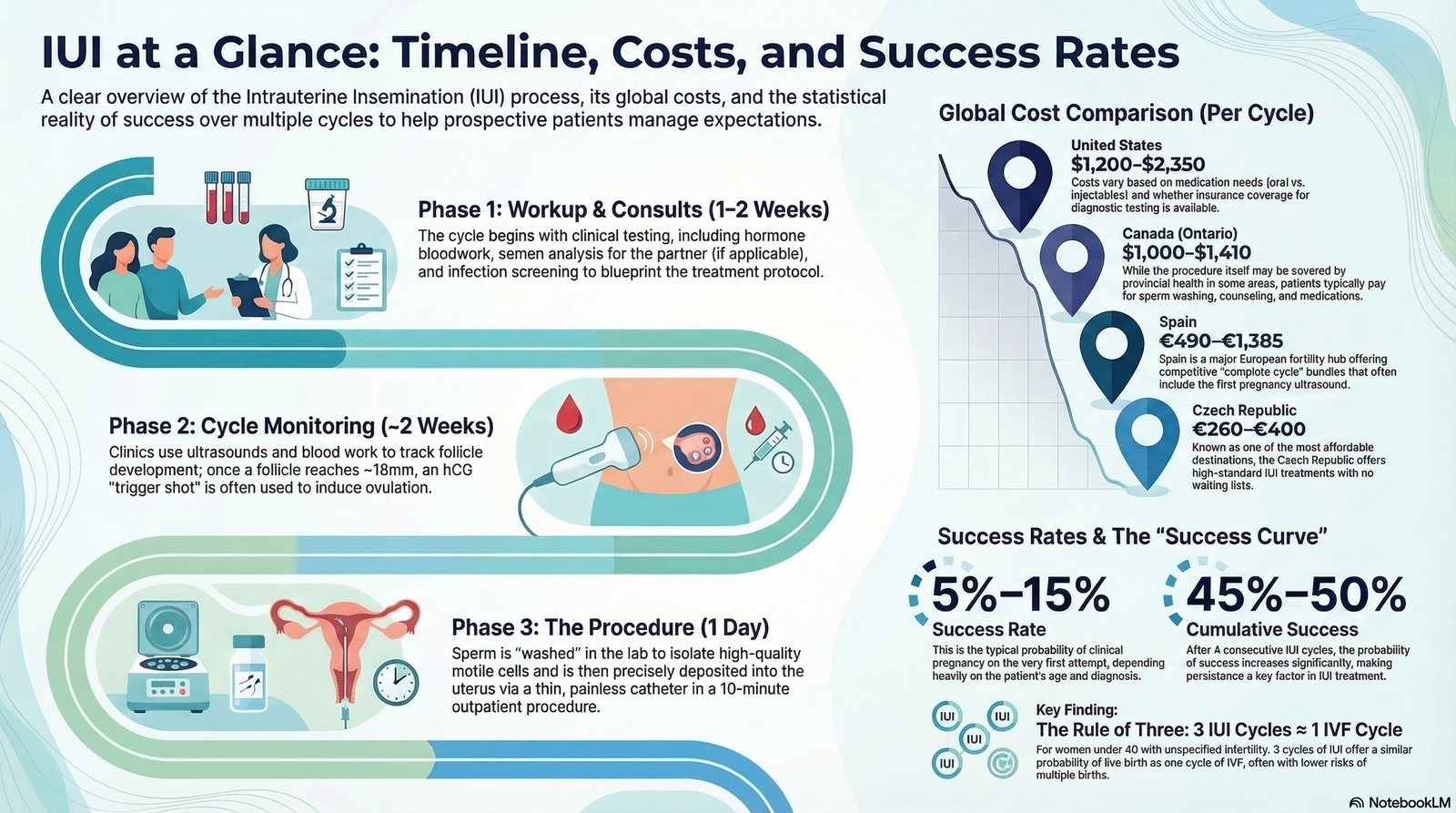
IUI at a Glance: Timeline, Typical Per Cycle Costs, and Success Rates Over Multiple Cycles
Here is how IUI costs break down across major regions, based on the most common self-pay price ranges clinics publish today.
United States and Canada
In the United States, a self-pay IUI cycle usually costs between $1,200 and $2,350. That range covers the insemination and some basic monitoring. If you use donor sperm, vials cost about $800 to $2,200 each, and shipping and storage add another $200 to $500.
Lower-cost clinics, such as CNY Fertility, list IUI at about $618 for the procedure. Once you add in-house monitoring, your total reaches $1,613 per attempt.
In Canada, the average cost in Ontario sits around $1,000, even when the procedure itself is covered by the provincial plan, and you are paying for add-ons only. At clinics such as Markham Fertility Centre, a non-funded cycle starts at $1,410, with medications ranging from $300 to $2,000.
European Destinations (Spain, Portugal, Czech Republic)
If you are open to treatment in the European Union, you often get a balance of strong lab standards and more transparent price lists.
- Spain: A single IUI cycle with partner sperm costs about €490 to €1,385. Three cycle bundles, sometimes sold as three for the price of two, cost around €1,170 to €1,525.
- Portugal: A standard IUI cycle costs about €750. If you use donor sperm, that total rises to about €1,450.
- Czech Republic: This is one of the most affordable EU regions, with IUI procedures routinely priced between €260 and €400.
The Balkans and Eastern Europe
If you are focused on the lowest base prices and are ready to research clinic quality on your own, the Balkans offer striking numbers.
- Bulgaria: About €225 to €1,220 per cycle.
- Romania: About €200 to €1,669.
- Latvia: Around €345 to €350 per cycle.
Asia-Pacific and the Middle East
- Australia: A cycle costs $3,370 up front, and Medicare rebates often bring your out-of-pocket cost closer to $2,753.
- New Zealand: At clinics such as Repromed, a cycle is $2,430, usually including oral stimulation medications.
- Thailand: Prices fall in the $300 to $600 range, which is why some people add an IUI cycle to a longer medical trip.
- Turkey: At high-end clinics such as Bahçeci Fertility, a standard IUI cycle costs $2,040.
| Region | Typical IUI Cost Range | Notes |
|---|---|---|
| United States | $1,200 to $2,350 | Higher sticker price, more financing and donor options |
| Canada (Ontario) | $1,000 to $1,410 | Procedure may be funded, pay for meds and lab extras |
| Spain | €490 to €1,385 | Popular for multi-cycle bundles and donor options |
| Czech Republic | €260 to €400 | Often half the price of North America for similar lab quality |
| Mexico | around $1,120 | Some clinics bundle wash, consult, and insemination |
Understanding Your Inclusions: What Is in the “Bundle”?
If you want a budget that does not surprise you later, you need to look past the headline price for the procedure itself. Most clinics split IUI into three phases: testing and consults, cycle monitoring, and the insemination day. Each phase has its own costs.
Phase 1: Workup and Consultations
Before your first IUI, your team wants to understand why you are not conceiving on your own. That means tests for both partners.
- Initial consultations: These range from free online calls to €160 (around $175) for an in-person specialist visit.
- Semen analysis: This costs from $100 to $450 and checks sperm count, movement, and shape.
- Infection screening: Tests for HIV, hepatitis, and other infections usually add $50 to $300 per person.
Phase 2: Cycle Monitoring
Monitoring makes sure your insemination lines up with ovulation. This is where people often underestimate the total bill.
- In Japan, ultrasound and hormone tests together cost about 10,000 yen (around $67) when covered under insurance.
- In the United States, a separate monitoring package can run around $995 per cycle if it is billed outside of a bundle.
Phase 3: The IUI Procedure
On insemination day, you pay for lab work and the procedure itself.
- Sperm wash: In Canada, labs charge about $200 to $750 for this process, which prepares the sample.
- IUI procedure: In Mexico, for example, the Fertility Center offers an all-inclusive price of about $1,120 that covers the wash, consults, and insemination.
Insurance Coverage and Public Funding: Who Qualifies?
If you are trying to figure out whether your insurance covers IUI or how far public funding will stretch, you need to look at where you live and how your country defines infertility as a medical need.
Japan: Universal Coverage With Limits
Japan brought IUI and IVF into its national insurance system in April 2022. This made a significant difference for many couples.
- Age and cycle limits: Women under 43 qualify. Those under 40 can access up to six transfers. Those aged 40 to 42 have coverage for up to three transfers.
- Who qualifies: The system usually requires a legal marriage or a recognized long-term partnership. Single women and same sex couples still face limits for some advanced procedures, so you need to check local rules carefully.
Ontario, Canada: Unlimited Funded IUI Cycles
Ontario's public program is one of the most generous when it comes to IUI.
- The benefit: If you have a valid OHIP card, you can access unlimited funded IUI cycles during your reproductive years.
- What you still pay: You cover the sperm wash, which is about $685 in many clinics, and all of your medications.
Germany: Fifty Percent Cost Coverage
In Germany, statutory insurance recognizes infertility as a condition and shares the costs when you meet certain criteria.
- Insurance usually covers 50 percent of the cost for up to eight IUI cycles without stimulation, or three cycles with stimulation.
- To qualify, you need to be married, and the woman must be between 25 and 40 years old.
The Balkan Region
- Bosnia and Herzegovina: Eligible women up to 42 years old have the right to three IUI attempts.
- North Macedonia: Public funding usually covers up to four cycles until you reach a viable pregnancy.
What This Means for Your IUI Budget
3 in 4 Pregnancies – Live Birth Reality: In a large IUI trial, about 3 out of 4 pregnancies led to a live birth. This shows that once you get pregnant with IUI, your chances of taking home a baby are encouraging. When you plan your budget, it helps to know that most treatment pregnancies do not end in loss. Source: New England Journal of Medicine (PMID: 9895397).
Almost All Multiples – From Strong Stimulation: That same research showed that nearly all twin, triplet, and quadruplet pregnancies came from more aggressive stimulation plans, not simpler IUI cycles. You can ask your doctor about gentle protocols that aim for one baby at a time, which often lowers both medical risks and overall cost. Source: New England Journal of Medicine (PMID: 9895397).
42% vs. 15% – Staying the Course: In a cost study, about 42 in 100 couples dropped out of IVF before finishing treatment, compared with only about 15 to 16 in 100 on IUI. IVF was harder for many people to complete. If you worry about burnout, starting with IUI may be easier to stick with emotionally and financially. Source: Lancet (PMID: 10615885).
Together, these findings suggest that IUI can be a realistic and manageable first step for many couples when you match the plan to your situation.
The Donor Factor and Hidden Costs
If you are a same-sex female couple or a single mother by choice, donor sperm becomes a central part of your IUI cost. Even if you are a different-sex couple, you may still turn to donor sperm when sperm quality or genetic concerns are present.
Cost of Donor Sperm
Sperm banks price vials based on whether they are washed or unwashed and on the donor’s profile and testing.
- Cryobank pricing in the United States: Expect to pay around $900 to $2,200 per vial. Many clinics advise buying two vials per attempt to allow for lab issues or thaw problems.
- Donor addition fees: In New Zealand and some other countries, clinics add a donor administration fee of about $1,865 to cover donor screening, genetic testing, and counseling.
Legal and Counseling Costs
Most countries add legal and psychological support when you use donor gametes to protect everyone involved.
- Notarial deeds: In Greece, the deed that confirms your family rights costs about €160.
- Counseling: Required counseling sessions usually cost between $175 and $350 each.
Shipping and Storage
Moving and storing reproductive material safely has its own price tag.
- International shipping: Cryogenic shipping for sperm or embryos often costs between $3,000 and $8,500, depending on distance and regulations.
- Annual storage: Clinics charge about $150 to $1,200 per year to store sperm or extra embryos.
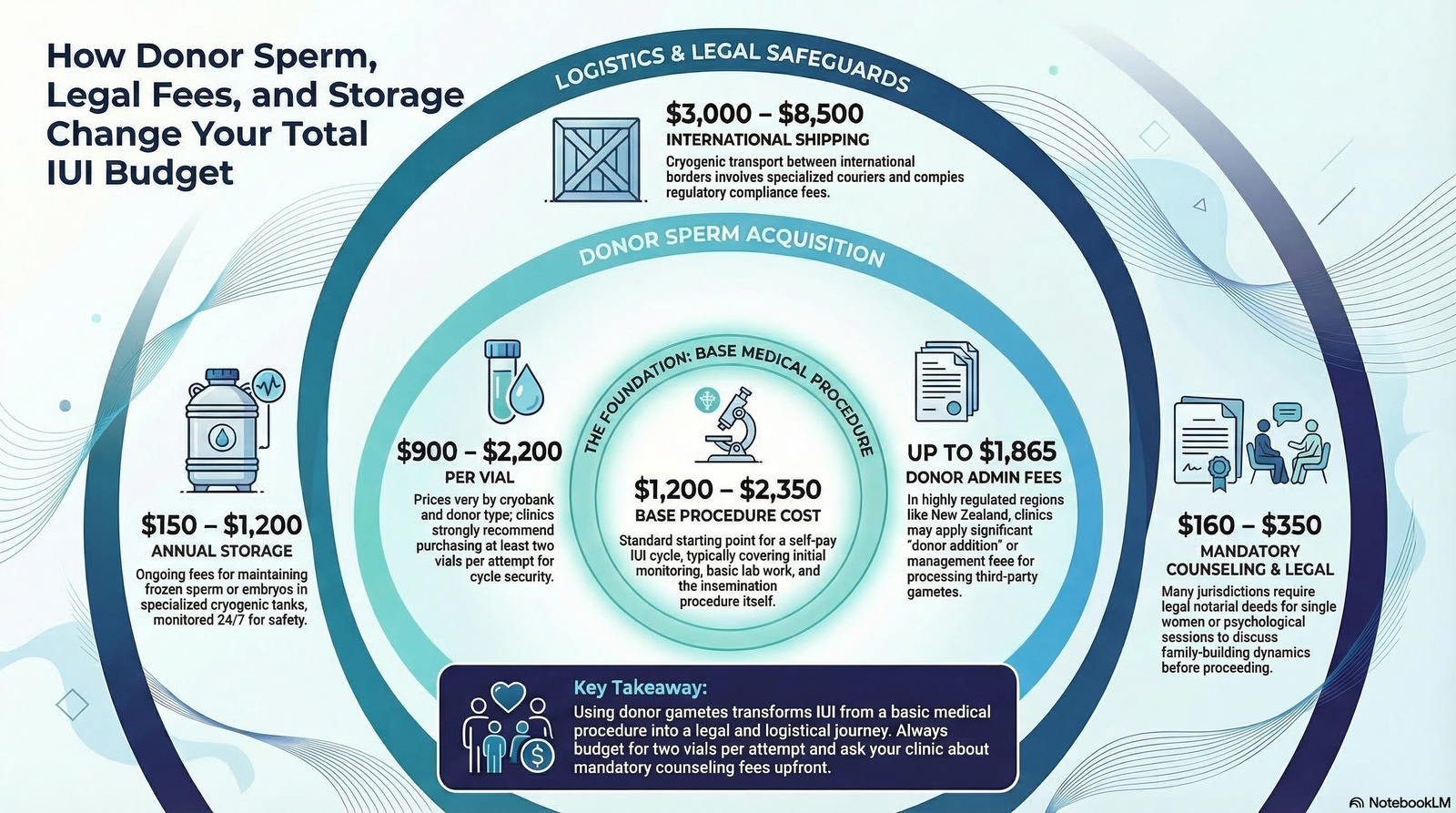
How Donor Sperm, Legal Fees, and Storage Change Your Total IUI Budget
Financing Your Treatment and Saving Money Where You Can
Very few people pay for several IUI cycles in cash without support. It is normal to piece together insurance coverage, savings, financing, and sometimes travel plans to make the numbers work.
Specialized Fertility Lenders
In the United States, companies such as Future Family and LendingClub offer fertility loans up to about $50,000.
- Predictable payments: Monthly payments often land between $150 and $475, depending on your credit and loan length.
- Quick pre-checks: Many lenders offer short online pre-screening that does not affect your credit score.
Using Superannuation in Australia
In Australia, SuperCare helps you apply to use your superannuation funds for treatments such as IUI, IVF, and egg freezing. This approach lowers your immediate out of pocket cost, but it uses money from your retirement, so you want to talk through the tradeoffs before you commit.
Grants and Scholarships
If you live in the United States, several non-profits help fill the gap between what you can pay and what treatment costs.
- General fertility grants: Organizations such as Baby Quest Foundation, Cade Foundation, and Nest Egg Foundation offer grants for fertility treatment.
- Oncology-related grants: Programs such as Livestrong Fertility and Team Maggie for a Cure help patients whose fertility has been affected by cancer treatment.
Practical Money Saving Strategies
Once you have a sense of the total cost, you can look for safe ways to lower it.
- Use HSA or FSA funds: In the United States, paying through a Health Savings Account or Flexible Spending Account uses pre-tax money and can save you about 20 to 30 percent.
- Consider three cycle bundles: Many clinics sell three IUI cycles as a package. These bundles often offer a 10 to 19 percent discount compared with paying one cycle at a time.
- Choose oral medications when safe: If your medical picture allows, tablets such as Clomiphene (Clomid) cost about $40 to $100. Injectable FSH often runs from $2,000 to $5,500 per cycle.
- Travel for care: More than 10,000 people travel each year to more affordable clinics. An IUI cycle in Mexico or the Czech Republic can be about 60 percent cheaper than a similar cycle in the United States, even after you add flights and hotels.
- Use tax credits: In Ontario, the Fertility Treatment Tax Credit allows you to claim back about 25 percent of eligible expenses, up to $5,000 per year.
How Experts View IUI in Modern Fertility Care
Low-Intensity Options Matter: A recent review on alternatives to IVF highlights IUI and mild stimulation as key tools in modern fertility care. The authors stress that not everyone needs the most aggressive treatment to have a baby. For many couples, especially when you are younger and dealing with unexplained infertility, starting with lower-intensity IUI cycles is a thoughtful, cost-aware choice, not second-best care. Source: Fertility and Sterility review on alternatives to IVF (Journal article link).
How to Build Your IUI Budget
When you are already stressed about your fertility, sitting down with a spreadsheet might feel like the last thing you want to do. It can also be one of the most powerful ways to take back a sense of control.
A clear budget turns vague fear into specific line items that you and your clinic can talk through and adjust. Here is a simple way to structure that budget.
- Diagnostic testing: Blood work, HSG tube check, and semen analysis.
- Base cycle fees: Consultations, monitoring ultrasounds, and the IUI procedure.
- Medications: Oral tablets, trigger shots, and any progesterone support.
- Sperm costs: Vial purchase, shipping, and sperm wash or lab handling.
- Administrative fees: Block fees, coordination fees, or language support fees at international clinics.
- Travel and lodging: Flights, hotels, and ground transport if you go out of state or abroad.
Want help comparing clinics and costs?
If this feels like a full time job, and it often does, our advisors can collect clear, itemized quotes from verified clinics and map your IUI or IVF plan with you at no cost.

Why trust this guide? The OVU commitment
You are probably juggling hope, timelines, and a lot of tabs open in your browser. And you deserve clear, current, human advice. At OVU, we review clinic protocols, compare real quotes, and talk to people who have done this - intended parents and gestational carriers - so we can give you practical steps, not just theory. If you want help comparing options without sales pressure, we will gather itemized quotes and success data that match your exact situation. You decide, we will bring the info to your table.
Frequently Asked Questions
How many IUI cycles should I plan for?
Most fertility specialists suggest that you plan for about three to four IUI cycles before you move on to IVF or other options. Research shows that pregnancy rates remain solid for up to about eight consecutive IUI cycles in younger patients, but after three or four cycles, you and your doctor will usually pause and review your plan.
Is IUI better than IVF?
IUI is less invasive and much cheaper per cycle, but it also has lower success per attempt than IVF. For women under 40 with unexplained infertility, three carefully planned IUI cycles can give a similar overall chance of having a baby as one IVF cycle. The right choice for you depends on your age, diagnosis, budget, and how quickly you want to move forward.
What is a sperm wash, and why does it cost extra?
A sperm wash is a lab process that removes the semen fluid and chemicals that can cause cramping inside your uterus. It also concentrates the best moving sperm. Clinics often bill this as a separate lab fee, which usually ranges from about $150 to $750.
Are there hidden fees at international clinics?
There can be. Some Japanese clinics, for example, charge an English support fee of about 16,500 yen, around $110, per visit. Other clinics add small charges for document translation or coordination with foreign labs. Always ask for a full, written, itemized quote in your own language before you book travel.
Can I use donor sperm for IUI if I am single?
Yes, in many countries you can. Countries such as Portugal, Spain, and Argentina allow single women to use donor sperm for IUI. In other places, treatment is still tied to marital status, so you need to confirm current laws for the country where you plan to have treatment.
Does age affect how much IUI ends up costing?
Age does not change the price of one cycle, but it changes how many cycles and which medications you are likely to need. After 40, IUI success rates drop, which often means more cycles or stronger medications. That raises your total spend, and your doctor may recommend moving to IVF sooner.
What happens if my IUI cycle is cancelled?
Most clinics have a clear cancellation policy. If your insemination does not go ahead for medical reasons, you usually still pay for monitoring, medications, and lab work already done. In Spain, for example, clinics may charge around €350 when a cycle is cancelled before the catheter is placed.
Reference List 6 sources
Journal Article (Research): Multiple authors. Efficacy of superovulation and intrauterine insemination in the treatment of infertility. New England Journal of Medicine. 1999;340(3):177–183. PMID: 9895397. Available from: https://pubmed.ncbi.nlm.nih.gov/9895397/
Journal Article (Cost-Effectiveness Study): Multiple authors. Intrauterine insemination or in-vitro fertilisation in idiopathic subfertility and male subfertility: a randomised trial and cost-effectiveness analysis. Lancet. 2000;355(9197):13–18. PMID: 10615885. Available from: https://pubmed.ncbi.nlm.nih.gov/10615885/
Journal Article (Comparative Study): Multiple authors. IVF versus IUI with ovarian stimulation for unexplained infertility: a collaborative individual participant data meta-analysis. Human Reproduction. 2024;[Epub ahead of print]. PMID: 38148104. Available from: https://pubmed.ncbi.nlm.nih.gov/38148104/
Committee Opinion (Guidance): American Society for Reproductive Medicine Practice Committee. Evidence-based treatments for couples with unexplained infertility: a guideline. Fertility and Sterility. 2020;113(2):305–322. PMID: 32106976. Available from: https://pubmed.ncbi.nlm.nih.gov/32106976/
Committee Guideline (Guidance): European Society of Human Reproduction and Embryology (ESHRE). Unexplained infertility guideline. ESHRE Guideline Document. 2023. Available from: https://www.eshre.eu/-/media/sitecore-files/Guidelines/UI/UI-guideline_-Final.pdf
Journal Article (Review): Multiple authors. Alternatives to in vitro fertilization. Fertility and Sterility. 2023;120(3):[pages to be confirmed]. Available from: https://www.sciencedirect.com/science/article/pii/S0015028223000493
Final Thoughts
Fertility treatment is a major emotional and financial commitment. The costs of IUI can add up over time, but for many people, it remains the most reachable path to trying for a biological child.
Whether you are using public funding in Ontario, sharing costs with insurance in Germany, or flying to more affordable clinics in Mexico or the Czech Republic, the same rule holds. The clearer you are about the numbers, the more confident you feel about your next decision.
You do not have to figure this out by yourself. You can ask your clinic direct questions about every fee, explore grants and tax credits, and lean on trusted advisors when you compare clinics and countries. When you build a plan that fits both your medical needs and your budget, you protect your hope for a baby and your long-term financial health.
Ready to map out your next step?
If you want help turning this information into a concrete plan, talk with an OVU advisor. You will get clinic options, cost comparisons, and a suggested timeline tailored to your situation.
Related articles

Employer Fertility Benefits: How to Read the Fine Print and Protect Your Budget
Fertility Benefits & Financing Your guide to understanding employer fertility benefits, costs, and coverage gaps Last Updated: 22 July 2026 Medically Reviewed 14 min read Evidence-based If you are trying to build your family and running into roadblocks, it probably feels like you are living in two worlds. In one, friends seem to get pregnant without thinking about it. In the other, you are juggling clinic visits, lab results, and bills that look more like a mortgage down payment than a medical copay. It is an exhausting place to live. The numbers behind what you are feeling are stark. The
19 min read
Fertility Grants & Scholarships: How to Actually Afford IVF
Fertility Costs & Financing Your guide to fertility grants, IVF costs, and real-world budgeting Last Updated: 19 July 2026 Medically Reviewed 16 min read Evidence-based I know the sticker price of fertility treatment is terrifying. When you first get that folder from your clinic, it is easy to feel completely overwhelmed. Very few of us can easily set aside $25,000 for a single IVF cycle, especially when that investment comes with no guarantees. This financial pressure forces a difficult internal dialogue: “How are we going to pay for this?” or even worse, “Are we paying for treatment or paying to
16 min read
Fertility Financing Options: How To Pay For IVF Without Losing Your Mind
Fertility Costs & Financing Your guide to fertility treatment costs and financing options Last Updated: 16 July 2026 Medically Reviewed 20 min read Evidence-based If you have just opened a clinic estimate and seen figures like $20,000 or $30,000, you might feel a wave of embarrassment or anxiety. It is natural to hesitate before rushing into treatment when your mind is overwhelmed by the thought of affording it all without taking on a second job or starting a side business just to cover the costs. You aren’t just thinking about the medications and procedures; you’re wondering how to pay for
16 min read