


Dr. Sony Sherpa (MBBS)
In addition to her clinical experience, Dr. Sherpa is a published medical researcher and holistic health advocate. Her dual expertise in emergency care and alternative therapies brings a unique lens to medically reviewed content—ensuring it is both accurate and accessible.
If you are comparing clinics across countries and wondering whether IVF in Greece is a realistic way to grow your family, you are not on your own. Many people look at prices in the United States, the United Kingdom, or Canada and then start searching for safer, more affordable options abroad, allowing them to complete a cross-border treatment cycle without hassle and bustle, without compromising the quality, and without exceeding their IVF-envisaged budget.
Every year, an estimated 20,000 to 25,000 couples travel to another country specifically for fertility treatment. This trend highlights the patient demand for destinations offering high-quality, cost-effective care. Greece has become one of the main destinations because it provides access to internationally accredited clinics, a liberal legal framework that allows treatment up to age 54 with special approval, and total IVF costs that are often less than half of US prices.
In this guide, you will see what IVF in Greece actually costs in 2026, how the legal rules work for your age and family structure, what real success rates look like, and where the main risks are hidden so you can plan with clear expectations.
If you are considering IVF in Greece in 2026, you are looking at roughly €5,000–8,000 for a full IVF cycle, including medications and lab work, compared with €16,000–34,000 in the United States. Greek law allows treatment up to age 54 with special approval, permits anonymous egg donation, and recognizes altruistic surrogacy. Success rates for younger women are similar to those of other leading European countries, but donor-egg and over-50 pregnancies carry higher risks and need close medical follow-up.
Next step: Use this guide to map your likely costs and eligibility, then book a consult with both a Greek clinic and your home doctor to plan the medical and legal details.
What the Latest Research Shows
Recent European registry data show that more than one million assisted reproduction cycles were performed in 2019, with about 3% of all babies in reporting countries born after IVF or related treatments. Greece sits within this established field of European fertility treatment and pairs solid success rates with one of the most flexible legal frameworks in Europe for age limits and donor use.
A Greek multi-hospital study also shows that IVF pregnancies at very advanced ages face higher rates of complications such as preeclampsia and placental problems. That does not mean you cannot try at older ages, but it does mean your pregnancy team must treat you as higher risk from the start.
In This Guide
Greece: ~€5,000–8,000 total cycle cost
USA: ~€16,000–34,000 per cycle
IVF is allowed up to age 54 with special approval
Donor eggs and altruistic surrogacy are permitted
Under 34: ~53% pregnancy rate per transfer
Strong cumulative rates over multiple cycles
Why Greece Is a Leading IVF Destination
If you feel as if IVF has turned into a full-time research project, Greece can look like a rare combination of clear laws and manageable costs. You get access to clinics that meet European standards, you can legally receive treatment as a single woman or in an unmarried couple, and you are not automatically excluded at 42 or 43, the way you might be in other countries.
The biggest practical draw is financial. A complete IVF cycle in Greece often lands in the €5,000–8,000 range once you include medications and lab work. In the United States, similar cycles frequently cost €16,000–34,000, especially if you need ICSI, freezing, or advanced genetic testing. That gap is large enough that you can sometimes afford two or three Greek cycles for the price of one US cycle.
At the same time, European registry data show that assisted reproduction is a mature, mainstream field. More than one million treatment cycles were reported in Europe in 2019, and around 3% of all births in those countries came after IVF or related treatments. Greece participates in that system and has positioned itself as a hub for cross-border care.
Latest Research Insights
53% Pregnancy Rate & Lower Cost: A 2025 review of Greek clinics reported pregnancy rates of about 53% for IVF or ICSI rounds with embryo transfers in women under 34, with delivery rates around 31%. Total cycle costs in Greece often fall between €5,000 and €8,000, versus €16,000–34,000 in the United States. This means you can often reach similar outcomes for far less money, even affording a multi-cycle bundle with several transfer attempts or covering PGT expenses and vitrified embryo transfer.
3 in 100 Births from IVF: A pan-European report covering over one million cycles found that about 3% of all births in reporting countries now come from IVF or related treatments. IVF is not an experiment anymore; it is a standard part of modern fertility care.
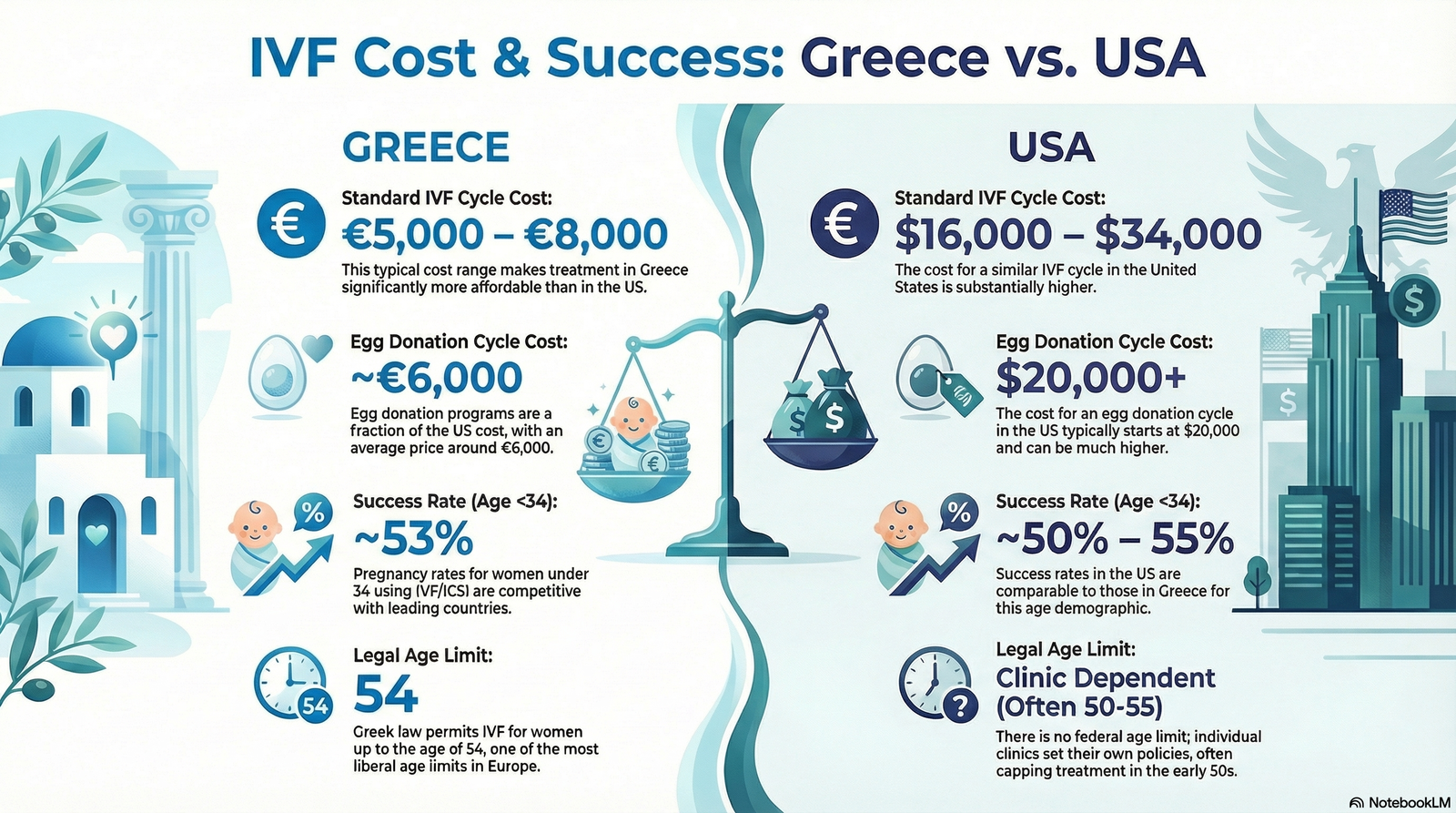
Cost and success overview: IVF in Greece versus the USA.
Legal Framework: Who Can Access IVF in Greece?
Understanding who can legally be eligible for fertility treatment in Greece should be one of your first steps, especially if you are older, single, or considering donor eggs or surrogacy.
Age Limits and Eligibility
Greek law allows IVF up to age 54, provided a national committee approves your case. This upper limit is higher than in most European countries, where treatment often stops between 42 and 46.
You can receive IVF in Greece if you are:
- In a heterosexual couple
- A single woman
- In an unmarried relationship
If you are single or in an unmarried couple, you must sign a notarial deed confirming your consent and family status. Expect notary fees around €160 for that, and roughly €100 for extra required consents.
Donor Eggs, Donor Sperm, and Surrogacy
Greece allows anonymous egg and sperm donation. That is a key difference from countries that require identity release for donors or limit donation strongly. Clinics match you with a donor based on your medical profile and phenotype and handle the legal documentation under Greek law.
If you need sperm donation, you can either use the clinic’s bank for an extra fee or arrange for frozen donor eggs or sperm from a European cryobank and ship them to Greece. You cover bank and shipping costs yourself.
Altruistic surrogacy is legal in Greece through a court process. The court must approve the arrangement before embryo transfer. This makes Greece one of the few European countries where intended parents can combine donor eggs and surrogacy within one legal system.
Real IVF Costs in Greece (2026)
When you plan treatment abroad, you need more than headline prices. You need to see what each clinic includes in its package and what you still need to budget for on top.
Own-Egg IVF: Core Package Examples
Here is how three well-known Greek clinics structure their own-egg IVF prices.
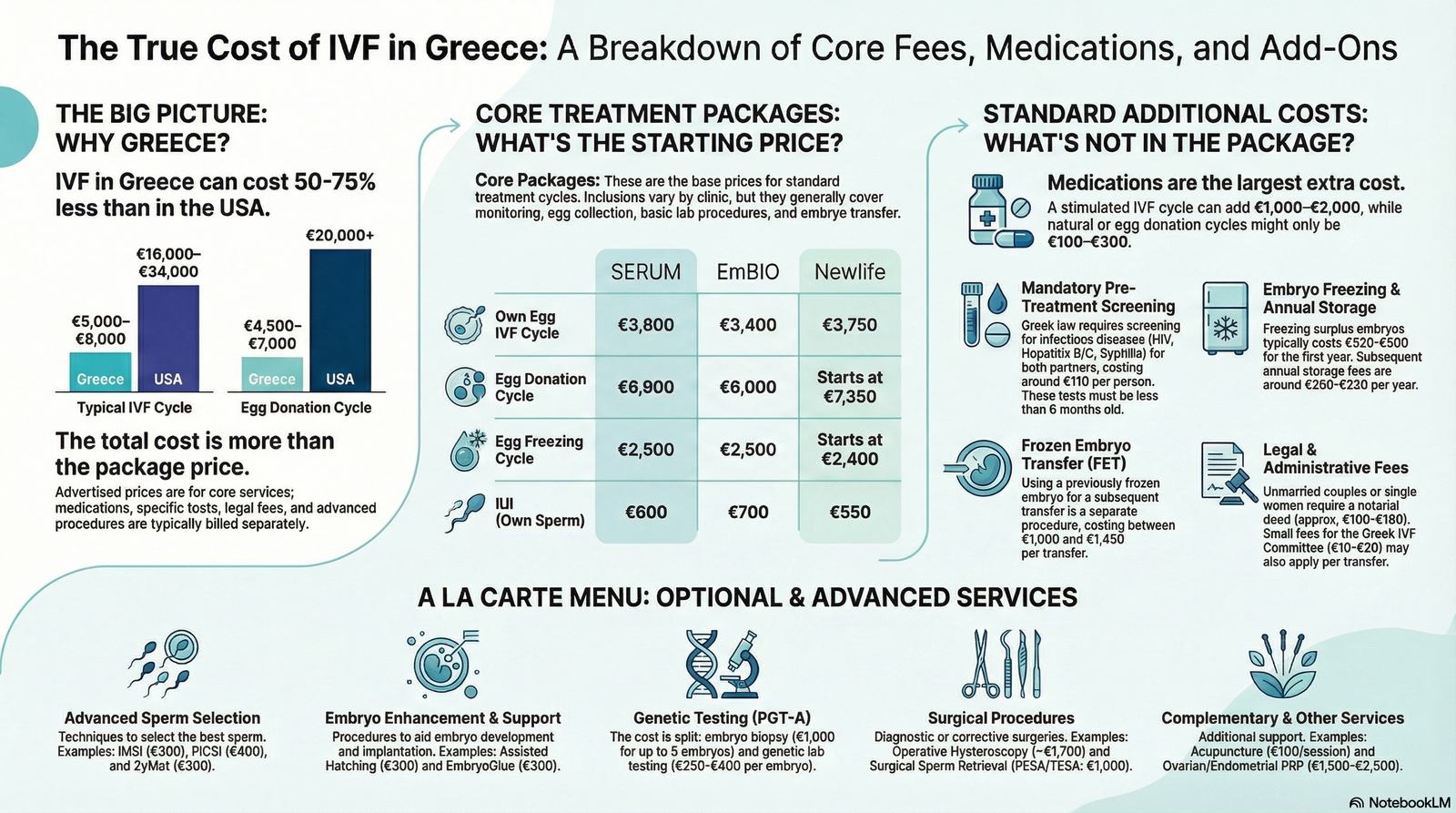
| Clinic | Core IVF Price | Included | Not Included |
|---|---|---|---|
| SERUM | €3,600 | Ovulation scans, egg collection, IVF or ICSI, blastocyst culture, and embryo transfer | Medications, lab blood tests, €20 Greek IVF Committee fee per transfer, and other services you might need, such as preimplantation genetic testing, vitrification of embryonic cohort, or frozen embryo transfer. |
| EmBIO | €3,400 | Egg collection, lab work, ICSI, and embryo transfer | Monitoring visits, medications, and tests. |
| Newlife | €3,750 | Consultation, scans in Greece, sedation, ICSI, extended culture, assisted hatching if needed, and back-up sperm freezing | Preliminary investigations, extra tests, medications, freezing and storage, and travel expenses. |
A few details matter for your budget:
- SERUM offers two own-egg IVF cycles within one year for €6,000, prepaid and non-refundable.
- SERUM’s DUO STIM package, with two egg collections in one cycle and two frozen transfers, costs €6,000.
- If SERUM retrieves no viable eggs, you pay €1,500 instead of the full €3,600; if embryos are created, the full fee applies even if transfer is postponed.
Egg Donation: What You Actually Pay
Egg donation costs in Greece are far lower than in the United States and many Western European countries.
- SERUM charges €6,900 for a full fresh donor-egg cycle, which covers the donor’s screening, medications, monitoring, egg collection, fertilization, blastocyst culture, and transfer. Your own medications and blood tests are extra. If you import frozen eggs, the fee drops to €3,600.
- EmBIO offers a donor-egg package at €6,000, which includes sperm freezing and analysis, egg collection, ICSI, phenotype matching, and embryo transfer.
- Newlife’s standard fresh egg donation package begins at €7,350 and guarantees two top-quality blastocysts if sperm parameters are normal. The advanced package core cost starts at €10,550, guarantees four blastocysts, and includes the same clinical steps.
Freezing, Storage, and FET
You also need to plan for freezing and future frozen embryo transfers (FET):
- Newlife charges €1,450 for each frozen embryo transfer after the first one in a package.
- SERUM charges €1,000 for a standard FET. If embryos arrive from another clinic, the fee is €1,500 and includes handling, first-year storage, endometrial preparation, thawing, and transfer.
- SERUM embryo freezing costs €500 per straw of blastocysts and includes a year of storage. From year two, storage costs €200 per straw per year.
- Newlife’s embryo freezing ranges from €320 to €850, depending on how many straws you have. Storage from year two onward costs €220 per year.
- SERUM egg freezing costs €2,500 per cycle (excluding medications) and includes freezing up to two straws (around eight eggs). Extra straws cost €300 each, with annual storage of €100 per straw from year two.
Medications and Required Tests
Most clinics separate fertility drugs and test costs from their core packages. For a stimulated IVF cycle, you should expect to spend roughly €1,000–2,000 on medications. In donor-egg or natural-cycle protocols, drug costs can drop to around €100–300.
Greek regulations also require up-to-date infection screening (HIV-1 and HIV-2, Hepatitis B, Hepatitis C, Syphilis, Anti-HBc IgM). If you undergo these tests at your Greek clinic, you will often pay about €110. Results from your home country are accepted if they are less than six months old.
Any procedure under anesthesia requires a recent ECG from a hospital or cardiologist. In Athens or Thessaloniki, these usually cost around €100–120.
| Service | Typical Price | Clinic Examples |
|---|---|---|
| IUI with partner’s sperm | €550–700 | SERUM €600, EmBIO €700, Newlife €550 |
| PGT-A biopsy and testing | Clinic fee €1,000 plus €250–400 per embryo for lab | SERUM, Newlife; EmBIO included in some bundles |
| Surgical sperm retrieval | Around €700–1,000 | SERUM €1,000, Newlife TESE from €720 |
| Ovarian PRP rejuvenation | €1,800 | SERUM |
If you add up core packages, medications, tests, and freezing, your total per IVF cycle in Greece usually sits between €5,000 and €8,000. That is still significantly below the €16,000–34,000 often seen in US programs.
How Greek IVF costs break down into core fees, medications, and add-ons.
Success Rates and What They Mean for You
Looking at success rates can feel confusing, especially when each clinic frames its numbers differently. The key is to focus on age groups, whether the numbers refer to each transfer or all transfers from one egg collection, and whether donor eggs or PGT-A were used.
Examples from EmBIO
EmBIO reports the following first-attempt pregnancy rates with your own eggs:
- Under 29: 65% pregnancy, rising to 78% cumulative over all transfers from one collection
- Age 30–34: 63% first-attempt, 76% cumulative
- Age 35–39: 55% first-attempt, 67% cumulative
- Age 40–44: 55% first-attempt, 59.1% cumulative
For egg donation, EmBIO reports pregnancy rates of about 78.2% on the first attempt, 96.3% by the second, and 98.5% by the third, once all embryos from that donor cycles are used. These numbers show why donor eggs are often recommended when you are older or have very low ovarian reserve.
Examples from Newlife IVF Greece
Newlife reports success separately for fresh transfers and frozen PGT-A tested transfers.
- Under 35, fresh embryos: about 62.1% pregnancy and 39% live birth per transfer.
- Age 35–37, fresh: about 59.45% pregnancy and 40.54% live birth; PGT-A frozen transfers reach 75% pregnancy and 50% live birth.
- Age 38–39, fresh: around 53% pregnancy and 26.5% live birth; PGT-A frozen transfers can reach 71.4% for both pregnancy and live birth when a euploid embryo is available.
- Age 40–42, fresh: about 31% pregnancy and 17.32% live birth; PGT-A frozen transfers show around 70% pregnancy and 60% live birth.
- Over 42, fresh: about 25.45% pregnancy and 10.34% live birth; PGT-A frozen transfers show about 55% pregnancy and 42.4% live birth.
Supporting Evidence on IVF Outcomes
Donor Eggs and Preeclampsia: A large meta-analysis found that pregnancies from donor eggs had about five times higher risk of preeclampsia than natural conception and roughly three times higher risk than IVF with your own eggs. This is one reason donor-egg pregnancies are usually followed in high-risk antenatal clinics.
Single Embryo Transfer Gains Ground: European data show that by 2019, about 55% of fresh IVF and ICSI transfers used a single embryo. Twin delivery rates fell to around 12%, and triplets became extremely rare. For you, that means many clinics can now aim for one healthy baby with one embryo at a time.
Risks and Safety When You Travel for IVF
Every IVF cycle carries risks, whether you have treatment at home or abroad. When you add international travel, different laws, and high expectations, it becomes even more important to understand where the main medical and practical risks lie.
Age-Related Pregnancy Risks
If you are over 40, your baseline risk of high blood pressure, gestational diabetes, preterm birth, and placental problems is already higher. IVF adds another layer, and donor eggs add one more.
The Greek multi-hospital study mentioned earlier looked specifically at IVF pregnancies in women over 50. It found:
- Preeclampsia in 23% of women aged 50–54 versus 6.1% in younger women
- Gestational diabetes and preterm birth are also more frequent in the older group
- Placental problems (such as placenta previa and accreta) occurred in 34.5% of older women versus 11.8% of younger women
If you choose IVF in your early fifties, Greece gives you a legal path. Medically, you need a high-risk obstetrician and a clear plan for monitoring your blood pressure, glucose levels, and placental health.
Donor Eggs and Hypertensive Disorders
International data show that donor-egg pregnancies are more likely to develop preeclampsia and other hypertensive disorders than pregnancies using your own eggs. You should treat these risks as trade-offs: you get higher chances of a baby at older ages, but you accept a higher chance of needing extra monitoring, possible hospital stays, and a higher likelihood of early delivery.
Cross-Border IVF and Pregnancy Complications
A US study of IVF pregnancies at one hospital found that about a quarter had been conceived abroad. Among those cross-border cases, nearly 70% developed some form of hypertensive disorder, compared with about 38% of those conceived at domestic IVF clinics. Multiple pregnancies were also more frequent in the cross-border group.
The reasons may include higher average age, more donor-egg use, and more embryos transferred per cycle in some foreign programs. Whatever the cause, you should assume that your pregnancy team at home needs to monitor you closely if you conceive through IVF abroad.
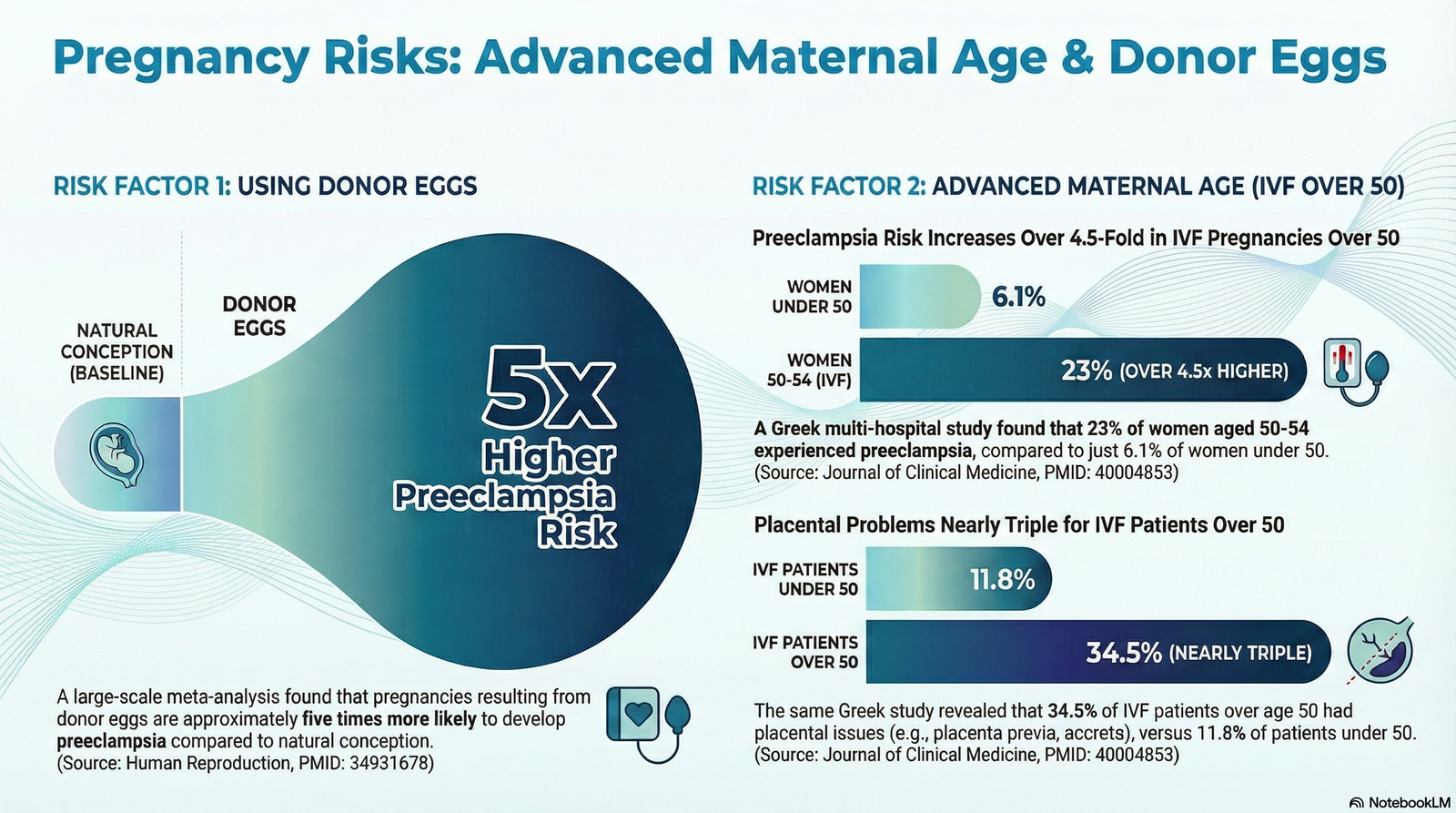
How age, donor eggs, and cross-border treatment change pregnancy risks.
Top Clinic Options and How to Choose
Once you decide that Greece looks promising, the next step is to choose a clinic. At this point, you are weighing more than success rates. You are looking at communication style, support for international patients, cost transparency, and your own comfort with the team.
EmBIO IVF Center (Athens)
EmBIO is widely known among international patients and is led by Dr Thanos Paraschos. The clinic offers clear pricing for both own-egg and donor-egg cycles and bundles some advanced services into set-price packages.
- Own-egg IVF: €3,400 core price for egg collection, lab work, ICSI, and transfer.
- Advanced IVF with PGD: €8,000 bundle including genetic testing and extended culture.
- Strong track record for egg donation, with high cumulative pregnancy rates by the second and third attempts.
Newlife IVF Greece (Thessaloniki)
Newlife offers free initial and follow-up consultations, either by video or in person. Its pricing is structured around clear packages with guarantees on the number of embryos for egg donation.
- Own-egg IVF: €3,750 core package.
- Fresh egg donation: From €7,350 (two guaranteed blastocysts) to €10,550 (four guaranteed blastocysts), assuming normal sperm.
- Good transparency on freezing and storage fees and use of time-lapse technology.
SERUM Advanced IVF Center (Athens)
SERUM is especially popular with patients who have had repeated failed cycles elsewhere or who need more in-depth immune or uterine investigations.
- Own-egg IVF: €3,600, with a two-cycle package at €6,000.
- Donor-egg IVF: €6,900 for a full cycle.
- Range of add-ons such as hysteroscopy, ovarian PRP, immune testing, and treatment.
How to Compare Greek Clinics Fairly
When you line up clinics on a spreadsheet, pay attention to how they report success rates. Look for age brackets, whether the numbers refer to each transfer or all embryos from one collection, and how many embryos they usually transfer. Two clinics with similar pregnancy rates can offer very different safety profiles if one relies heavily on double-embryo transfers and the other favors single transfers.
Travel, Legal, and Practical Logistics
Once you narrow your clinic list, the practical questions begin: how many trips you need, how long you will stay, and how your home healthcare team will coordinate with your Greek medical team.
Working with Your Home Doctor
Your home gynecologist or reproductive endocrinologist can help you understand your diagnosis and baseline risks and may be willing to handle early monitoring and follow-up. The ASRM Ethics Committee states that doctors are not obliged to research foreign clinics in detail, but they must avoid misleading you about your options.
Before you confirm treatment in Greece, it helps to:
- Share your Greek treatment plan with your local doctor.
- Clarify who will monitor your pregnancy if you conceive.
- Plan how test results will move between your clinic and the local healthcare team.
Legal and Documentation Steps
You also need to check how your home country handles parentage, birth certificates, and citizenship after egg donation or surrogacy. In most cases, you will need a local lawyer to review your situation before you start.
In Greece, your clinic will manage consent forms and notarial deeds required for IVF, egg donation, or surrogacy. You may need certified translations of some documents when you return home, and each translation will carry a fee.
Want help comparing clinics and costs?
If this already feels like a full-time job, our advisors can collect clear, itemized quotes from verified clinics and map your likely timeline at no cost to you.

Why trust this guide? The OVU commitment
You are probably juggling hope, timelines, and a lot of tabs open in your browser. And you deserve clear, current, human advice. At OVU, we review clinic protocols, compare real quotes, and talk to people who have done this - intended parents and gestational carriers - so we can give you practical steps, not just theory. If you want help comparing options without sales pressure, we will gather itemized quotes and success data that match your exact situation. You decide, we will bring the info to your table.
Frequently Asked Questions
What is the maximum age for IVF in Greece?
Greek law offers a broader legal window for older women seeking IVF compared to many other European countries, which usually stop between the ages of 42 and 46. The maximum age for IVF in Greece is 54 years, provided a national committee approves your case.
How much does a full IVF cycle really cost in Greece?
The total cost typically ranges between €5,000 and €8,000 per IVF cycle in Greece, which generally covers clinic fees, medications, required tests, and vitrification of embryos. Exact costs depend on your specific medical protocol, whether you require advanced procedures, such as ICSI or PGT-A, and any optional add-ons you choose.
Are egg donors anonymous in Greece?
Yes. Greek law allows anonymous egg and sperm donation. You will not receive identifying information about your donor, and your child will not have automatic rights to that information either. This is different from some countries that require identity-release donors.
How many trips to Greece do I need for IVF?
That depends on your clinic and protocol. Many clinics handle initial consults and much of your workup remotely, then ask you to come for around 7–12 days for stimulation, egg collection, and embryo transfer. If you are using donor eggs and frozen embryo transfer, your time in Greece can be shorter because you may only need to come for lining preparation checks and transfer.
Reference List 10 sources
Journal Article (Research): Loukopoulos T, Zikopoulos A, Kolibianakis E, et al. High-risk outcomes in in vitro fertilization pregnancies for women of a very advanced maternal age: insights from a multi-hospital study in Greece. Journal of Clinical Medicine. 2025;14(4):1323. PMID: 40004853. Available from: https://pubmed.ncbi.nlm.nih.gov/40004853/
Journal Article (Research): Smeenk J, Wyns C, De Geyter C, et al. ART in Europe, 2019: results generated from European registries by ESHRE. Human Reproduction. 2023;38(12):2321–2338. PMID: 37847771. Available from: https://pubmed.ncbi.nlm.nih.gov/37847771/
Journal Article (Research): Calhaz-Jorge C, Smeenk J, Wyns C, et al. Survey on ART and IUI: legislation, regulation, funding, and registries in European countries—an update. Human Reproduction. 2024;39(9):1909–1924. PMID: 39043375. Available from: https://pubmed.ncbi.nlm.nih.gov/39043375/
Journal Article (Research): Rodriguez S, Marquez K, St Louis G, et al. Incidence of cross-border reproductive care and pregnancy outcomes: a retrospective evaluation of IVF conceptions. Journal of Assisted Reproduction and Genetics. 2025;42(5):1671–1677. PMID: 40119090. Available from: https://pubmed.ncbi.nlm.nih.gov/40119090/
Journal Article (Research): Simopoulou M, Sfakianoudis K, Giannelou P, et al. Treating infertility: current affairs of cross-border reproductive care. Open Medicine (Warsaw). 2019;14:292–299. PMID: 30931395. Available from: https://pubmed.ncbi.nlm.nih.gov/30931395/
Journal Article (Systematic Review & Meta-Analysis): Keukens A, van Wely M, van der Meulen C, Mochtar MH. Pre-eclampsia in pregnancies resulting from oocyte donation, natural conception or IVF: a systematic review and meta-analysis. Human Reproduction. 2022;37(4):586–599. PMID: 34931678. Available from: https://pubmed.ncbi.nlm.nih.gov/34931678/
Journal Article (Research): Yan J, Qin Y, Zhao H, et al. Live birth with or without preimplantation genetic testing for aneuploidy. New England Journal of Medicine. 2021;385(21):2047–2058. PMID: 34818479. Available from: https://pubmed.ncbi.nlm.nih.gov/34818479/
Committee Opinion (Guidance): Ethics Committee of the American Society for Reproductive Medicine. Cross-border reproductive care: an Ethics Committee opinion. Fertility and Sterility. 2022;117(5):954–962. PMID: 35216836. Available from: https://www.asrm.org/practice-guidance/ethics-opinions/cross-border-reproductive-care-an-ethics-committee-opinion-2022/
Journal Article (Review): Christoforidis C, Anastasiadou SD. Assisted reproduction in Greece in the context of medical tourism: a review of legal, medical, economic, and social dimensions. Sci. 2025;7(4):149. Available from: https://www.mdpi.com/2413-4155/7/4/149
Journal Article (Review): Hudson N, Culley L, Blyth E, et al. Cross-border reproductive care: a review of the literature. Reproductive Biomedicine Online. 2011;22(7):673–685. PMID: 21498121. Available from: https://pubmed.ncbi.nlm.nih.gov/21498121/
Final Thoughts
Deciding to travel for IVF is a big step. Greece offers a rare mix of lower costs, broad legal access, and solid success rates. If you are older, single, or need donor eggs, the Greek system gives you choices you might not have at home.
At the same time, those choices come with responsibilities. You need to weigh the extra pregnancy risks that come with age and donor eggs, and you need a clear plan for medical care once you are back home. If you put in the effort up front, you can enter treatment in Greece with a realistic budget, a dependable clinic, and a support team prepared to manage a high-risk pregnancy if that is where you belong.
Ready to explore IVF in Greece with expert backup?
You can start by shortlisting a few clinics and then asking OVU advisors to sanity-check your choices, so you feel confident about both the medical and financial side before you book flights.
Related articles

How to Choose Fertility Clinics Abroad: Complete Vetting Guide 2026
Fertility Tourism & Global Care Your guide to fertility treatment abroad Last Updated: 31 December 2025 Medically Reviewed 14 min read Evidence-based If you are staring at Spain’s IVF prices and wondering if the flight is worth it, or checking Mexico and trying to decide if “affordable” also means “safe”, you are not alone in being forced to explore the alternative destinations offering less expensive options. Infertility now affects 1 in 6 people worldwide, and that pressure has pushed more people to look outside their home country for treatment. By 2024, over 60% of fertility patients said they were considering
21 min read
IVF in Ukraine 2026: Costs, Clinics, Success Rates & Surrogacy Options
IVF Abroad & Surrogacy Your guide to IVF in Ukraine, donor eggs, and surrogacy options Last Updated: 24 December 2025 Medically Reviewed 18 min read Evidence-based If you are looking at IVF or surrogacy in Ukraine, you are probably already tired, worried about money, and wondering how much longer you can keep going. It is a significant step to leave your home country for treatment, and it helps to see clearly what you are getting into before booking a single flight. The good news is that Ukraine has been a major destination for donor-egg IVF and gestational surrogacy, with some
14 min read
IVF in Mexico 2026: Medical Tourism, Costs & Fertility Clinic Guide
IVF & Fertility Treatments Your guide to IVF in Mexico , part of our cross-border fertility care series Last Updated: 22 December 2025 Medically Reviewed 18 min read Evidence-based If you are looking at IVF prices in the United States or Canada and wondering how you will ever afford treatment, you are not alone. Many couples and single parents in your position start to look at Mexico when the numbers at home simply do not add up. You might be imagining yourself boarding a plane or crossing the border, scheduling clinic visits and post-clinic activities, and hoping this trip is
15 min read